 Self Wealth Management
Tax-Efficient Investing
A reference to search and compare, not a book to read cover to cover. Every major UK tax wrapper — what each one does, what it's commonly used for, and what to watch out for.
Overview
Every major UK tax wrapper — what each one does, what it's commonly used for, and what to watch out for.
Financial planners often call these tax wrappers. A wrapper is simply the legal account that holds your investments. It doesn't usually change the investment itself, but it can have a significant impact on how it's taxed.
This guide covers every major tax wrapper available in the UK — what each one does, what it's commonly used for, and what to watch out for. It's a reference to search and compare, not a book to read cover to cover.
Same fund. Same manager. Same underlying holdings. Only the tax treatment changes — because a pension isn't an investment, it's a container.
Compare every wrapper at a glance
| Wrapper | Tax relief | Tax-free growth | Access | IHT | Complexity |
|---|---|---|---|---|---|
| Pension (Personal Pension / SIPP) | Yes | Yes | Age 55+* | Outside estate* | Medium |
| ISA (Individual Savings Account) | No | Yes | Anytime | In estate | Low |
| Lifetime ISA (LISA) | 25% bonus | Yes | Home / Age 60 | In estate | Medium |
| General Investment Account (GIA) | No | No | Anytime | In estate | Low |
| Offshore Bond | No | Gross roll-up | 5%/yr deferred | In estate* | High |
| Onshore Bond | No | Net of internal tax | 5%/yr deferred | In estate* | High |
| Venture Capital Trust (VCT) | 20% | Yes | 5yr hold | In estate | High |
| Enterprise Investment Scheme (EIS) | 30% | Yes | 3-7yr illiquid | BR after 2yr | High |
| Seed Enterprise Investment Scheme (SEIS) | 50% | Yes | 3yr+ | BR after 2yr | Very High |
| Business Relief (BR) Investments | No | No | Anytime* | Relief after 2yr | Medium |
| Full SIPP | Yes | Yes | Age 55+* | Outside estate* | High |
| Small Self-Administered Scheme (SSAS) | Yes | Yes | Age 55+* | Outside estate* | Very High |
| Junior ISA (JISA) | No | Yes | Age 18 | Gift rules | Low |
| Junior Pension (Junior SIPP) | Yes | Yes | Decades away | Gift rules | Low |
| Child Trust Fund (CTF) | No | Yes | Age 18 | Gift rules | Low |
| Help to Buy ISA | 25% bonus | Yes | First home | In estate | Low |
*Pensions are currently outside the estate for inheritance tax. The government has legislated bringing unspent pensions within the estate from April 2027.
This is educational navigation, not a recommendation — several wrappers can suit the same goal.
Educational disclaimer: This information is for educational purposes only and should not be considered financial advice or a recommendation. Investments can fall as well as rise in value, and you may get back less than you invest. Past performance is not a reliable indicator of future results.
Pension (Personal Pension / SIPP)
The most tax-efficient long-term savings vehicle available to most people — tax relief going in, tax-free growth, and flexible access from age 55 (rising to 57 in 2028).
| Tax Relief | Tax-Free Growth | Access | IHT | Complexity |
|---|---|---|---|---|
| Yes | Yes | Age 55+* | Outside estate* | Medium |
What is it?
A pension is the most tax-efficient long-term savings vehicle available to most people. This covers personal pensions and standard SIPPs.
A SIPP (Self-Invested Personal Pension) is a personal pension that gives you direct control over where your money is invested, with access to a wider range of funds, shares and other assets than a standard personal pension. The tax rules are identical to a personal pension. Full SIPPs and SSASs have materially different investment capabilities and are covered in their own sections.
Although pensions are currently outside the estate for IHT purposes, from April 2027 unspent pensions will be within the estate and therefore liable to IHT.
Why does it exist?
Pensions exist to encourage long-term saving for retirement, in exchange for generous tax incentives: relief on contributions, tax-free growth inside the wrapper, and flexible access from a set minimum age.
Key features
Contributions and tax relief. You can personally contribute up to 100% of your UK earnings per year, or £3,600 gross if you earn less. The standard annual allowance is £60,000 (2026/27), covering personal and employer contributions combined.
Contributions attract income tax relief at your marginal rate. For most people this works automatically through relief at source: you pay 80% and the provider claims the remaining 20% from HMRC. Higher and additional rate taxpayers can claim further relief through self-assessment. A 40% taxpayer making an £8,000 net contribution effectively pays just £6,000 after reclaiming higher rate relief.
The chart below shows exactly what this looks like for a £10,000 gross pension contribution, across four different tax positions. £10,000 always ends up in the pension — what changes is how much of that actually comes out of your own pocket once every layer of relief is accounted for.
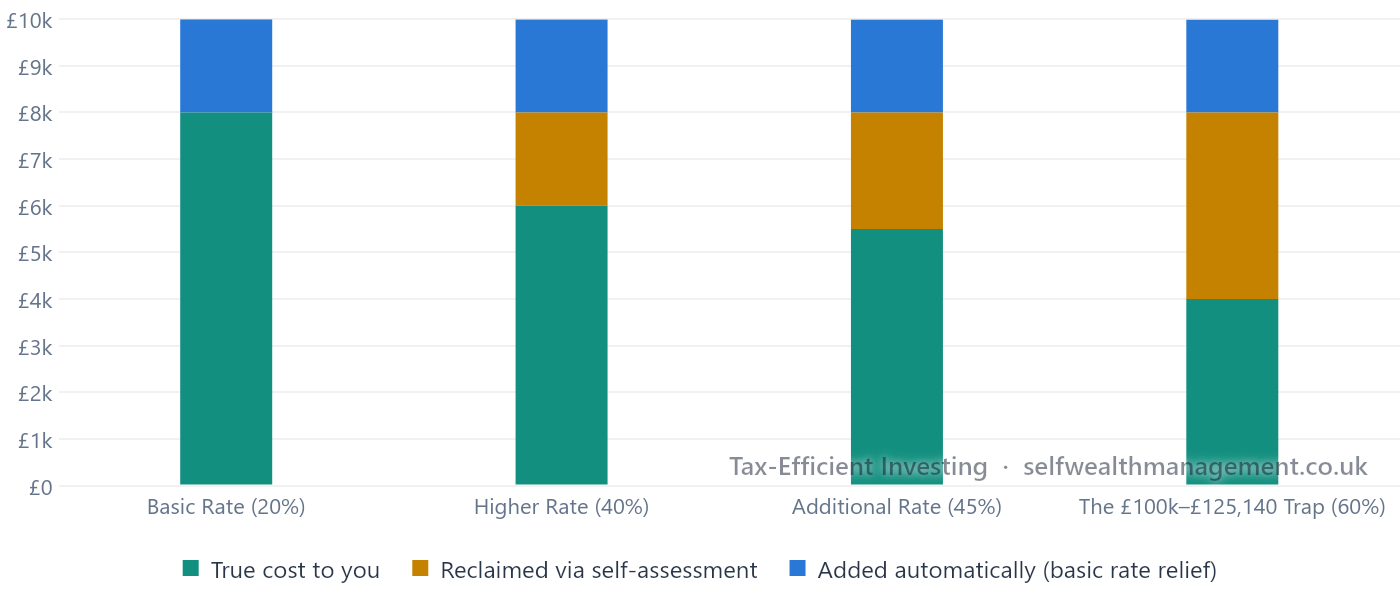
Notice how little changes mechanically between bands — the same £8,000 leaves your account and the same £2,000 is added automatically every time. The only thing that changes is how much of that £8,000 you get back later through your tax return, which is why higher and additional rate taxpayers should never assume their pension relief is "done" once the provider's basic rate top-up lands — the rest has to be actively claimed.
Employer contributions count towards the annual allowance but don't attract personal tax relief — they're simply a cost to the employer, paid gross.
Unused annual allowance from the previous three tax years can often be carried forward, subject to sufficient earnings.
The tapered annual allowance. For high earners, the allowance reduces gradually. If threshold income exceeds £200,000 and adjusted income exceeds £260,000, the allowance reduces by £1 for every £2 of adjusted income above £260,000, down to a minimum of £10,000.
The £100,000 trap. Between £100,000 and £125,140, the personal allowance is withdrawn at £1 for every £2 of income — an effective marginal rate of 60%. As the chart above shows, a £10,000 gross pension contribution in this band can cost as little as £4,000 out of pocket once all relief is accounted for — some of the most powerful relief available anywhere in the tax system. Pension contributions that bring income below £100,000 restore the personal allowance and can be extraordinarily tax-efficient.
Tax treatment
Investments inside a pension grow completely free of income tax and capital gains tax. On withdrawal, 25% is tax-free (subject to the lump sum limit) and the remaining 75% is taxed as income at your marginal rate in the year it's withdrawn. Spreading withdrawals across tax years can reduce the overall tax paid.
- Tax relief on contributions at your marginal rate
- Tax-free growth inside the wrapper
- Employer contributions on top of your own
- Outside the estate for IHT (currently)
- No requirement to buy an annuity
- No access before age 55 (rising to 57 in 2028)
- 75% of withdrawals taxed as income
- Annual and tapered allowances limit contributions for high earners
- Rules and allowances have changed frequently
Commonly used where…
- Long-term retirement saving
- Higher earners escaping the £100k-£125,140 trap
- Anyone with employer matching available
- Money you might need before age 55
- Very short-term saving goals
Tax relief on pension contributions has existed for decades, but annual allowances and access rules have changed frequently — including the abolition of the lifetime allowance in April 2024 and changes to pension IHT treatment from April 2027.
Confusing tax relief with tax-free withdrawals. Contributions get relief going in, but 75% of what comes out is taxed as income — a pension defers tax, it doesn't eliminate most of it.
Run it on your whole financial picture
Enter your figures once in My Money and every calculator uses them, from income tax to inheritance tax, alongside a year-by-year cashflow plan.
- Saved onceYour pension pot, salary and spending carry across every tool.
- Projected forwardSee how today's decision plays out year by year to retirement.
- Checked for youInsights flag allowances and reliefs you haven't used.
Educational disclaimer: This information is for educational purposes only and should not be considered financial advice or a recommendation. Investments can fall as well as rise in value, and you may get back less than you invest. Past performance is not a reliable indicator of future results.
ISA (Individual Savings Account)
The simplest and most flexible tax-efficient wrapper available — money grows completely free of tax, with nothing to declare on a tax return.
| Tax Relief | Tax-Free Growth | Access | IHT | Complexity |
|---|---|---|---|---|
| No | Yes | Anytime | In estate | Low |
What is it?
An ISA is the simplest and most flexible tax-efficient wrapper available. Money invested in an ISA grows completely free of tax, and withdrawals are entirely tax-free — with nothing to declare on a tax return.
Why does it exist?
ISAs exist to make tax-efficient saving and investing simple and accessible, without the complexity or access restrictions of a pension.
Key features
Types of ISA:
- Stocks and Shares ISA — investments in funds, shares, bonds and other assets. The most common choice for long-term wealth building.
- Cash ISA — savings held as cash, earning interest tax-free.
- Innovative Finance ISA (IFISA) — peer-to-peer lending and similar investments. Higher risk and less widely used.
- Lifetime ISA and Junior ISA — see their own sections.
Contribution limits. The annual ISA allowance is £20,000 per person per tax year (2026/27), currently splittable across ISA types in any combination, but capped at £20,000 in total. Unused allowance cannot be carried forward.
Change from April 2027. From 6 April 2027, no more than £12,000 of the £20,000 allowance will be able to go into a Cash ISA. The remaining £8,000 (or more) will need to go into a Stocks and Shares ISA or another non-cash ISA type — cash alone will no longer be able to use the full £20,000 allowance.
Flexible ISAs allow you to withdraw and replace funds in the same tax year without losing your allowance. Standard ISAs allow withdrawals at any time, but the allowance isn't replenished.
Tax treatment
There's no upfront tax relief — you invest money that's already been taxed. In return, dividends, interest and capital gains inside an ISA are all completely tax-free, and withdrawals are tax-free at any age.
- No tax on growth, income or withdrawals
- Full flexibility on access
- Nothing to declare on a tax return
- No lifetime cap on total ISA holdings
- No upfront tax relief, unlike a pension
- £20,000 annual limit that can't be carried forward
- Forms part of your estate for inheritance tax
Commonly used where…
- Tax-free accessible savings and investing
- A first step before considering more complex wrappers
- Money you might need within your lifetime, at any point
- Very large estates without an IHT plan
- Higher earners who haven't yet maximised pension relief
Introduced in 1999 to replace PEPs and TESSAs, with the aim of making tax-efficient saving simpler for the public.
Assuming ISA allowance rolls over. It doesn't — unused allowance is lost at the end of each tax year, which is why many people top up before the 5 April deadline.
Educational disclaimer: This information is for educational purposes only and should not be considered financial advice or a recommendation. Investments can fall as well as rise in value, and you may get back less than you invest. Past performance is not a reliable indicator of future results.
Lifetime ISA (LISA)
Designed for two specific purposes — buying a first home or saving for retirement — with a generous 25% government bonus.
| Tax Relief | Tax-Free Growth | Access | IHT | Complexity |
|---|---|---|---|---|
| 25% bonus | Yes | Home / Age 60 | In estate | Medium |
What is it?
The Lifetime ISA is designed for two specific purposes: buying a first home or saving for retirement. Outside these two uses, it's relatively inflexible.
Why does it exist?
Introduced to help younger people save for a first home or supplement retirement saving, with a bonus generous enough to meaningfully boost either goal.
Key features
Who can use it. You must be aged 18–39 to open a LISA, and can contribute until age 50.
Contribution limits. Up to £4,000 per year, which counts within the overall £20,000 ISA allowance.
Government bonus. The government adds 25% on top of contributions, up to £1,000 per year. Over a full lifetime of contributions from 18 to 50, the maximum total bonus is £32,000.
Tax treatment
Growth is tax-free, like other ISAs. Permitted withdrawals — a first home purchase (property value £450,000 or less), from age 60, or on terminal illness — are entirely tax-free, with the bonus retained.
Withdrawing for any other reason triggers a 25% government charge. This erodes more than just the bonus: £4,000 contributed plus a £1,000 bonus becomes £5,000, and a 25% charge on that is £1,250 — leaving £3,750 from an original £4,000 contribution.
- 25% government bonus — an immediate, guaranteed uplift
- Tax-free growth like any ISA
- Excellent for first-time buyers
- A genuine option for high earners once their (tapered) pension allowance is fully used for the year
- 25% charge for withdrawing outside the permitted reasons
- Can't open one after age 39
- Weaker than a pension for most employed people with allowance still available, since it misses employer contributions and higher-rate relief
Commonly used where…
- Saving for a first home
- Retirement saving under age 40, alongside a pension
- Basic rate taxpayers who value the flexibility
- High earners under 40 whose tapered annual allowance is already fully used for the year — once pension contributions aren't possible, a guaranteed 25% bonus is hard to beat regardless of income
- Access may be needed before age 60 for reasons other than a first home
- Higher earners who still have unused pension annual allowance available
Withdrawing for something other than a first home or retirement without realising the 25% charge eats into the original contribution, not just the bonus.
Educational disclaimer: This information is for educational purposes only and should not be considered financial advice or a recommendation. Investments can fall as well as rise in value, and you may get back less than you invest. Past performance is not a reliable indicator of future results.
General Investment Account (GIA)
A standard investment account with no special tax treatment — but no limits either, making it the natural home once other allowances are used up.
| Tax Relief | Tax-Free Growth | Access | IHT | Complexity |
|---|---|---|---|---|
| No | No | Anytime | In estate | Low |
What is it?
A GIA is a standard investment account with no tax wrapper. It has no contribution limits, no restrictions on withdrawals, and no special tax treatment — gains and income are subject to normal capital gains tax and income tax rules.
Why does it exist?
A GIA exists simply as the default, unrestricted way to hold investments once tax-efficient allowances are exhausted, or where flexibility matters more than tax shelter.
Key features
Contribution limits. None.
Tax on growth. Capital gains are taxed when investments are sold. Each individual has an annual CGT exemption of £3,000 (2026/27); gains above this are taxed at 18% (basic rate) or 24% (higher/additional rate) for most investments.
Income (dividends and interest) is taxed at income tax rates, subject to the dividend allowance (£500 in 2026/27) and personal savings allowance.
Tax treatment
No special treatment — gains are subject to CGT at the time of disposal, and income is taxed in the normal way.
- No contribution limits at all
- Complete flexibility on access
- Useful for deliberate tax planning — timing disposals, using annual exemptions
- No tax shelter — gains and income are both taxable
- Forms part of the estate for IHT
- Requires more active management to be tax-efficient
Commonly used where…
- Once pension and ISA allowances are exhausted
- Money needed with full flexibility before pension access age
- Deliberate capital gains planning
- As a first choice before ISA and pension allowances are used
Ignoring the annual £3,000 CGT exemption. It doesn't carry forward — using it (or not) is a yearly decision, and many investors accidentally let it go to waste.
Educational disclaimer: This information is for educational purposes only and should not be considered financial advice or a recommendation. Investments can fall as well as rise in value, and you may get back less than you invest. Past performance is not a reliable indicator of future results.
Offshore Bond
A life insurance policy that lets investments grow gross of UK tax, with withdrawals of up to 5% a year deferred rather than taxed immediately.
| Tax Relief | Tax-Free Growth | Access | IHT | Complexity |
|---|---|---|---|---|
| No | Gross roll-up | 5%/yr deferred | In estate* | High |
What is it?
An offshore bond is a life insurance policy issued by a provider in a low-tax jurisdiction (typically Ireland or the Isle of Man). Unlike an onshore bond, income and gains accumulate within the policy gross — without deduction of UK tax at source.
Why does it exist?
Offshore bonds exist to let higher and additional rate taxpayers defer tax on investment growth, often until a year when they expect to pay a lower rate — such as retirement.
Key features
Contribution limits. None, though very large contributions may need provider approval.
The 5% rule. You can withdraw up to 5% of the original premium each year, cumulatively, without an immediate tax charge. This is a deferral, not an exemption — the gain is eventually taxed on full surrender or when withdrawals exceed the cumulative allowance. Unused allowance carries forward, so taking nothing for five years allows a 25% withdrawal later without triggering a chargeable event.
Segments. Offshore bonds are typically written in multiple segments (often 100+). Surrendering individual segments, rather than the whole bond, allows precise management of the chargeable event gain in any given year.
Tax treatment
When a chargeable event occurs — full surrender, exceeding the 5% allowance, or death — the gain (surrender value + withdrawals − premiums − previous gains) is taxed as income at your marginal rate. No 20% notional tax credit applies (unlike onshore).
Top slicing example. An investor surrenders after 10 years with a £50,000 gain, on £40,000 of other income. Without top slicing, the full gain stacks on top of income, pushing much of it into the 40% band. With top slicing, the gain is divided by 10 years — a £5,000 "slice" — keeping the total comfortably within the basic rate band, so the effective rate on the whole gain is 20%, not 40%.
- Full gross roll-up — no annual tax drag
- 5% withdrawal facility with deferred tax
- Top slicing relief can substantially reduce the effective rate
- Useful for managing when tax is triggered
- Complex — segments, chargeable events and top slicing all need understanding
- No notional tax credit, unlike an onshore bond
- Forms part of the estate unless written in trust
Commonly used where…
- Higher and additional rate taxpayers expecting a lower rate later
- Those with irregular income who can choose when to trigger gains
- Trustees managing assets for beneficiaries
- Basic rate taxpayers who'd benefit more from an onshore bond's tax credit
- Those wanting a simple, easily understood wrapper
Surrendering the whole bond in one go instead of individual segments. Cashing in everything at once can push the entire gain into a single tax year and a higher rate, when surrendering only the segments needed — and spreading the rest across future years — could have kept much of it in the basic rate band.
Educational disclaimer: This information is for educational purposes only and should not be considered financial advice or a recommendation. Investments can fall as well as rise in value, and you may get back less than you invest. Past performance is not a reliable indicator of future results.
Onshore Bond
Similar to an offshore bond, but UK-based — the fund pays internal corporation tax, which then acts as a basic-rate tax credit on withdrawal.
| Tax Relief | Tax-Free Growth | Access | IHT | Complexity |
|---|---|---|---|---|
| No | Net of internal tax | 5%/yr deferred | In estate* | High |
What is it?
An onshore bond is similar to an offshore bond but is issued by a UK insurance company and is subject to UK corporation tax within the fund (currently 20%). This means growth isn't entirely gross — there's an element of tax within the bond, equivalent to basic rate tax.
Why does it exist?
Onshore bonds exist as a UK-based alternative to offshore bonds, trading some gross growth for a built-in tax credit that can fully settle a basic rate taxpayer's liability on surrender.
Key features
The 5% rule, top slicing relief and segment structure all work the same way as an offshore bond.
Tax within the fund. The bond pays corporation tax internally, which acts as a basic rate tax credit. When a chargeable event gain arises, basic rate taxpayers pay no further tax — the internal tax is treated as having already settled their liability. Higher rate taxpayers pay the difference between their marginal rate and 20%; additional rate taxpayers pay an extra 25%.
Tax treatment
The gain is added to income with a notional 20% basic rate credit applied. No further tax for basic rate taxpayers; higher rate taxpayers pay an additional 20% on the gain; additional rate taxpayers pay an additional 25%.
- No further tax at all for basic rate taxpayers on surrender
- Same 5% and top slicing facilities as an offshore bond
- Simpler, UK-based structure
- Internal tax creates a drag on growth compared to gross offshore roll-up
- Less efficient than offshore for higher and additional rate taxpayers
- Still requires understanding chargeable events and top slicing
Commonly used where…
- Basic rate taxpayers seeking the 5% annual withdrawal facility
- Those who want a simple, UK-based bond
- Certain trust arrangements where the internal credit is beneficial
- Higher and additional rate taxpayers, where offshore is usually more efficient
- Anyone wanting maximum gross growth
Choosing an onshore bond purely because it sounds simpler, without checking whether the internal 20% tax drag costs more over the years than an offshore bond's gross growth would have earned. The 'simpler' option isn't automatically the cheaper one.
Educational disclaimer: This information is for educational purposes only and should not be considered financial advice or a recommendation. Investments can fall as well as rise in value, and you may get back less than you invest. Past performance is not a reliable indicator of future results.
Venture Capital Trust (VCT)
A listed company investing in early-stage UK businesses, offering 20% upfront income tax relief and tax-free dividends in exchange for higher risk.
| Tax Relief | Tax-Free Growth | Access | IHT | Complexity |
|---|---|---|---|---|
| 20% | Yes | 5yr hold | In estate | High |
What is it?
A VCT is a listed company that invests in early-stage UK businesses. It offers significant tax incentives in exchange for taking on higher investment risk.
Why does it exist?
VCTs exist to channel investment into small UK businesses that would otherwise struggle to raise capital, with generous tax relief compensating investors for the higher risk.
Key features
Contribution limits. Up to £200,000 per tax year.
Income tax relief. 20% upfront relief on new VCT subscriptions, provided shares are held at least five years. A £10,000 investment costs an effective £8,000 after relief.
Tax-free dividends. VCT managers typically aim to return value through regular tax-free dividends, commonly targeting 3–5% yields, though this isn't guaranteed and depends on the underlying portfolio's performance.
Tax treatment
Dividends from VCTs are tax-free, and capital gains on disposal are tax-free. Selling before five years claws back the income tax relief.
- 20% upfront income tax relief
- Tax-free dividends and capital gains
- Supports early-stage UK businesses
- High risk — small, early-stage companies, and losses aren't uncommon
- Illiquid — shares can be hard to sell at a fair price
- Relief clawed back if sold within five years
- Doesn't qualify for Business Relief
Commonly used where…
- Investors who've maximised pensions and ISAs and want further tax-efficient exposure
- Those comfortable with high risk and illiquidity
- Anyone who hasn't yet used mainstream pension and ISA allowances
- Money that might be needed within five years
Investing in a VCT purely for the 20% relief without understanding that the underlying investments are genuinely high risk — the tax benefit doesn't offset a real loss of capital.
Educational disclaimer: This information is for educational purposes only and should not be considered financial advice or a recommendation. Investments can fall as well as rise in value, and you may get back less than you invest. Past performance is not a reliable indicator of future results.
Enterprise Investment Scheme (EIS)
Tax relief for investing in qualifying small UK companies — higher risk than a VCT, but with more generous reliefs including CGT deferral.
| Tax Relief | Tax-Free Growth | Access | IHT | Complexity |
|---|---|---|---|---|
| 30% | Yes | 3-7yr illiquid | BR after 2yr | High |
What is it?
EIS offers tax relief for investment in qualifying small and medium-sized UK companies. It's higher risk than a VCT but offers more generous relief.
Why does it exist?
EIS exists to direct private capital into smaller UK companies with strong growth potential, using relief generous enough to compensate for the elevated risk of investing directly in individual early-stage businesses.
Key features
Contribution limits. Up to £1,000,000 per tax year (£2,000,000 for knowledge-intensive companies).
Income tax relief. 30% upfront relief, provided shares are held at least three years.
Loss relief. If EIS shares fall in value, losses can be offset against income, not just capital gains — making the downside more manageable.
Tax treatment
Gains on shares held three years or more are completely CGT-exempt. EIS can also defer capital gains from other disposals — reinvesting a gain into EIS shares defers the CGT until the EIS shares are sold. If the investor dies while still holding the shares, the deferred gain is wiped out entirely rather than crystallising, which makes EIS deferral a genuinely powerful estate planning tool.
EIS shares also qualify for Business Relief after two years, meaning they can pass on free of inheritance tax.
- 30% upfront income tax relief
- CGT-free growth after three years
- Can defer gains from other investments
- Loss relief against income if it goes wrong
- Business Relief after two years for IHT
- High risk — many EIS companies fail
- Illiquid, with no guaranteed exit for three to seven years
- Complex rules around qualifying conditions
Commonly used where…
- Experienced investors who've maximised mainstream allowances
- Deferring a significant capital gain from another disposal
- Estate planning alongside genuine growth investing
- Money that might be needed within three to seven years
- Investors without capacity to absorb a total loss on part of the portfolio
Investing money that might be needed within three to seven years. EIS has no guaranteed exit route — there's usually no way to force a sale early if circumstances change, regardless of how the investment is performing.
Educational disclaimer: This information is for educational purposes only and should not be considered financial advice or a recommendation. Investments can fall as well as rise in value, and you may get back less than you invest. Past performance is not a reliable indicator of future results.
Seed Enterprise Investment Scheme (SEIS)
The smaller-company equivalent of EIS, targeting the earliest-stage businesses, with the most generous reliefs of any mainstream wrapper.
| Tax Relief | Tax-Free Growth | Access | IHT | Complexity |
|---|---|---|---|---|
| 50% | Yes | 3yr+ | BR after 2yr | Very High |
What is it?
SEIS is the smaller company equivalent of EIS, targeting very early-stage businesses. The tax reliefs are more generous to reflect the higher risk.
Why does it exist?
SEIS exists to support the very earliest stage of UK company formation, where the funding gap and risk are both greatest — hence the most generous relief available in the tax system.
Key features
Contribution limits. Up to £200,000 per tax year.
Income tax relief. 50% upfront relief — a £10,000 investment costs an effective £5,000.
Loss relief. As with EIS, losses can be offset against income.
Tax treatment
CGT-free on disposal after three years. Gains from other disposals reinvested into SEIS qualify for 50% CGT reinvestment relief — meaning half the gain is permanently exempt, not merely deferred, which is more generous than EIS's deferral-only treatment. SEIS also qualifies for Business Relief after two years.
- 50% upfront income tax relief — the most generous available
- Permanent 50% CGT exemption on reinvested gains
- CGT-free growth after three years
- Loss relief against income
- Very high risk — earliest-stage companies, many of which fail
- Highly illiquid
- Should only ever be a small part of a diversified portfolio
Commonly used where…
- Experienced investors seeking maximum tax relief for capacity to accept very high risk
- A small allocation within an otherwise diversified portfolio
- Anyone who can't afford to lose the entire amount invested
- Core retirement or house-deposit savings
Over-allocating to SEIS because the relief looks attractive. These should represent only a small part of a diversified portfolio, given how high the risk of complete loss genuinely is.
Educational disclaimer: This information is for educational purposes only and should not be considered financial advice or a recommendation. Investments can fall as well as rise in value, and you may get back less than you invest. Past performance is not a reliable indicator of future results.
Business Relief (BR) Investments
Not a wrapper itself, but a relief that can make qualifying investments free of inheritance tax after just two years — while remaining accessible.
| Tax Relief | Tax-Free Growth | Access | IHT | Complexity |
|---|---|---|---|---|
| No | No | Anytime* | Relief after 2yr | Medium |
What is it?
Business Relief is not a wrapper in itself, but a tax relief that can apply to qualifying investments — typically shares in AIM-listed companies or unlisted trading businesses. After holding qualifying investments for two years, they become exempt from inheritance tax.
Why does it exist?
Business Relief (formerly Business Property Relief) exists to protect trading businesses from being broken up to pay inheritance tax. Investing in qualifying shares lets individuals access the same relief as part of an estate planning strategy.
Key features
IHT treatment. After a two-year holding period, qualifying BR investments attract 100% IHT relief, subject to a cap of £2.5 million per individual (£5 million for a married couple, as the cap transfers to a surviving spouse). Above the cap, the excess is taxed at the standard IHT rate. AIM-listed shares attract 50% relief, not 100%.
If you sell a BR-qualifying investment and reinvest within three years, the two-year qualifying period doesn't restart — the original clock continues. This gives meaningful flexibility to switch providers or strategies without losing accumulated benefit.
Tax treatment
Unlike a gift into trust, BR investments remain in your name and can be accessed at any time — though selling or spending the assets removes the relief. Capital gains tax applies on disposal, and income is taxed normally; the benefit is specifically on the IHT side.
- 100% IHT relief after just two years — far faster than the seven years for gifts
- Assets stay in your name and remain accessible
- No need to give money away to reduce an IHT liability
- AIM shares and unlisted businesses carry meaningfully higher risk
- Relief is lost if the investment is sold and not reinvested in time
- Capped at £2.5m per individual (£5m per couple)
Commonly used where…
- Those with a significant estate wanting to reduce IHT without giving assets away
- Complementing pension planning, which currently also sits outside the estate
- Those uncomfortable with AIM or unlisted company risk
- Very large estates well above the relief cap without further planning
Business Relief was introduced as Business Property Relief in 1976, originally to stop family trading businesses being broken up or sold simply to pay an inheritance tax bill.
Assuming BR and pensions are always a clean complementary pairing for IHT planning. The government's changes to pension IHT treatment from April 2027 may affect this interaction, so advice should be taken as rules evolve.
Educational disclaimer: This information is for educational purposes only and should not be considered financial advice or a recommendation. Investments can fall as well as rise in value, and you may get back less than you invest. Past performance is not a reliable indicator of future results.
Full SIPP
A more powerful SIPP variant that can hold commercial property directly — popular with business owners who want their pension to own their premises.
| Tax Relief | Tax-Free Growth | Access | IHT | Complexity |
|---|---|---|---|---|
| Yes | Yes | Age 55+* | Outside estate* | High |
What is it?
A Full SIPP is a more powerful variant of the standard SIPP, offering a significantly wider investment universe — including commercial property — not available through a standard or low-cost SIPP platform.
Why does it exist?
Full SIPPs exist for individuals who want the additional capability to hold commercial property within a pension, without needing the full complexity of an employer-sponsored SSAS.
Key features
Key additional capability. A Full SIPP can purchase commercial premises — including a business's own offices or trading premises — and lease them back to the business. Rental income accumulates tax-free within the scheme, and the property is held within the pension rather than the business.
Borrowing. A Full SIPP can borrow up to 50% of its net asset value to fund property purchases — the same facility available within a SSAS. A Full SIPP with £500,000 of assets could borrow up to £250,000 to help fund a commercial property acquisition.
Compared to a SSAS. Both can hold commercial property and borrow up to 50% of NAV. The key differences are governance: a SSAS is an employer-sponsored trust with collective trustee control and the ability to loan money back to the sponsoring employer, which a Full SIPP cannot do. A Full SIPP is simpler to administer and doesn't require a sponsoring employer.
Tax treatment
All the same pension tax rules apply — contributions, tax relief, annual allowance, access from age 55 (rising to 57 in 2028), 25% tax-free cash, income tax on withdrawals, and death benefit rules are identical to a standard pension.
- All standard pension tax benefits
- Can hold and lease back commercial property
- Can borrow up to 50% of net asset value
- No sponsoring employer required, unlike a SSAS
- More complex and costly to run than a standard SIPP
- Property is illiquid within the pension
- Same access restrictions as any pension
Commonly used where…
- Business owners who want their pension to own their trading premises
- Professionals or property investors wanting commercial property access without a SSAS
- Those who don't need commercial property exposure — a standard SIPP is simpler and usually cheaper
Choosing a Full SIPP by default without needing its property capability, and paying higher costs for a feature that's never used.
Run it on your whole financial picture
Enter your figures once in My Money and every calculator uses them, from income tax to inheritance tax, alongside a year-by-year cashflow plan.
- Saved onceYour pension pot, salary and spending carry across every tool.
- Projected forwardSee how today's decision plays out year by year to retirement.
- Checked for youInsights flag allowances and reliefs you haven't used.
Educational disclaimer: This information is for educational purposes only and should not be considered financial advice or a recommendation. Investments can fall as well as rise in value, and you may get back less than you invest. Past performance is not a reliable indicator of future results.
Small Self-Administered Scheme (SSAS)
An employer-sponsored occupational pension for directors and key employees — the only wrapper that can loan money back to the sponsoring business.
| Tax Relief | Tax-Free Growth | Access | IHT | Complexity |
|---|---|---|---|---|
| Yes | Yes | Age 55+* | Outside estate* | Very High |
What is it?
A SSAS is an occupational pension scheme set up by a company — typically a small, owner-managed business — for its directors and key employees. It's fundamentally different from a personal pension or SIPP in structure, governance and the range of things it can do.
Why does it exist?
SSASs exist to give business owners a pension structure with genuine control over investment decisions and a direct financial relationship with their own company, including the ability to lend the scheme's assets back to the business.
Key features
Who can use it. A SSAS is established by the sponsoring employer. Members are typically the business owners and directors, though other employees can be included — there's no minimum number of members, and many schemes have just one or two.
Contributions. The same £60,000 annual allowance rules apply (2026/27). Employer contributions receive corporation tax relief; member contributions attract income tax relief as with any personal pension. Carry forward applies in the same way.
Loan-back to the sponsoring employer. One of the most distinctive features — up to 50% of the scheme's net assets can be loaned to the employer, subject to strict conditions: the loan must be secured on assets of equal value, carry a commercial interest rate, and be repaid within five years (with an option to renew).
Commercial property. A SSAS can purchase commercial property, including the business's own premises, and lease it back to the company. Rental income grows tax-free within the scheme, and the property passes to the pension on the company's ownership changing rather than forming part of the business's assets.
Tax treatment
Investments grow completely free of income tax and capital gains tax within the scheme, as with any pension. Access follows the same rules — from age 55 (rising to 57 in 2028), with up to 25% tax-free and the remainder taxable as income.
- Can loan up to 50% of assets back to the sponsoring employer — a genuine business finance tool
- Can hold and lease back commercial property
- Collective control for family businesses pooling pension assets
- All standard pension tax benefits
- Significantly more administration than a personal pension or SIPP
- Requires a sponsoring employer
- More expensive to run — not the right structure for everyone
- Trustees are collectively responsible for compliance
Commonly used where…
- Business owners wanting to finance the business or purchase premises via pension funds
- Family businesses pooling pension assets across multiple director-members
- Individuals without a business to sponsor the scheme
- Those wanting simplicity over control and flexibility
Underestimating the ongoing administration a SSAS requires. Trustees are collectively responsible for compliance with HMRC and Pensions Regulator rules, and most schemes need a pensioneer trustee service to manage this properly.
Run it on your whole financial picture
Enter your figures once in My Money and every calculator uses them, from income tax to inheritance tax, alongside a year-by-year cashflow plan.
- Saved onceYour pension pot, salary and spending carry across every tool.
- Projected forwardSee how today's decision plays out year by year to retirement.
- Checked for youInsights flag allowances and reliefs you haven't used.
Educational disclaimer: This information is for educational purposes only and should not be considered financial advice or a recommendation. Investments can fall as well as rise in value, and you may get back less than you invest. Past performance is not a reliable indicator of future results.
Junior ISA (JISA)
An ISA held in a child's name, inaccessible until they turn 18 — a simple way for family to save tax-free on a child's behalf.
| Tax Relief | Tax-Free Growth | Access | IHT | Complexity |
|---|---|---|---|---|
| No | Yes | Age 18 | Gift rules | Low |
What is it?
A Junior ISA is an ISA held in a child's name. It cannot be accessed until the child turns 18.
Why does it exist?
Designed to let parents, grandparents and other family members save tax-efficiently for a child's future, replacing the older Child Trust Fund scheme.
Key features
Contribution limits. £9,000 per tax year (2026/27). Anyone can contribute, subject to the annual limit.
Types. Stocks and shares JISA or cash JISA, as with adult ISAs.
Access. The child can take control of the account at 16 but cannot withdraw funds until 18, when it automatically converts to an adult ISA. There's no early access, unlike a Child Trust Fund.
Tax treatment
Growth and withdrawals are entirely tax-free, exactly as with an adult ISA.
- Tax-free growth for a child's future
- High annual allowance relative to an adult ISA
- Simple for family members to contribute to
- No access at all until 18, even in an emergency
- Child gains full control at 18, regardless of the parents' wishes
- Contributions are irrevocable gifts
Commonly used where…
- Saving for a child's future — university, a first home, a head start
- Money the family might need access to before the child turns 18
Introduced in 2011 to replace the Child Trust Fund for new applicants.
Forgetting the child gains full control at age 18 — including the ability to spend the entire balance however they choose, regardless of what it was saved for.
Educational disclaimer: This information is for educational purposes only and should not be considered financial advice or a recommendation. Investments can fall as well as rise in value, and you may get back less than you invest. Past performance is not a reliable indicator of future results.
Junior Pension (Junior SIPP)
A pension opened in a child's name — a small annual allowance, but decades of tax-free compound growth before the child can ever touch it.
| Tax Relief | Tax-Free Growth | Access | IHT | Complexity |
|---|---|---|---|---|
| Yes | Yes | Decades away | Gift rules | Low |
What is it?
A Junior Pension — usually structured as a Junior SIPP — is a personal pension opened in a child's name by a parent or legal guardian. It works on the same tax rules as an adult pension, just started decades earlier.
Why does it exist?
Junior Pensions exist to let families use a child's own pension allowance from birth, giving compound growth the longest possible runway before retirement.
Key features
Who can contribute. A parent or legal guardian must open the account, but anyone — parents, grandparents, other family — can contribute.
Contribution limits. Up to £3,600 gross per tax year (2026/27), the same allowance that applies to anyone without earnings. In practice this means contributing £2,880, with the pension provider automatically claiming £720 of basic rate relief to make it up to £3,600 — even though the child has no income of their own.
Ownership. The child becomes the beneficial owner of the pension, but has no ability to access, manage or even see the account until they're old enough to do so as an adult.
Tax treatment
Exactly as with an adult pension: contributions receive basic rate tax relief automatically, investments grow completely free of income tax and capital gains tax, and on withdrawal — decades from now — 25% is tax-free with the remainder taxed as income at the child's marginal rate at the time.
- Tax relief added even though the child has no income
- Decades of tax-free compound growth before it can be touched
- Simple way for grandparents to pass on wealth outside their estate
- Uses an allowance that would otherwise go unused
- Completely inaccessible for the child's entire childhood and most of their working life
- Small annual allowance compared to a Junior ISA
- Rules on pension access age may well change again before the child can benefit
Commonly used where…
- Grandparents or parents wanting to give a child the longest possible investment runway
- Families who've already maximised a Junior ISA and want a further tax-efficient option
- Money the family might want the child to use for university, a first home, or anything before retirement age
Junior SIPPs use the same "non-earner" pension rules that have existed for decades — allowing anyone without earnings, including children, to contribute up to £3,600 gross a year and still receive basic rate tax relief.
Assuming a Junior Pension is a substitute for a Junior ISA. The two serve very different purposes — a Junior ISA can help with university or a first home at 18; a Junior Pension is locked away for a working lifetime.
Run it on your whole financial picture
Enter your figures once in My Money and every calculator uses them, from income tax to inheritance tax, alongside a year-by-year cashflow plan.
- Saved onceYour pension pot, salary and spending carry across every tool.
- Projected forwardSee how today's decision plays out year by year to retirement.
- Checked for youInsights flag allowances and reliefs you haven't used.
Educational disclaimer: This information is for educational purposes only and should not be considered financial advice or a recommendation. Investments can fall as well as rise in value, and you may get back less than you invest. Past performance is not a reliable indicator of future results.
Child Trust Fund (CTF)
The legacy predecessor to the Junior ISA — no longer open to new applicants, but many adults now hold accounts opened for them as children.
| Tax Relief | Tax-Free Growth | Access | IHT | Complexity |
|---|---|---|---|---|
| No | Yes | Age 18 | Gift rules | Low |
What is it?
Child Trust Funds are no longer available to new applicants (replaced by Junior ISAs in 2011), but many adults now hold CTF accounts that were opened for them as children.
Why does it exist?
CTFs were the government's original tax-free children's savings scheme, later replaced by the more flexible Junior ISA.
Key features
Existing CTF accounts continue to operate on broadly the same tax-free basis as when they were opened, and can still receive contributions from family members up to the same annual limit as a JISA.
Tax treatment
Growth within the CTF is tax-free, and withdrawals are tax-free, matching Junior ISA treatment.
- Same tax-free growth as a Junior ISA
- Can be transferred into a Junior ISA if preferred
- No longer open to new applicants
- Often overlooked, since holders may not realise they have one
Commonly used where…
- Existing CTF holders approaching 18
- Parents wanting to consolidate into a Junior ISA
- New savings for a child — a Junior ISA is now the equivalent, open option
Child Trust Funds were introduced in 2005 and closed to new applicants in 2011, replaced by Junior ISAs.
Forgetting a CTF exists at all. Because they stopped being opened in 2011, many families lose track of accounts set up for children who are now adults.
Educational disclaimer: This information is for educational purposes only and should not be considered financial advice or a recommendation. Investments can fall as well as rise in value, and you may get back less than you invest. Past performance is not a reliable indicator of future results.
Help to Buy ISA
Closed to new savers, but existing holders can still claim a 25% government bonus of up to £3,000 towards a first home.
| Tax Relief | Tax-Free Growth | Access | IHT | Complexity |
|---|---|---|---|---|
| 25% bonus | Yes | First home | In estate | Low |
What is it?
Help to Buy ISAs are closed to new applicants (closed November 2019). Existing account holders can continue to save and claim the government bonus when purchasing a qualifying first home.
Why does it exist?
Introduced to help first-time buyers save a deposit, later replaced by the Lifetime ISA for new savers.
Key features
Government bonus. 25% bonus on savings, up to £3,000 in total (based on £12,000 of savings).
Tax treatment
Growth is tax-free, matching other cash ISAs. The bonus is paid on completion of a qualifying first home purchase (property value up to £250,000, or £450,000 in London), and cannot be used alongside a Lifetime ISA bonus on the same purchase.
- 25% government bonus for existing holders
- Simple cash-based saving
- Closed to new applicants since 2019
- Lower bonus cap than a Lifetime ISA
- Cannot be combined with a LISA bonus on the same purchase
Commonly used where…
- Existing Help to Buy ISA holders nearing a first home purchase
- Anyone without an existing account — a Lifetime ISA is now the equivalent, open option
Introduced in 2015 and closed to new applicants in November 2019, superseded by the Lifetime ISA.
Assuming a Help to Buy ISA and a Lifetime ISA bonus can be combined on the same purchase. They can't — only one government bonus applies per purchase.
Educational disclaimer: This information is for educational purposes only and should not be considered financial advice or a recommendation. Investments can fall as well as rise in value, and you may get back less than you invest. Past performance is not a reliable indicator of future results.