 Self Wealth Management
Financial Planning Academy
Every major financial planning idea and strategy, explained plainly — pensions, tax, mortgages, protection, inheritance tax and the decisions that connect them. Education, not advice: we explain the trade-offs, you decide.
What Is Financial Planning?
Financial planning is a holistic, ongoing process built around what someone actually wants from their money — not a competition to build the largest possible pot.
In short: Financial planning is the process of working out what you actually want from your money, then building a plan to get there efficiently — not a competition to build the largest possible pot. It covers retirement, tax, protection, cashflow and inheritance together, as tools in service of your goals, not goals in themselves.
Financial planning is the process of working out what someone actually wants from their money, and building a plan to get there as efficiently as possible. It isn't a competition to accumulate the largest possible pot — a pension twice the size of someone else's isn't automatically a better outcome if it doesn't get either person any closer to what they actually wanted.
It's about goals, not the biggest number
Two people can retire with an identical £1 million pension and have completely different outcomes. One wanted to retire at 55 and travel. Another wanted to leave as much as possible to their children. A third barely wanted to stop working at all, and just wanted the security of knowing the option was there. None of these is more correct than the others — the only meaningful measure of a good plan is whether it gets someone closer to what they actually wanted, not how large the number on the statement is.
This matters practically, not just philosophically. Maximising a pension at all costs, without reference to what it's actually for, can mean locking away money someone genuinely needed accessible for something else entirely — the trade-off covered in the next chapter. Planning that starts with "what do you actually want" tends to produce a very different, and usually better, plan than planning that starts with "how do I get the biggest number."
What it typically covers
The tools below all exist in service of that outcome — they're means, not goals in themselves.
- Retirement planning — how much someone might need for the life they actually want, and how to get there.
- Tax planning — using available allowances and reliefs efficiently each year.
- Protection — insuring against events that could derail your finances.
- Cashflow modelling — projecting your financial future to make informed decisions today.
- Inheritance planning — passing on wealth as tax-efficiently as possible.
- Investment strategy — building a portfolio matched to goals, time horizon and risk tolerance.
Why it's a process, not a document
A good financial plan isn't a one-off document that gets filed away. It's an ongoing process that evolves as life, circumstances, goals and legislation all change around it. A plan built for someone in their 30s with young children looks nothing like the same plan a decade later — not just because the tax rules underneath it may have changed, but because what they actually want may have changed too.
This Academy walks through the building blocks: the order money typically flows, how pensions and tax interact, what protection is for, how inheritance tax works, and the mortgage and property decisions most people face along the way.
When a planner sits down with someone, the first question is rarely about numbers at all — it's about what they actually want their money to do for them. A pension contribution might also affect Child Benefit. A mortgage decision might affect how much someone can invest. A protection gap might undo years of careful saving in a single bad year. But none of that means anything without first understanding the goal it's all supposed to be serving.
- Financial planning is built around what someone actually wants from their money, not around maximising a single number.
- It covers retirement, tax, protection, cashflow, inheritance and investment strategy together, as tools in service of that goal, not as goals in themselves.
- A financial plan is an ongoing process that changes as life and legislation change, not a fixed document.
Educational disclaimer: This information is for educational purposes only and should not be considered financial advice or a recommendation. Investments can fall as well as rise in value, and you may get back less than you invest. Past performance is not a reliable indicator of future results.
Liquidity and Opportunity Cost
Every financial decision has a cost measured in what else that money could have done — and the money that's hardest to reach can be the most expensive to need.
In short: Every financial decision has a cost measured in what else that money could have done, and the money that's hardest to reach can be the most expensive to need. The most tax-efficient wrappers are usually the least accessible, which is why many plans deliberately balance the two rather than maximising one alone.
Two ideas run quietly through almost every chapter in this Academy, even where they're never named directly. Understanding them early makes everything that follows easier to interpret.
Opportunity cost: what every decision gives up
Every pound has only one job at a time. Money used to overpay a mortgage can't simultaneously be invested. Money gifted this year can't still be sitting in an estate next year. Money put into a bigger house can't be growing in a pension. The cost of any financial decision isn't just what was spent — it's the value of the next-best alternative that was given up to do it.
This idea threads through the rest of this Academy, even where it isn't named. It's there in the chapter on overpaying a mortgage versus investing, in the chapter on gifting now versus later, and in the comparison between a pension and an ISA. None of those chapters try to give a single right answer, because the "right" answer depends entirely on what else that money could have done for that particular person — which is exactly what opportunity cost means in practice.
Liquidity: a specific and often underestimated version of this cost
Liquidity is how easily money can be turned into cash when it's actually needed. It's a cost in its own right, separate from tax efficiency or expected returns — and it's one that's easy to overlook, because inaccessible money still shows up as wealth on paper.
Someone in their 40s with £2 million locked inside a pension, but only a few hundred pounds in a current account, is genuinely wealthy — and could still struggle to pay for an unexpected car repair. That pension may not be accessible for another decade or more, and even once it is, withdrawals beyond the tax-free portion are taxed as income. On paper, the tax planning behind that £2 million might be excellent. In the moment a car needs fixing, none of it helps.
Why accessible money matters
This is the reasoning behind the emergency fund covered in the previous chapter: not because cash is a good long-term investment, but because some needs are unpredictable, urgent, and can't wait for a wrapper to become accessible. A plan built entirely around tax efficiency, with no accessible money at all, can leave someone unable to respond to exactly the kind of situation a financial plan is supposed to help with.
The balance between tax efficiency and accessibility
Across nearly every wrapper covered in this Academy, tax efficiency and accessibility tend to move in opposite directions. Pensions are usually the most tax-efficient option available, and also the least accessible, often locked away for decades. Cash is the most accessible, and typically the least tax-efficient once inflation and tax on interest are accounted for. ISAs sit in an unusually useful middle position — genuinely tax-efficient, and fully accessible at any time — which is part of why they're often treated as a flexible core holding rather than a specialist tool.
Why maximising tax efficiency isn't always the goal
It can be tempting to treat "most tax-efficient" as the same thing as "best." But a technically optimal plan that leaves no accessible money at all can turn out worse than a slightly less tax-efficient one that can actually respond to what happens in the meantime. This is why many financial plans deliberately hold a mix of tax-efficient, less liquid wrappers alongside more accessible ones, rather than pushing everything into whichever option offers the largest tax saving on paper.
Liquidity planning usually comes down to a handful of questions: how predictable are this person's future cash needs, how stable is their income, do they have accessible money elsewhere already, and what would actually happen if an unexpected cost landed next month. The answer shapes how much goes into the most tax-efficient, least accessible wrappers versus how much stays within easier reach — and it's rarely the same answer twice, even for two people with similar-sized pots.
- Every financial decision has an opportunity cost — the value of the next-best alternative given up, not just the amount spent.
- Liquidity, how easily money can be accessed, is a cost in itself, separate from tax efficiency or expected returns.
- The most tax-efficient wrappers are often the least accessible, which is why many financial plans deliberately balance the two rather than maximising one alone.
Educational disclaimer: This information is for educational purposes only and should not be considered financial advice or a recommendation. Investments can fall as well as rise in value, and you may get back less than you invest. Past performance is not a reliable indicator of future results.
Building Your Emergency Fund
An emergency fund exists to avoid being forced to sell investments or take on debt at the worst possible moment.
In short: A commonly used guideline is the "three-six-nine" rule: three months of essential expenses for a fairly stable income, six months with a mortgage or dependants, nine months if self-employed or the sole earner in a household. Retirees often think about this differently, sometimes holding 18 to 36 months — though guaranteed income like a State Pension reduces how much of that is genuinely at risk.
A commonly used guideline for how much to hold is the "three-six-nine" rule — though, like any guideline, individual circumstances may reasonably call for more or less than the figures below.
The three-six-nine rule
Rather than a single fixed number, this widely used guideline scales the target by circumstance:
- Three months — a fairly stable income, no mortgage, no dependants
- Six months — a mortgage, or supporting dependants
- Nine months — self-employed, income that varies month to month, or the sole earner in a household
None of this is a hard rule. It's a starting point that shifts with individual circumstances, not a formula to apply mechanically — someone with several of these factors at once, or other sources of financial uncertainty, may reasonably sit above even the nine-month figure.
A different consideration for retirees
Retired and drawing an income from investments? The three-six-nine framework doesn't quite fit, since there's no employment income as a backstop, and a market downturn early in retirement carries more weight than one later on. Some retirees consider holding towards 18 to 36 months of expenses instead.
One adjustment matters here: any guaranteed income — a State Pension, a defined benefit pension — already covers spending without needing to sell anything. It's the gap between total expenses and guaranteed income that a buffer is genuinely protecting, not total expenses themselves. Someone whose guaranteed income covers most of their spending needs a much smaller buffer than the headline 18-to-36-month figure might suggest.
A separate consideration: money needed soon
Large expenses already planned for the next few years — a wedding, a car, school fees — are a different question from an emergency fund entirely. An emergency fund is for the unpredictable; this is money already earmarked for something specific, and it generally shouldn't be exposed to market movements either, since there's little time to recover from a downturn before it's needed. Worth holding as its own separate figure alongside an emergency fund, not folded into the same total.
What it's actually for
The purpose of an emergency fund isn't to generate returns — it's to avoid being forced to sell investments, or take on debt, at the worst possible moment. A boiler breaking down shouldn't mean selling shares during a market downturn simply because there was nowhere else to find the money.
Treating an emergency fund as an investment decision, and chasing the highest possible interest rate at the expense of accessibility. The point of this money is availability, not yield — a slightly lower rate with same-day access is usually worth more than a slightly higher rate with a notice period.
- A commonly used guideline is the three-six-nine rule — three months for a stable income, six with a mortgage or dependants, nine if self-employed or the sole earner.
- Retirees often need a different approach entirely, sometimes holding 18 to 36 months — though guaranteed income like a State Pension reduces how much of that is genuinely at risk.
- Its purpose is availability, not investment return — and large expenses already planned for the next few years are a separate consideration, not part of the same figure.
Educational disclaimer: This information is for educational purposes only and should not be considered financial advice or a recommendation. Investments can fall as well as rise in value, and you may get back less than you invest. Past performance is not a reliable indicator of future results.
Should You Pay Off Debt Before Investing?
High-interest debt almost always comes first — but not all debt is treated the same way.
In short: High-interest debt, like credit cards, almost always comes first, since the guaranteed cost of carrying it typically exceeds any realistic investment return. Low-rate debt, like a mortgage, is more of a judgement call than an automatic decision.
The answer depends heavily on what kind of debt is involved.
High-interest debt usually comes first
Credit cards and personal loans almost always take priority. The guaranteed cost of carrying that debt typically exceeds any realistic investment return — paying it down is effectively a guaranteed, risk-free "return" equal to the interest rate being charged.
Low-rate debt is a different question
A mortgage at a low rate, held alongside a long-term investment portfolio, is a considered financial decision rather than something that necessarily needs fixing urgently. The right answer depends on tax position, time horizon, and personal attitude to debt — some people simply sleep better without it, and that's a legitimate factor too.
- High-interest debt, such as credit cards, typically takes priority over investing.
- Low-rate debt, such as a mortgage, is more of a judgement call than an automatic decision.
- Personal attitude to debt is a legitimate factor, not just the arithmetic.
Educational disclaimer: This information is for educational purposes only and should not be considered financial advice or a recommendation. Investments can fall as well as rise in value, and you may get back less than you invest. Past performance is not a reliable indicator of future results.
The Order of Operations: Where Should Your Money Go First?
Financial planners typically work through a broadly similar priority order — though every situation is genuinely unique.
In short: There's a broadly typical sequence many planners work through: emergency fund, employer pension match, high-interest debt, pension, ISA, then GIA and more specific tools. It's a strong starting point, not a fixed rule — the right order depends on individual circumstances.
There's no single right answer for everyone, but there is a broadly similar sequence many financial planners work through when deciding where new money should go.
A typical sequence
Why this order, broadly
- Emergency fund — commonly three to nine months of essential expenses in accessible cash before investing anything, scaling with circumstance as covered in the earlier chapter.
- Employer pension match — employer contributions are often described as effectively free money, since they add to what's personally contributed rather than replacing it.
- High-interest debt — credit cards and similar borrowing carry a guaranteed cost that typically exceeds realistic investment returns, which is one reason it tends to appear early in the typical sequence.
- Pension — the most tax-efficient long-term savings vehicle for most people, particularly powerful for higher earners and anyone caught in the 60% trap. It's worth noting this is less clear-cut for someone very young — locking money away for several decades is a bigger trade-off early in a career, when flexibility for a first home, further study or simply an uncertain future may matter more than the tax relief.
- ISA — tax-free growth and withdrawals, fully flexible, accessible at any age.
- General Investment Account (GIA) — no contribution limit; useful once the ISA allowance is exhausted, though gains and income are potentially taxable.
- Investment bonds, VCTs and similar — for more specific situations: certain higher-rate taxpayers, inheritance tax planning, school fees planning, or experienced investors comfortable with higher risk.
Why order matters more than people expect
Skipping a step rarely feels like a mistake at the time. Investing in a GIA while an employer pension match sits unclaimed, or building an ISA before clearing a credit card balance, can both feel like reasonable, active choices — but the guaranteed cost of the debt, or the guaranteed uplift of the match, usually outweighs what comes next in the sequence.
A planner would rarely treat this as a strict, rigid checklist. Someone with a very stable income and strong risk appetite might invest before finishing their emergency fund. Someone close to the 60% trap might prioritise pension contributions well ahead of an ISA. The sequence is a strong starting point, not a rule — the details depend entirely on individual circumstances.
- There's a broadly typical order — emergency fund, employer match, high-interest debt, pension, ISA, then GIA and more specific tools.
- Employer pension contributions are one of the easiest things to leave unclaimed by accident.
- The sequence is a starting point for thinking, not a fixed rule for everyone.
Educational disclaimer: This information is for educational purposes only and should not be considered financial advice or a recommendation. Investments can fall as well as rise in value, and you may get back less than you invest. Past performance is not a reliable indicator of future results.
The State Pension and National Insurance Gaps
The State Pension is built from National Insurance qualifying years — and checking a forecast is one of the simplest, highest-value things most people never do.
In short: The State Pension is built from National Insurance qualifying years — most people need around 35 for the full amount. Checking a free State Pension forecast, and filling any gaps with voluntary contributions, is one of the highest-value, most overlooked things most people never do. Deferring it increases the eventual payment by roughly 5.8% a year, though this can work against anyone close to means-tested benefits.
Before looking at private pensions, it's worth understanding the foundation almost everyone in the UK is building toward: the State Pension.
State Pension age is currently 66, rising to 67 between 2026 and 2028. Under current law it rises again to 68 between 2044 and 2046, for those born from April 1977. That timetable could change: the government must review State Pension age periodically, and the latest review, launched in July 2025, must report by March 2029. Earlier reviews suggested bringing the rise to 68 forward, but nothing was legislated, any change needs Parliament, and the government has committed to giving ten years' notice. For anyone decades from retirement, the age that ends up applying may be later than today's timetable suggests.
How it's built
The new State Pension is based on National Insurance qualifying years, built up through employment, self-employment, or certain National Insurance credits — for example, while claiming Child Benefit for a child under 12. Most people need around 35 qualifying years for the full amount, and at least 10 to receive anything at all.
Why gaps happen
Gaps are more common than people expect — time spent abroad, years of low self-employed profits, or periods without National Insurance credits being claimed (such as a parent not registered for Child Benefit, even where no payment was actually due) can all leave a year short. Each missing year can reduce the eventual State Pension.
Checking and filling gaps
A State Pension forecast — available directly from HMRC — shows exactly how many qualifying years exist, and what the projected State Pension looks like as a result. Where gaps exist, it's sometimes possible to fill them with voluntary Class 3 National Insurance contributions, which can meaningfully increase the eventual State Pension for a comparatively modest cost. There are normally limits on how far back gaps can be filled, though these limits have been extended at various points — it's worth checking the current rules directly rather than assuming a fixed cut-off.
Deferring the State Pension
Rather than claiming it as soon as eligible, the State Pension can be deferred — and doing so permanently increases the eventual weekly amount by roughly 5.8% for every full year deferred (1% for every 9 weeks). Unlike the rules that applied before April 2016, there's no option to take the increase as a one-off lump sum; it's only ever added to the ongoing weekly payment. Deferral can suit someone still earning a high income who doesn't need the extra taxable income immediately, or someone with a longer than average life expectancy who'll benefit from a permanently higher payment for longer.
The uplift is broadly designed to be actuarially neutral around average life expectancy — on the current rate, it typically takes somewhere around 17 years of receiving the higher payment to recover what was given up by deferring, meaning the real question is less "does it pay more" and more "will the higher payment be received for long enough to be worth it."
Assuming National Insurance credits are automatic. A parent who isn't the one claiming Child Benefit for a couple can miss out on qualifying years without realising it — even in households where the benefit itself isn't wanted or needed financially, claiming it (and then opting out of the payment, if appropriate) can still protect the credits. Deferral carries its own overlooked trap: anyone receiving, or likely to receive, means-tested benefits such as Pension Credit shouldn't defer without checking first — Pension Credit is calculated as though the State Pension had already been claimed, so deferring in that situation can mean losing out twice over, not gaining anything.
- The new State Pension is generally based on around 35 National Insurance qualifying years.
- Gaps are common and can arise from time abroad, low self-employed profits, or missed credits — voluntary Class 3 contributions can sometimes fill them at a relatively modest cost for the increase gained.
- Deferring increases the eventual payment by roughly 5.8% a year, with no lump-sum option — but it can work against anyone close to means-tested benefits, where the gain is effectively cancelled out.
Educational disclaimer: This information is for educational purposes only and should not be considered financial advice or a recommendation. Investments can fall as well as rise in value, and you may get back less than you invest. Past performance is not a reliable indicator of future results.
Why Pension Tax Relief Is So Valuable
When you contribute to a pension, the government effectively returns the income tax you already paid on that money.
In short: Pension contributions get relief at your marginal tax rate, but only the basic 20% happens automatically — higher and additional-rate taxpayers have to actively claim the rest through self-assessment. Most people also get relief at a higher rate on the way in than they pay tax on the way out, which is why a £10,000 contribution can sometimes cost as little as £5,500 net and still return £8,500 later.
Pension tax relief is often described as the single most valuable feature of a pension — and once the mechanics are clear, it's easy to see why.
How the relief works
The chart below shows what this looks like for a £10,000 gross pension contribution, across four different tax positions. £10,000 always ends up in the pension — what changes is how much actually comes out of your own pocket once every layer of relief is accounted for.
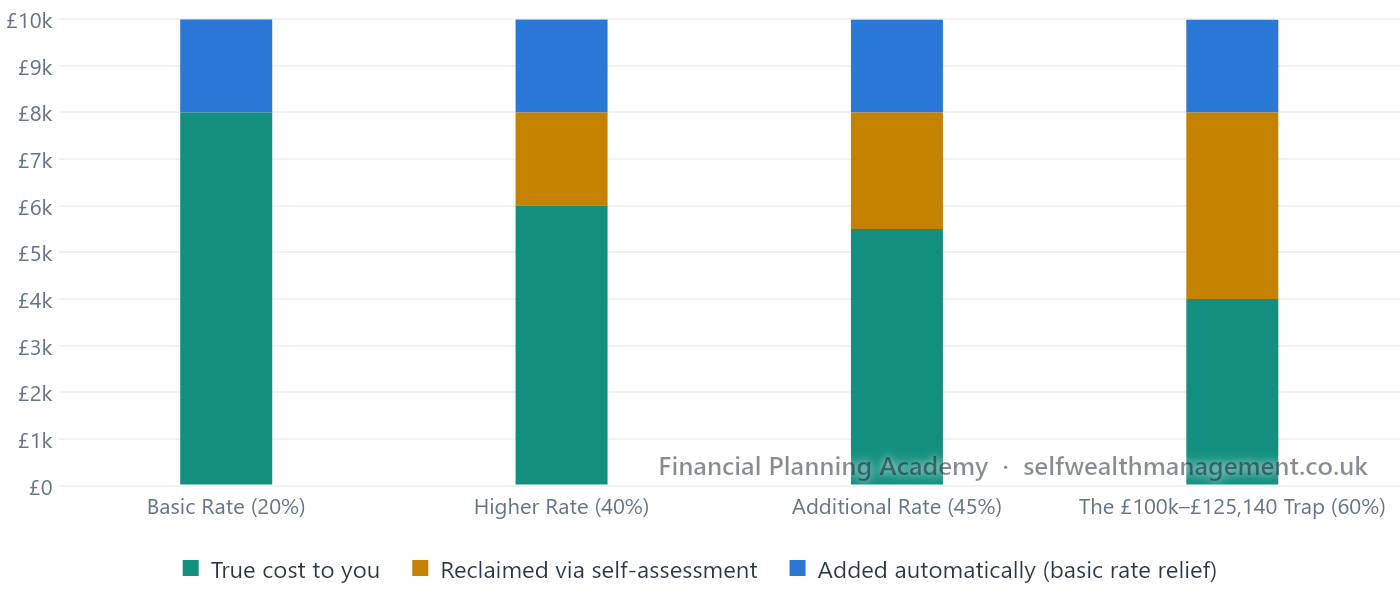
Notice how little changes mechanically between bands — the same £8,000 leaves your account and the same £2,000 is added automatically every time. The only thing that changes is how much of that £8,000 comes back later through your tax return. Even the 60% trap band, covered in a later chapter, follows exactly the same pattern — just with considerably more coming back.
The higher the tax rate, the more valuable the relief becomes.
The step that's easy to miss
Only the basic 20% is applied automatically, through what's known as relief at source. Higher and additional-rate taxpayers have to actively claim the rest through self-assessment — it doesn't happen on its own, and it's a step a surprising number of people simply miss, effectively leaving free money unclaimed.
How tax relief counteracts tax on withdrawals
Relief on the way in is only half the story — what matters just as much is the tax paid on the way out. The table below assumes a £10,000 gross contribution, with the standard 25% of the eventual withdrawal taken entirely tax-free and the remaining 75% taxed as income at the relevant rate.
Find your own relief rate down the side and your expected tax rate on withdrawal along the top. Green is a strong return, amber is marginal, red is where the arithmetic turns negative.
| RELIEF IN ↓ / TAX OUT → | 20% | 40% | 45% |
|---|---|---|---|
| 20% net cost £8,000 | +6.3% £8,500 back | -12.5% £7,000 back | -17.2% £6,625 back |
| 40% net cost £6,000 | +41.7% £8,500 back | +16.7% £7,000 back | +10.4% £6,625 back |
| 45% net cost £5,500 | +54.5% £8,500 back | +27.3% £7,000 back | +20.5% £6,625 back |
The bottom-left corner is the reason retirement income needs planning too, not just contributions — basic-rate relief going in, followed by higher-rate tax coming out, is the one combination that consistently loses money.
- Pension tax relief effectively returns the income tax already paid on a contribution.
- Only the basic 20% is applied automatically — higher and additional-rate relief has to be actively claimed.
- Relief on the way in is often at a higher rate than tax paid on the way out — but the wrong sequence, basic-rate relief followed by higher-rate tax, can turn that advantage negative.
Educational disclaimer: This information is for educational purposes only and should not be considered financial advice or a recommendation. Investments can fall as well as rise in value, and you may get back less than you invest. Past performance is not a reliable indicator of future results.
How Salary Sacrifice Can Increase a Pension
Salary sacrifice routes pension contributions around payroll entirely, saving both Income Tax and National Insurance in the process.
In short: Salary sacrifice routes a pension contribution around payroll entirely, saving both Income Tax and National Insurance rather than just Income Tax. Many employers also pass on some of their own NI saving as an extra contribution.
Salary sacrifice is an arrangement where an employee gives up some salary, with the employer paying the equivalent straight into their pension instead.
Why it can be more efficient than a personal contribution
Because the sacrificed amount never passes through payroll as taxable income, it can save both Income Tax and National Insurance. Many employers also pass on some or all of their own NI saving, as an additional contribution on top.
Who benefits most
For basic-rate taxpayers in particular, the National Insurance saving on top of the usual tax relief can meaningfully increase the value of contributing this way rather than personally. It's worth checking whether an employer offers it — not everyone does.
One technical note: for the tapered annual allowance, salary sacrifice arrangements set up after July 2015 are added back into the threshold income calculation, which matters for higher earners — covered in the next chapter.
- Salary sacrifice reduces salary in exchange for an equivalent employer pension contribution.
- It can save both Income Tax and National Insurance, unlike a standard personal contribution.
- Basic-rate taxpayers often see a particularly strong relative benefit from the NI saving.
Educational disclaimer: This information is for educational purposes only and should not be considered financial advice or a recommendation. Investments can fall as well as rise in value, and you may get back less than you invest. Past performance is not a reliable indicator of future results.
Should You Take Your Tax-Free Cash?
Taking it isn't automatically right, and leaving it isn't automatically right either — the answer depends on what else it's competing against.
In short: The simplest reasons to take tax-free cash are to spend it or gift it — and doing so doesn't trigger the Money Purchase Annual Allowance. If it's reinvested instead, the withdrawal itself is tax-free, but that status doesn't carry over automatically — moving it into an ISA is what keeps it growing tax-free afterwards, otherwise any income or gains it produces are taxable as normal. Leaving it means the whole pot keeps growing inside the pension's tax-advantaged wrapper. For large pensions especially, the better answer often depends on what else is available to fund the same need.
Taking the 25% tax-free element of a pension feels like an obviously good idea — money, tax-free, available now. It isn't automatically the right call.
The case for taking it
The most straightforward reasons are to spend it or to gift it — money used or given away has already served its purpose, with nothing further to plan around. For larger pensions specifically, there can be other reasons too, covered in the worked example below. Taking tax-free cash also doesn't trigger the Money Purchase Annual Allowance, unlike accessing the taxable portion of a pension.
If it isn't spent or gifted, and is simply reinvested instead, it's worth being clear about what stays tax-free and what doesn't: the withdrawal itself is genuinely tax-free, but that status doesn't carry over automatically. Left in a savings account or general investment, any interest, dividends or gains it then produces are taxable in the normal way. Moving it into an ISA is what keeps it growing completely tax-free from that point on — without that step, it's really just ordinary money sitting outside a tax-advantaged wrapper.
The case for leaving it
Left inside the pension, the whole pot — including the portion that would eventually be tax-free — keeps growing within the pension's tax-advantaged wrapper. Pensions have also historically sat outside the taxable estate, though this is exactly what the 2027 changes alter, covered in a later chapter on pension death benefits.
A worked example for larger pensions
Someone with a pension well above £1,073,100 and no transitional protections has tax-free cash capped at £268,275 — a shrinking proportion of an otherwise large pot, covered in the box below. Suppose they also hold £268,275 in an ISA, and have a mortgage of the same amount outstanding.
Paying off the mortgage with the tax-free cash, rather than draining the ISA, generally makes more sense. The ISA keeps compounding tax-free and without limit for as long as it's left invested, whilst the tax-free cash stops growing if there is already £268,275 or more in there — any further growth in a large pension simply adds to the taxable element, not the amount available tax-free. Draining the ISA for the same purpose would give up growth that has no cap and no expiry date.
There's no obligation to take tax-free cash all at once. Phased or flexible drawdown allows it to be taken gradually alongside a smaller amount of taxable income, keeping more of the pot inside the pension's tax-free wrapper for longer.
The first 25% of most pensions can usually be taken tax-free, capped at £268,275 (the Lump Sum Allowance). That cap is exactly 25% of £1,073,100 — so pensions up to roughly that size get the full proportional 25% tax-free, while the tax-free proportion of anything larger gradually shrinks, since the cash element itself doesn't grow past £268,275. It's a mechanic worth understanding before assuming a bigger pension always means a bigger tax-free lump sum in percentage terms.
A planner would typically look at what else is available to meet the same need before assuming tax-free cash is the right source — the answer changes considerably depending on what sits alongside it.
- Spending it or gifting it are the most straightforward reasons to take tax-free cash, and doing so doesn't trigger the Money Purchase Annual Allowance.
- If it's reinvested rather than spent, the withdrawal itself is tax-free, but it doesn't stay that way automatically — moving it into an ISA is what keeps it growing tax-free, whereas leaving it inside the pension keeps the whole pot growing there instead, though the 2027 changes weaken the traditional inheritance tax case for doing so.
- For larger pensions, using tax-free cash for a specific need — rather than draining an ISA for the same purpose — often preserves more valuable, ongoing tax-free growth elsewhere.
Educational disclaimer: This information is for educational purposes only and should not be considered financial advice or a recommendation. Investments can fall as well as rise in value, and you may get back less than you invest. Past performance is not a reliable indicator of future results.
How Much Can You Pay Into a Pension?
The standard annual allowance is £60,000 — and unused allowance from previous years can often be carried forward.
In short: The standard annual allowance is currently £60,000, or 100% of earnings if lower. Unused allowance from the previous three tax years can often be carried forward, which can make a much larger one-off contribution possible. Non-earners, including children, can still receive basic-rate relief on contributions up to £3,600 gross a year despite having no earnings at all.
The annual allowance is the maximum that can be contributed to pensions in a tax year while still receiving tax relief.
The standard position
For most people this is currently £60,000 a year, though it can't exceed annual earnings.
Carrying forward unused allowance
Unused allowance from the previous three tax years can often be carried forward, making a larger one-off contribution possible — particularly valuable in an unusually high-earning year, such as one with a large bonus. To use it, membership of a registered pension scheme is needed in each of the years being carried forward from, and the total contribution still can't exceed current-year earnings.
Contributing for someone with no earnings at all
Anyone under 75 — including a non-earning spouse, or a child of any age — can still receive basic-rate tax relief on pension contributions up to £3,600 gross a year, despite having no earnings whatsoever. Paying in £2,880 gets topped up to the full £3,600, an automatic £720 added by the government, regardless of whether any tax was actually paid. This allowance can't be carried forward if unused, and because there's no tax being reclaimed against, only basic-rate relief is available — there's no higher-rate top-up to claim through self-assessment, even for a higher-rate taxpayer funding the contribution on someone else's behalf.
- The standard annual allowance is currently £60,000, or 100% of earnings if lower.
- Unused allowance from the previous three tax years can often be carried forward, particularly useful in a single unusually high-earning year.
- Non-earners, including children, can still receive basic-rate relief on pension contributions up to £3,600 gross a year — paying in £2,880 gets topped up to the full amount automatically.
Educational disclaimer: This information is for educational purposes only and should not be considered financial advice or a recommendation. Investments can fall as well as rise in value, and you may get back less than you invest. Past performance is not a reliable indicator of future results.
The Tapered Annual Allowance
High earners may find their £60,000 allowance quietly reduced — sometimes without realising it.
In short: High earners can see their £60,000 allowance reduced to as little as £10,000, through two separate income tests that both have to be exceeded. Because employer contributions count towards this, a generous workplace pension can catch someone in the taper without their personal income changing at all.
High earners may find their annual allowance reduced through a mechanism called the tapered annual allowance. It works through two separate tests, both of which have to be exceeded for tapering to apply.
Threshold income
Broadly: total income, plus salary sacrifice arrangements set up after July 2015, minus personal pension contributions. If this is £200,000 or below, no taper applies at all — regardless of how high adjusted income is.
Adjusted income
Broadly: total income plus all employer pension contributions. Once this exceeds £260,000, the allowance reduces by £1 for every £2 above that figure, down to a minimum of £10,000.
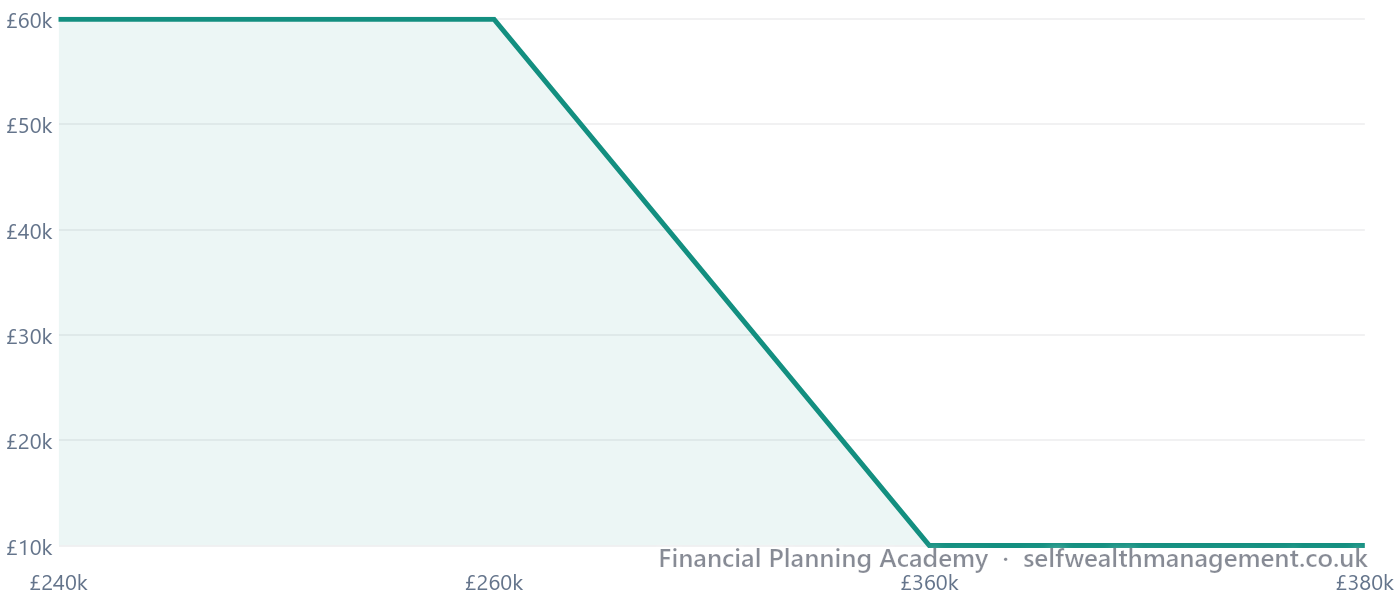
Why both tests matter
Because adjusted income includes employer contributions, a generous workplace pension can catch someone in the taper without them realising it. And because both tests have to be exceeded, a personal pension contribution that brings threshold income back to £200,000 or below can switch the taper off entirely — one of the more powerful, and more overlooked, planning levers available to higher earners.
Assuming the tapered annual allowance only depends on salary. Because adjusted income includes employer contributions, someone can be caught by the taper purely because of a generous workplace pension scheme — without their personal income changing at all.
- Both threshold income and adjusted income must be exceeded for the taper to apply.
- Employer pension contributions count towards adjusted income, which can catch people unexpectedly.
- A personal contribution that reduces threshold income below £200,000 can switch the taper off entirely.
Educational disclaimer: This information is for educational purposes only and should not be considered financial advice or a recommendation. Investments can fall as well as rise in value, and you may get back less than you invest. Past performance is not a reliable indicator of future results.
The 60% Tax Trap — And How Pensions Can Defuse It
Between £100,000 and £125,140, the effective marginal tax rate reaches 60% — one of the highest anywhere in the UK tax system.
In short: Income between £100,000 and £125,140 is taxed at an effective 60%, not 40%, because the Personal Allowance is being withdrawn at the same time. A pension contribution that brings income back under £100,000 can restore the lost allowance, sometimes at a very low effective cost.
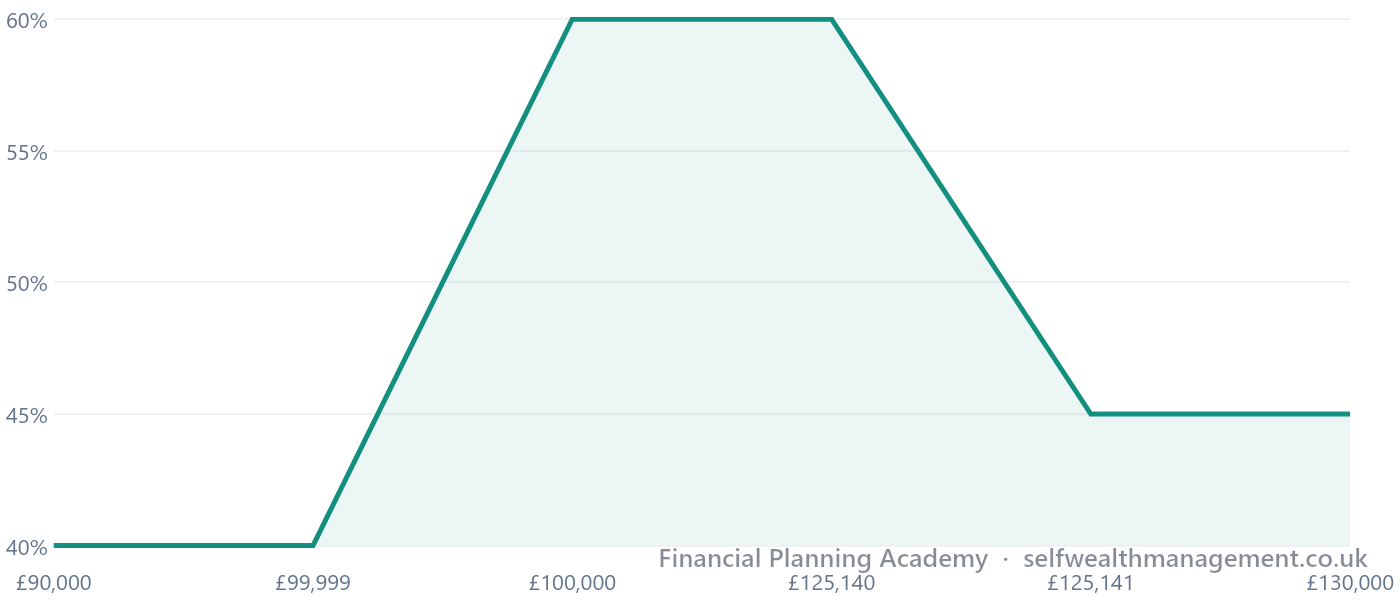
Between £100,000 and £125,140, every £2 of income causes £1 of Personal Allowance to be lost.
Why the rate reaches 60%
Income in this band is taxed at 40% directly. The disappearing Personal Allowance adds an additional effective 20% on top. Combined, that's a 60% effective marginal rate — one of the highest anywhere in the UK tax system, and one that catches a lot of people by surprise.
How pension contributions help
Pension contributions reduce the income figure this is measured against, restoring the lost Personal Allowance. A £10,000 gross contribution made while income sits in this band can effectively cost as little as £4,000 — the arbitrage table in the earlier chapter on pension tax relief shows exactly why.
"I earn £110,000, so I'll just pay the tax." It's an understandable reaction — but income in this band is being taxed at an effective 60%, not 40%. Many people in this position don't realise quite how expensive that stretch of income is, or that a pension contribution is one of the more direct ways available to reduce it.
- Between £100,000 and £125,140, the effective marginal tax rate reaches 60%.
- This happens because the Personal Allowance is withdrawn at £1 for every £2 of income in this band.
- Pension contributions can restore the lost allowance, sometimes at a very low effective cost.
Educational disclaimer: This information is for educational purposes only and should not be considered financial advice or a recommendation. Investments can fall as well as rise in value, and you may get back less than you invest. Past performance is not a reliable indicator of future results.
One Contribution, Several Benefits at Once
A single pension contribution can restore Child Benefit, preserve childcare entitlements and recover the Personal Allowance — sometimes all at the same time.
In short: Pension contributions reduce adjusted net income, the figure that also governs the Personal Savings Allowance, Child Benefit, and the Personal Allowance itself. A single contribution can sometimes restore several of these at once, well beyond the value of the pension contribution alone.
Pension contributions are measured against a figure called adjusted net income (ANI) — broadly, total income minus gross personal pension contributions and gift aid.
What ANI unlocks
| If ANI exceeds… | The impact is… |
|---|---|
| £50,270 | Personal Savings Allowance reduces from £1,000 to £500 |
| £60,000 | High Income Child Benefit Charge begins — covered in full in a later chapter |
| £80,000 | Child Benefit fully clawed back |
| £100,000 | 60% tax trap starts. Free childcare hours and Tax-Free Childcare lost. |
| £125,140 | Personal Allowance is lost completely |
Why one contribution can do so much
Because a pension contribution reduces ANI directly, it can restore several of these thresholds at once — Child Benefit, childcare entitlements, and the Personal Allowance — sometimes from a single contribution. It's worth being clear that ANI is a completely separate calculation from the threshold and adjusted income tests used for the tapered annual allowance, covered earlier — different figures, different purposes.
A £10,000 pension contribution can sometimes restore Tax-Free Childcare, preserve the 30 free childcare hours, and recover the Personal Allowance — all at the same time. For a higher-earning parent with young children, that combination can easily be worth several thousand pounds a year, well beyond the pension contribution itself.
- Adjusted net income (ANI) determines eligibility for several allowances at once, not just the Personal Allowance.
- Pension contributions and gift aid both reduce ANI, and can unlock multiple benefits simultaneously.
- ANI is entirely separate from the threshold and adjusted income tests used for the tapered annual allowance.
Educational disclaimer: This information is for educational purposes only and should not be considered financial advice or a recommendation. Investments can fall as well as rise in value, and you may get back less than you invest. Past performance is not a reliable indicator of future results.
The Money Purchase Annual Allowance (MPAA)
Once flexible income is taken from a pension, future contributions are capped at just £10,000 a year — permanently.
In short: Once someone flexibly draws income from a defined contribution pension, future contributions are permanently capped at £10,000 a year. Taking only tax-free cash, a DB pension, or a fixed lifetime annuity doesn't trigger it — only flexible access does.
Once someone begins flexibly drawing income from a defined contribution pension, the Money Purchase Annual Allowance is triggered.
What changes once it's triggered
- Future contributions to money purchase pensions are capped at just £10,000 a year
- Carry forward is no longer available for those contributions
- The change can't be reversed
Why this catches people out
Triggering the MPAA earlier than necessary — sometimes through a single, small flexible withdrawal — is one of the more common and expensive pension planning mistakes, particularly for anyone who still intends to keep contributing. It's worth checking exactly what kind of withdrawal is being made before taking one, since some options trigger it and others don't.
Not every way of taking money from a pension triggers the MPAA. Taking just the tax-free cash, without touching the rest, doesn't trigger it. Neither does income from a defined benefit pension, or buying a conventional, fixed lifetime annuity. It's specifically flexible access to a defined contribution pension — flexi-access drawdown or a flexible annuity, for example — that sets it off. Knowing the difference can be the line between taking tax-free cash safely and accidentally capping future contributions at £10,000 a year.
- The MPAA is triggered by flexibly accessing income from a defined contribution pension.
- It permanently caps future money purchase contributions at £10,000 a year.
- Taking tax-free cash alone, a DB pension, or a fixed lifetime annuity does not trigger it — only flexible access does.
Educational disclaimer: This information is for educational purposes only and should not be considered financial advice or a recommendation. Investments can fall as well as rise in value, and you may get back less than you invest. Past performance is not a reliable indicator of future results.
Pension Consolidation — What Gets Lost, Not Just What Gets Gained
Combining old pensions into one can bring welcome simplicity — but some older pensions carry valuable guarantees that are permanently lost on transfer, and defined benefit pensions are a different question entirely.
In short: Combining old pensions can bring genuine simplicity, but some older pensions carry valuable guarantees — enhanced tax-free cash, guaranteed annuity rates — that are lost permanently on transfer. Specialist advice is a legal requirement before transferring safeguarded benefits worth more than £30,000, and for defined benefit pensions specifically, most people who take that advice will likely be told not to transfer.
Many people accumulate several pensions over a working life — a workplace scheme from an early job, a personal pension started later, perhaps another from a spell of self-employment. Combining them into one is often described simply as tidying up.
Why people consolidate
- One place to view and manage retirement savings, rather than several
- Potentially lower or more transparent charges
- Easier to keep track of overall progress toward a goal
- Matching a single, deliberate investment strategy — rather than several old pensions each invested differently, sometimes pulling in different directions without anyone actively deciding that should be the case
- Ensuring that your pension has access to flexi-access drawdown and beneficiary drawdown, so that you and the beneficiaries of your pension can access it in the most tax efficient manner
What can be lost in the process
Some older pensions, particularly those taken out some years ago, can carry valuable guarantees that don't exist on modern pensions. Two of these — protected tax-free cash and a protected pension age — share the same rule: both are lost on an ordinary transfer, and only preserved if the transfer specifically qualifies as a "block transfer" (broadly, transferring together with at least one other member of the same scheme to the same receiving scheme), which most transfers don't meet.
- Enhanced or protected tax-free cash above the standard 25%
- Guaranteed annuity rates, which can be considerably more generous than anything available on the open market today
- Other safeguarded benefits, including defined benefit or final salary features
- A protected pension age — the right to access benefits earlier than the current normal minimum pension age
These guarantees are typically lost permanently once a transfer takes place, regardless of how straightforward the process looks. Anyone whose pension might carry any of these should seek financial advice before doing anything, rather than assuming a transfer is purely administrative.
Things to check before transferring
Workplace pensions aren't inherently worse than a personal pension — plenty of people transfer simply to bring everything into one place as they move between jobs, and that's a reasonable enough reason on its own. Beyond the guarantees above, a few practical things are worth checking:
- Fees — compare the charges on both the pension being left and the one receiving it. A workplace pension with a large employer sometimes has genuinely lower institutional pricing than an individual pension can match, so the receiving scheme isn't always the cheaper one.
- Investment choice — some older or more basic schemes offer a narrow range of funds; worth checking the receiving scheme actually offers what's needed, not just that it exists.
- Risk alignment — money sitting in a scheme's default fund isn't automatically matched to personal risk tolerance. Many workplace pensions default into a "lifestyle fund", which gradually shifts money into lower-risk assets as a target retirement date approaches. This was designed for an era when most people bought an annuity at that date — for anyone planning to stay invested through flexi-access drawdown instead, that gradual de-risking can start years or even decades too early, potentially giving up growth that would otherwise still be needed.
- Flexi-access drawdown — not every scheme supports flexible access to a pension in retirement. If that flexibility matters, it's worth confirming the receiving scheme genuinely offers it before transferring, rather than discovering the gap at retirement.
Defined benefit pensions: a different question entirely
Transferring a defined benefit (DB) or final salary pension is a fundamentally different decision from consolidating standard personal pensions. A DB pension provides a guaranteed income for life, usually inflation-linked and often continuing at a reduced rate to a spouse after death — giving this up in exchange for a transfer value is one of the more consequential decisions in financial planning, not a simple administrative step.
The Financial Conduct Authority's starting position is that a DB transfer is assumed to be unsuitable for most people, and advice on any DB pension worth more than £30,000 is a legal requirement before a transfer can proceed. Most people who take that advice will likely be told not to transfer.
Transfer values themselves move with interest rates and gilt yields, and have varied considerably over time. During the extended period of near-zero interest rates through 2020 and 2021, average transfer values reached record highs, prompting a wave of transfers as the exchange looked unusually attractive. Since interest rates and gilt yields rose from 2022 onwards, average transfer values have fallen by roughly half — a reminder that the case for transferring can look very different depending on when it's considered, not just on the specific pension involved.
The 2027 changes to how pensions are treated for inheritance tax add a further layer to this decision. One argument sometimes made for transferring out of a DB scheme is the flexibility a personal pension offers to pass on unused funds — but with that pot itself becoming subject to inheritance tax in April 2027, that particular advantage may be worth considerably less than it once was.
A rule worth knowing
Where safeguarded benefits are worth more than £30,000, specialist financial advice is a legal requirement before a transfer can proceed — not just a suggestion. That threshold exists precisely because these guarantees have caught people out before, and because their value is often much harder to judge than it first appears.
- Consolidating pensions can bring genuine simplicity, but isn't automatically the right move for every pension — check fees, investment choice, risk alignment and drawdown flexibility before transferring.
- Older pensions can carry guarantees — enhanced tax-free cash, guaranteed annuity rates, and sometimes a protected pension age — that are lost permanently on transfer unless specific conditions are met.
- Defined benefit pensions are a different question entirely — the FCA's starting assumption is that a transfer is unsuitable, and advice is a legal requirement above £30,000.
Educational disclaimer: This information is for educational purposes only and should not be considered financial advice or a recommendation. Investments can fall as well as rise in value, and you may get back less than you invest. Past performance is not a reliable indicator of future results.
Pension Recycling — A Rule Worth Knowing, Not Worrying About
HMRC has specific rules to stop tax-free cash being deliberately reinvested to generate further relief.
In short: HMRC's recycling rules only catch a tax-free lump sum reinvested as part of a pre-planned, significant increase in contributions — not an increase from a pay rise, new job, or inheritance. Genuine doubt about a specific plan is a reason to seek advice, not to guess.
Taking tax-free cash from a pension and reinvesting it into a pension to generate further relief is known as recycling.
When the rules actually apply
HMRC treats a tax-free lump sum as an unauthorised payment only if all of the following are true: the lump sum, combined with any others in the previous 12 months, exceeds £7,500; contributions increased significantly as a result; the cumulative increase over a five-year window exceeds 30% of the lump sum; and the whole thing was pre-planned. If any one of these isn't met, the rules don't apply.
What's specifically not recycling
Contributions increasing because of a pay rise, bonus, or new job aren't recycling. Neither are contributions funded from an inheritance or redundancy payment, or contributions made into someone else's pension, such as a spouse or child.
The practical takeaway
These rules aren't designed to prevent sensible retirement planning — increasing contributions in the years approaching retirement is legitimate and expected. They specifically target deliberate use of tax-free cash to generate additional relief on money that's already benefited from it. Where there's genuine doubt about whether a specific plan might be caught, that's a case for specialist advice rather than guesswork.
- Recycling rules only apply if all of a specific set of conditions are met together — not just one.
- Contribution increases from a pay rise, new job, or inheritance are specifically not treated as recycling.
- Genuine doubt about a specific plan is a reason to seek specialist advice, not to guess.
Educational disclaimer: This information is for educational purposes only and should not be considered financial advice or a recommendation. Investments can fall as well as rise in value, and you may get back less than you invest. Past performance is not a reliable indicator of future results.
Defined Benefit Pensions: A Different Set of Rules
A DB pension pays guaranteed income, not a pot to draw down — which changes which questions actually matter.
In short: DB and State Pension income can't usually be varied once in payment, so the levers that matter come earlier: taking benefits early where income isn't needed in full, taking more tax-free cash for a lower pension, or — where a linked AVC exists — sometimes getting both a higher pension and higher tax-free cash at once.
A defined benefit (DB) pension pays a guaranteed income for life, not a pot to draw down. That changes which decisions actually matter.
Why the usual rules don't apply
DB and State Pension income generally can't be turned down or varied once both are in payment. There's no lever to pull on the income itself — only on how things are set up before that point.
Taking it early, deliberately
Retiring early and accepting the scheme's early payment reduction isn't only a trade-off to minimise — it can be a genuine tool. A permanently smaller pension, taken early, can keep combined income within the basic rate band even once the State Pension later stacks on top, where taking it at full rate might not. This works best where the extra income wasn't needed in full anyway.
Taking more tax-free cash for a lower pension
Many schemes allow more flexibility than the default option shown on a retirement quote — commuting more of the pension for a larger tax-free lump sum, in exchange for a lower ongoing income. This is a second lever toward the same goal: reducing taxable income that isn't needed in full, this time through the lump sum rather than early retirement.
An AVC can sometimes offer both at once
Where a linked Additional Voluntary Contribution (AVC) pot exists, it's sometimes possible to combine the higher pension with the higher lump sum, rather than choosing between them.
| Option A | Higher pension |
| Annual pension | £55,000 |
| Tax-free lump sum | £80,000 |
| Option B | Higher lump sum |
| Annual pension | £46,000 |
| Tax-free lump sum | £240,000 |
| Linked AVC pot | £160,000 |
Rather than choosing Option B for the larger lump sum, the AVC pot here happens to match the £160,000 difference between the two options exactly — so it may be possible to take the higher £55,000 pension from Option A, and still reach the full £240,000 tax-free cash total by using the AVC pot to make up the difference. This keeps the higher guaranteed income for life, while still getting money out of the pension tax-free — whether it's needed for spending or not, which matters more given the 2027 changes covered below. Whether this combination is actually available depends on the specific scheme's rules and the overall Lump Sum Allowance.
Why this matters more from 2027
Taking the £160,000 out as tax-free cash avoids the potential double taxation risk covered in the What Happens to a Pension When You Die chapter. It also gets the full AVC out tax-free, rather than having to pay income tax on it. That can now be spent or gifted as desired.
A planner would typically check the scheme's actual flexibility, whether an AVC exists, and whether early retirement is genuinely on the table, before assuming the standard quote is the only option.
- DB and State Pension income can't usually be varied once in payment — the real decisions happen before that point.
- Taking benefits early, or taking more tax-free cash for a lower pension, can both help keep income within a lower tax band where the extra isn't needed.
- Where a linked AVC exists, it's sometimes possible to get a higher pension and higher tax-free cash together, rather than choosing between them.
Educational disclaimer: This information is for educational purposes only and should not be considered financial advice or a recommendation. Investments can fall as well as rise in value, and you may get back less than you invest. Past performance is not a reliable indicator of future results.
The 85-Year Rule: A Local Government Pension Scheme Detail
A protection specific to the Local Government Pension Scheme, for members who joined before October 2006 — not a general public sector rule.
In short: The 85-year rule is specific to the Local Government Pension Scheme. Where age plus scheme membership reaches 85 by 60, some members who joined before October 2006 can take their pension from 60 without the usual early payment reduction. Other schemes have their own, quite different early-access features — the NHS, Police and Armed Forces each have something, but none work like the rule of 85, and Teachers and Civil Service have nothing comparable at all.
The "85-year rule" is a genuine LGPS detail, not a general public sector benefit — it doesn't apply to the NHS, Teachers, Civil Service, Police, or Armed Forces schemes, which each have their own separate arrangements.
Who it applies to
It applies to members who joined the Local Government Pension Scheme before 1 October 2006. Where age plus scheme membership, both in whole years, adds up to 85 or more, some or all of the pension can be taken from age 60 without the reduction that would otherwise apply for taking it early. Protection tapers by birth date and was phased out for benefits built up after certain dates — the detail genuinely varies by individual circumstances, and is worth checking directly with the pension fund rather than assumed.
Access before 60
The rule of 85 doesn't automatically apply to benefits taken before 60. Access from 55 (rising to 57 from 2028) is possible, but at the scheme employer's discretion, not as of right.
Flexible retirement
Some members can reduce their hours or move to a less senior role from the same minimum age, draw their LGPS pension at that point — with the rule of 85 applied if it's met — and fully retire later. Pension built up between that point and full retirement is generally still subject to the normal early payment reduction, even where the earlier benefits weren't.
What applies instead, in the other main public sector schemes
- NHS — Special Class Status or Mental Health Officer status effectively sets a Normal Pension Age of 55, rather than the standard 60, for certain nurses, midwives, health visitors and physiotherapists who joined before March 1995 — confirmed directly on NHS Pensions' own website. Full benefits are payable at 55 with no reduction at all, but only on benefits built up in the older 1995 Section, and only where the last five years were spent in a qualifying role. There's no age-plus-service test involved — it depends entirely on role and joining date. Retiring even earlier than 55 forfeits that protection, reverting to the standard reduction schedule calculated on a Normal Pension Age of 60 instead.
- Police (1987 scheme) — genuinely has three separate routes to an unreduced pension, not just one: 30 years' service at any age; 25 years' service from age 50; or, for Metropolitan officers of any rank and County Constables and Sergeants specifically, age 55 regardless of service length. County Inspectors and above need either 30 years or age 60 for the same treatment. Later police pension schemes are considerably less generous.
- Armed Forces (legacy scheme, AFPS 75) — closed to new entrants since 2005, and even those who served under it stopped building further entitlement under it from April 2022, so this only matters for service accrued before then. Where it applies, an Immediate Pension is payable, fully unreduced, after 16 years' service for officers (from age 21, so potentially as early as 37) or 22 years for other ranks (from age 18, so potentially from 40). Genuinely unusual among public sector schemes. Newer Armed Forces schemes offer an Early Departure Payment from age 40 with 18-20 years' service instead — less generous, but still distinctive.
- Teachers and Civil Service — neither has anything comparable. Early access before normal pension age carries a standard actuarial reduction in both, with no age-plus-service waiver available at all.
These protections don't extend to other sections someone may also be in
Since the 2015 reforms moved most public sector workers onto new career-average schemes for future service, many people now have benefits split across an older, protected section and a newer one that isn't. None of the protections above reach across that divide — a newer section is governed entirely by its own Normal Pension Age and reduction rules. Whether the two can actually be drawn separately, at different times, varies by scheme:
| Scheme | Can the older and newer sections be drawn separately? |
|---|---|
| LGPS | No — normally taken together. Flexible retirement is the one exception. |
| NHS | Yes — assessed and paid independently. |
| Police | Yes — assessed and paid independently. |
| Civil Service | Yes — assessed and paid independently. |
| Armed Forces | Yes — assessed and paid independently. |
| Teachers | Only if the older section is taken at or after its own scheme pension age. |
The LGPS — the subject of this chapter — is the strictest of the group. Confirming exactly how this applies to a specific combination of sections is worth doing directly with the relevant scheme administrator.
Assuming this applies more broadly than it does. It's an LGPS-specific detail — someone in the NHS Pension Scheme or Teachers' Pension Scheme has a genuinely different set of rules, not a variation on this one.
- The 85-year rule is specific to the Local Government Pension Scheme, not public sector pensions generally — the exact protection varies by birth date, worth checking directly with the specific pension fund.
- Where age plus membership reaches 85 by 60, some members who joined before October 2006 can access their pension from 60 without the usual reduction.
- Other schemes have their own, quite different early-access features, and whether an older, protected section can be drawn separately from a newer one varies too — the LGPS itself generally requires both to be taken together, unlike the NHS, Police, Civil Service and Armed Forces, where they're usually independent.
Educational disclaimer: This information is for educational purposes only and should not be considered financial advice or a recommendation. Investments can fall as well as rise in value, and you may get back less than you invest. Past performance is not a reliable indicator of future results.
Why Annuities Have Come Back Into Favour
Annuity rates have risen substantially since 2022 — and with them, a guaranteed income option many retirees had written off has become genuinely worth reconsidering.
In short: Annuity rates have risen roughly 50% since 2020, driven by higher gilt yields, making many retirees reconsider guaranteed income. Annuities don't have to be all-or-nothing — many people use only part of a pension for a guaranteed income floor and leave the rest in drawdown. It is always worth shopping around to find the best rates.
For much of the 2010s, annuity rates were so low that buying one felt like poor value for most people, and pension drawdown became the default choice for most retirees. That picture has changed considerably, even more so now that pensions will be within estates for inheritance tax purposes from April 2027. However, remember that annuities are still irreversible.
Why rates have risen so much
Annuity providers largely back their guaranteed payments with UK government bonds (gilts), so annuity rates move closely in line with gilt yields. Gilt yields rose sharply from 2022 — driven by higher interest rates and the market reaction to that year's mini-budget — and have stayed considerably higher since. A 65-year-old with a £100,000 pension pot who might have received around £4,500–£5,000 a year from a level annuity in 2020 or 2021 can now often secure £7,000 or more for the same pot — roughly 50% more guaranteed income for the same money.
You don't have to annuitise the whole pot
Buying an annuity doesn't have to be an all-or-nothing decision. Many retirees use only part of a pension to buy a guaranteed income floor — enough to cover essential living costs — while leaving the rest in drawdown, where it stays invested and remains flexible. This blended approach captures the certainty of an annuity for the money that absolutely needs to be there, without giving up the flexibility of drawdown for the rest.
Buying in stages, as rates rise with age
Annuity rates increase with age, because the provider expects to pay out for a shorter period. Some retirees buy annuities in stages over a number of years — for example, a portion at 65, a further portion at 70, and so on — rather than committing an entire sum at a single point. This spreads the decision across several different rate environments as well as capturing the improvement that comes with age, rather than relying on the rates available on one particular day.
The main options — and what they cost
Every annuity is built from a set of choices, and each one that adds protection or flexibility reduces the income the annuity starts paying.
- Guarantee period — ensures payments continue for a minimum number of years (commonly 5 or 10), even if the annuity holder dies shortly after purchase. Without one, payments can simply stop on death, however soon that is.
- Value protection — returns some or all of the original purchase amount, less income already paid, if death occurs before that amount has been paid out.
- Indexation — an income that rises each year, either by a fixed percentage chosen at outset or in line with RPI, rather than staying level throughout.
- Joint life / spousal continuation — continues paying an income (commonly 50% or 100% of the original amount) to a spouse or civil partner after the annuity holder's death.
- Lifetime or Fixed Term — some annuities can pay for the rest of your life. Others may only pay for a fixed term e.g. 60 year old retiree buys a 7-year fixed term annuity until his state pension and final salary pension begins.
Each of these is genuinely valuable to the right person. None of them are free — they're all funded by starting with a lower income than a single-life, level, no-guarantee annuity would pay.
The trade-off in detail: level vs RPI-linked
Because an RPI-linked annuity starts lower and grows over time, while a level annuity starts higher and never changes, there are two separate points worth understanding — and they're not the same thing.
The crossover point is when the RPI-linked annuity's annual income finally exceeds the level annuity's annual income. The breakeven point is later still — the point at which the RPI-linked annuity's cumulative total paid out catches up with the level annuity's cumulative total, which had a head start from years of higher payments early on.
Aviva's own published example, assuming average RPI of 3.5%, puts the crossover at around 11 years and the breakeven at around 20 years. For context, average life expectancy for a 65-year-old is around 18 to 20 further years — meaning many people won't live to see the breakeven point, even though most would live to see the crossover.
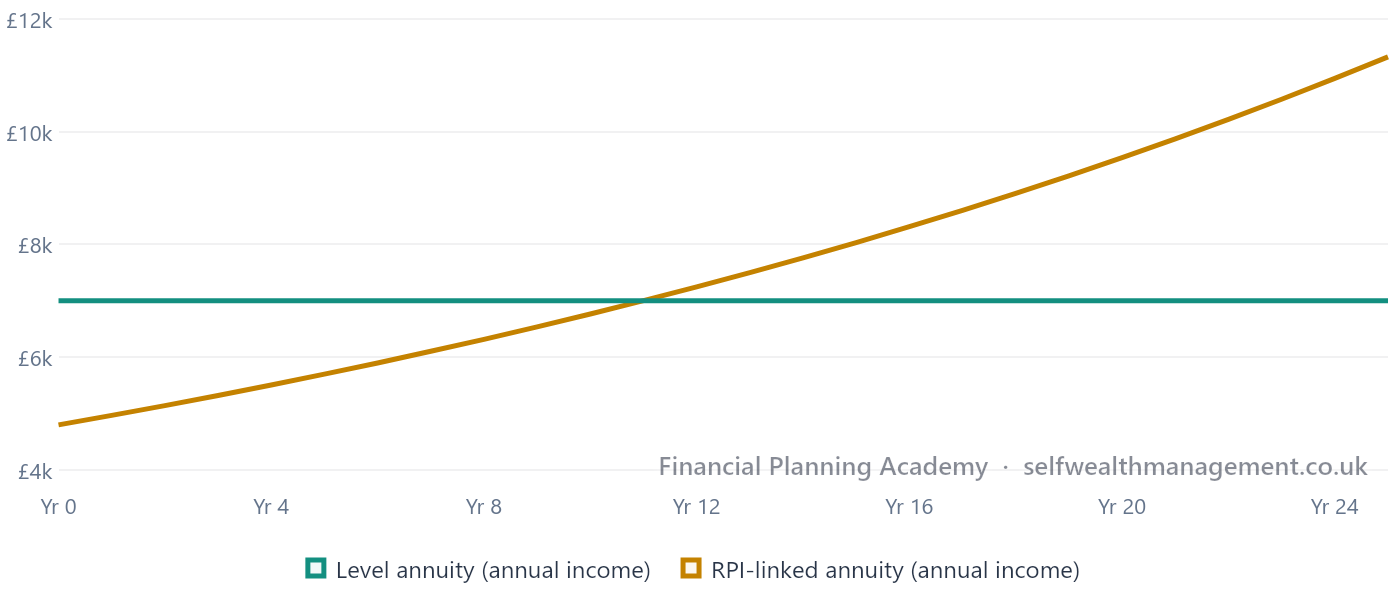
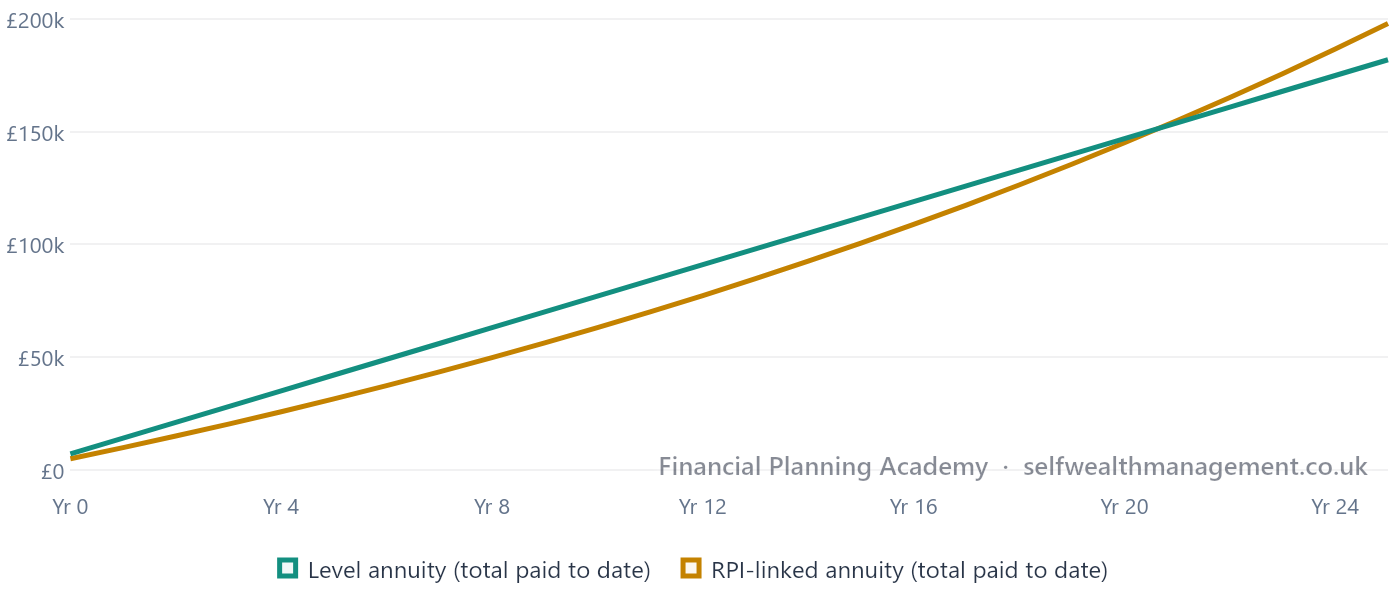
Figures are illustrative, based on Aviva's published example assuming 3.5% average RPI. Actual annuity rates and inflation will differ, and both change the crossover and breakeven points considerably.
Deciding how much, if any, of a pension to put into an annuity usually starts with a simple question: how much guaranteed income is needed to cover essential costs, on top of the State Pension? That figure often becomes the annuity floor, with the rest left in drawdown for flexibility and growth potential — connecting directly to the later chapter on the order of withdrawals in retirement. Health and life expectancy matter too: those with qualifying health conditions can often access enhanced rates, sometimes substantially higher than standard rates.
- Annuity rates have risen roughly 50% since 2020, driven by higher gilt yields, and have remained elevated since 2022.
- Annuities don't have to be all-or-nothing — many retirees use part of a pension for a guaranteed income floor and leave the rest in drawdown.
- The crossover point, where RPI-linked income overtakes level income, and the breakeven point, where cumulative totals catch up, are different milestones — Aviva's own figures put these at roughly 11 and 20 years.
Educational disclaimer: This information is for educational purposes only and should not be considered financial advice or a recommendation. Investments can fall as well as rise in value, and you may get back less than you invest. Past performance is not a reliable indicator of future results.
What Happens to a Pension When You Die
Pensions can usually pass to nominated beneficiaries outside the taxable estate — though changes from 2027 alter this.
In short: Pensions can usually pass to nominated beneficiaries, historically outside the taxable estate — tax-free if death occurs before age 75, taxed as income after. Rule changes from April 2027 will bring unused pensions within scope for inheritance tax for the first time.
Pensions can usually be passed to nominated beneficiaries, and have historically sat outside the taxable estate for inheritance tax purposes.
How the tax treatment depends on age
Dying before age 75 generally means beneficiaries can receive the pension tax-free, but only if your pension allows for beneficiary drawdown. Lump sums over the Lump Sum and Death Benefit Allowance of £1,073,100 would be taxed at the beneficiary's marginal rate of income. After 75, withdrawals are taxed at the beneficiary's own income tax rate. The type of pension and how benefits are taken — lump sum, drawdown, or annuity — also affect the detail.
A detail that's easy to forget
Pension nominations sit outside a Will entirely, which makes them easy to overlook. An out-of-date nomination — naming an ex-partner, for example — can mean a pension passes to someone it was never intended for. Reviewing nominations periodically is a small task with potentially significant consequences.
The 2027 change
From April 2027, unused pension funds are to fall within the scope of inheritance tax for the first time — sometimes referred to informally as the "pension double death tax," since IHT and income tax could both apply to the same inherited pension wealth.
Defined benefit schemes add their own death benefits
DB schemes typically layer their own benefits on top of this: a percentage of the pension — often 50% — continuing to a surviving spouse, civil partner, or dependent child, sometimes with a guarantee period of five or ten years protecting payments if death occurs shortly after the pension starts. Death before the pension is taken usually triggers a lump sum instead, often a multiple of salary or a refund of the member's own contributions, depending on the scheme.
- Pensions can usually pass to nominated beneficiaries, historically outside the taxable estate.
- Death before age 75 generally means tax-free receipt for beneficiaries; after 75, income tax usually applies.
- 2027 changes will bring unused pensions within scope for inheritance tax for the first time — and DB schemes typically add their own spousal pension, guarantee period, or lump sum death benefits on top.
Educational disclaimer: This information is for educational purposes only and should not be considered financial advice or a recommendation. Investments can fall as well as rise in value, and you may get back less than you invest. Past performance is not a reliable indicator of future results.
How HMRC Stacks Your Income
Different types of income are taxed in a specific order — and understanding that order can materially affect how much tax is actually due.
In short: UK income is taxed in a specific order — non-savings income, then savings income (including offshore bond gains), then dividends, then the taxable part of a redundancy payment, then onshore bond gains, with capital gains sitting above all of it. Where something sits in that stack affects which allowances are available to it — and capital gains, unusually, don't count towards adjusted net income at all.
Understanding how HMRC stacks different types of income across the tax bands matters for decisions about where to hold investments, which income to draw, and when.
The order, first to last
Why the ordering matters in practice
Each layer stacks on top of the previous one, consuming the remaining tax bands in sequence.
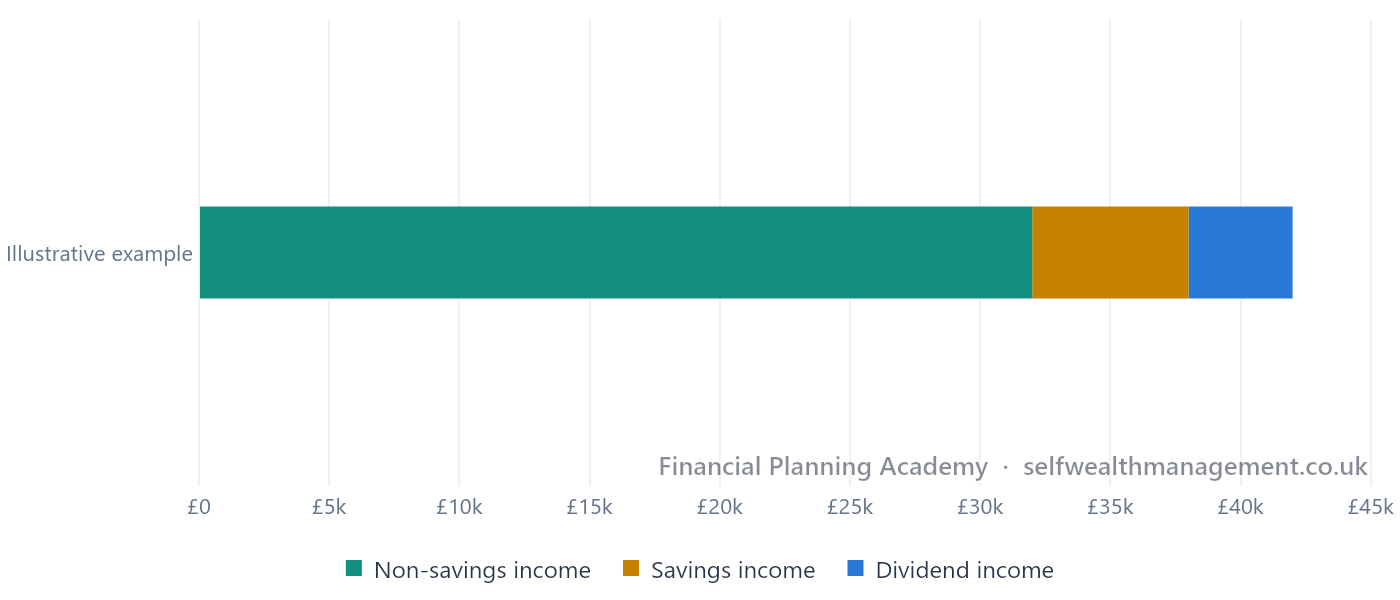
Offshore bond gains are taxed as savings income, sitting within that layer rather than as a separate category, and can benefit from the Personal Savings Allowance and the starting rate for savings — up to £5,000 at 0% where non-savings income is low. Their position means they can sometimes be sheltered more effectively than other gains.
The taxable part of a redundancy payment — anything above the £30,000 tax-free exemption — is added to income in the tax year it's received, broadly stacking above dividend income. Because it lands on top of whatever else has already used up the lower tax bands that year, the timing of a redundancy payment, and what other income arrives in the same tax year, can materially affect how much of it ends up taxed at a higher rate.
Onshore bond gains sit at the very top of the income tax stack, but carry a notional 20% basic rate credit. If the gain falls entirely within the basic rate band, that credit covers it and there's nothing further to pay. Tax only becomes due where the gain pushes into higher or additional rate bands, and even then only on the excess.
Capital gains sit above all income for the purpose of setting the CGT rate. This is why drawing income from other sources in the same tax year can push capital gains into a higher CGT bracket — the sequencing of income and disposals within a year genuinely matters. Capital gains are also, unusually, entirely outside adjusted net income — a large gain doesn't affect the Personal Allowance taper, the tapered annual allowance covered in an earlier chapter, or Child Benefit and Tax-Free Childcare covered in later chapters, in the way that the same amount of income would.
Top slicing relief
For bond gains, top slicing relief spreads the gain across the number of years the bond has been held, which can meaningfully reduce the effective rate of tax due. It applies to both onshore and offshore bonds, and matters most for larger, one-off chargeable event gains.
This ordering matters most in retirement, where income is often drawn from several sources at once — a pension, savings interest, dividends, maybe a bond. The sequence in which those are drawn, and in which tax year, can materially change the total tax paid across a retirement, not just in a single year.
- UK income is taxed in a specific order: non-savings income, then savings income (including offshore bond gains), then dividends, then the taxable part of a redundancy payment, then onshore bond gains, with capital gains sitting above all of it.
- Where something sits in that stack affects which allowances and reliefs are available to it.
- Capital gains don't count towards adjusted net income at all, unlike every income type below them in the stack — a large gain doesn't affect the Personal Allowance taper, the tapered annual allowance, or Child Benefit.
Educational disclaimer: This information is for educational purposes only and should not be considered financial advice or a recommendation. Investments can fall as well as rise in value, and you may get back less than you invest. Past performance is not a reliable indicator of future results.
What About Money You Need Sooner?
Pensions and long-term investing aren't right for every pound — low-coupon gilts are one lesser-known option for money with a specific, shorter time horizon.
In short: Low-coupon UK gilts deliver much of their return as a tax-free capital gain rather than taxable interest, which can meaningfully help a higher-rate taxpayer with money earmarked for a specific date. This only behaves as low-risk if held to the gilt's maturity, not if sold earlier.
Most tax planning is built around long-term money. But what about money earmarked for something in the next few years, where a pension simply isn't the right tool?
The problem with ordinary cash savings
For a higher or additional-rate taxpayer who's already used their Personal Savings Allowance, cash savings can be surprisingly tax-inefficient — every pound of interest above the allowance is taxed at their full marginal rate.
A lesser-known alternative: low-coupon gilts
UK government bonds (gilts) are exempt from Capital Gains Tax for individual investors. A gilt trading below its £100 redemption value delivers much of its total return as a capital gain when it matures, rather than as taxable coupon income — and that capital gain isn't taxed at all. For someone facing 40% or 45% tax on savings interest, that distinction can meaningfully change the after-tax return on money simply being held for a known period.
The important caveat
Because gilts are backed by the UK government, the credit risk is about as low as it gets in sterling terms — but the "risk-free" description really only holds if the gilt is held to its maturity date. Sell before then and the price can have moved, for better or worse, in the meantime. This tends to suit money with a fairly specific time horizon — a house deposit due in two years, for example — rather than money that might be needed at short notice.
- Cash savings can be tax-inefficient for higher and additional-rate taxpayers once the Personal Savings Allowance is used.
- Low-coupon gilts deliver much of their return as a tax-free capital gain rather than taxable income.
- This only behaves as low-risk if held to the gilt's specific maturity date, not if sold earlier.
Educational disclaimer: This information is for educational purposes only and should not be considered financial advice or a recommendation. Investments can fall as well as rise in value, and you may get back less than you invest. Past performance is not a reliable indicator of future results.
Child Benefit and the High Income Child Benefit Charge
Almost always worth claiming, even for high earners who'll pay some or all of it back — the claim itself protects something more valuable than the cash.
In short: Child Benefit pays £27.05 a week for the eldest child and £17.90 for each additional child, but the High Income Child Benefit Charge claws it back once the higher earner's adjusted net income passes £60,000, fully gone by £80,000. It's tested on the higher earner's individual income, not household income, which can catch a single-earner family well before a dual-income household earning far more. Claiming is usually still worth it even where the charge wipes out the payment, since it protects State Pension credits.
Child Benefit is one of the most widely claimed benefits in the UK, and one of the most misunderstood once income rises above a certain point.
How Child Benefit works
Child Benefit currently pays £27.05 a week for an eldest or only child, and £17.90 a week for each additional child, with no limit on the number of children covered. There's no means test to claim it in the first place — the means-testing happens separately, through the tax charge covered below.
The High Income Child Benefit Charge
Once the higher earner in a household has adjusted net income above £60,000, some or all of the Child Benefit received gets clawed back through a tax charge — 1% of the Child Benefit for every £200 of income above that threshold, until it's fully gone at £80,000.
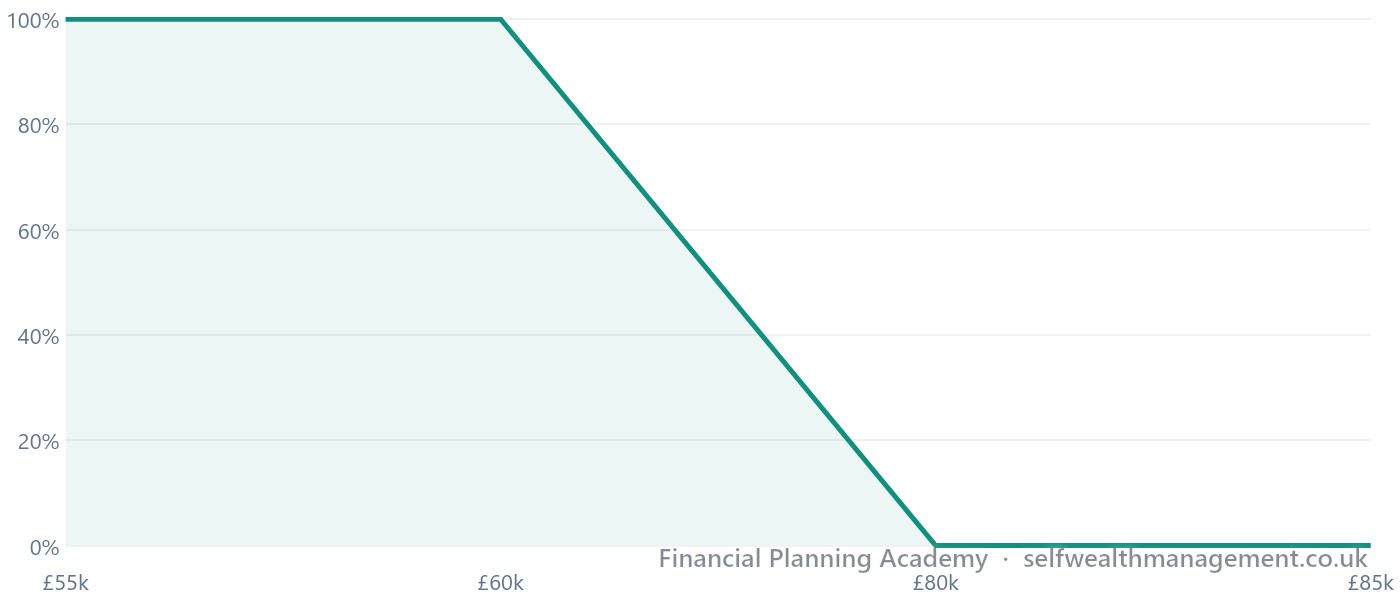
A worked example: a family with two children receives £2,337.40 a year in Child Benefit. If the higher earner has adjusted net income of £70,000 — exactly halfway through the taper — the charge claws back 50%, or £1,168.70, leaving £1,168.70 actually kept. A pension contribution can help reduce or even avoid the high income charge altogether.
Why this can catch one household and not another, earning far more
The charge is tested against the higher earner's own individual income, not combined household income. Two parents each earning £59,000 — a household income of £118,000 — face no charge at all, since neither individually crosses £60,000. A single-earner household on £81,000, with a partner who doesn't work, loses the entire benefit, despite having less than three-quarters of the two-earner household's income. This individual-income basis has been a long-standing point of criticism of the charge, and it's worth understanding precisely because it doesn't track household income the way many people assume it does.
Claiming without keeping the money
Where the charge is expected to wipe out some or all of the benefit, it's possible to claim Child Benefit and opt out of actually receiving the payments, avoiding the need to declare and repay it through self-assessment. Crucially, this still preserves two things separate from the cash itself: National Insurance credits toward the State Pension for a parent who isn't working, covered in more detail in the earlier chapter on the State Pension, and the child's automatic National Insurance number at age 16. Many people who assume there's no point claiming once they're above £80,000 aren't aware they can get these protections without ever touching the payment itself.
Around one in ten eligible families don't claim Child Benefit at all — often high earners who assume it isn't worth the paperwork. Even where the charge removes the entire cash benefit, the claim itself is what protects the National Insurance credits and the child's automatic NI number — benefits with no direct cash value that are easy to lose sight of entirely.
This connects directly to the earlier chapter on adjusted net income — a pension contribution that brings the higher earner back under £60,000, or reduces how far above it they sit, directly reduces the charge in exactly the same way it can restore the Personal Allowance or protect Tax-Free Childcare. For a family close to the threshold, this is often one of the more straightforward wins available.
- Child Benefit currently pays £27.05 a week for the eldest child and £17.90 for each additional child, with no limit on how many children can be claimed for.
- The High Income Child Benefit Charge claws this back between £60,000 and £80,000 of the higher earner's individual income, not household income — a single high earner can lose it entirely while a dual-income household earning far more keeps all of it.
- Claiming and opting out of payment, rather than not claiming at all, preserves State Pension National Insurance credits even where the charge removes the entire cash benefit.
Educational disclaimer: This information is for educational purposes only and should not be considered financial advice or a recommendation. Investments can fall as well as rise in value, and you may get back less than you invest. Past performance is not a reliable indicator of future results.
Free Childcare and Tax-Free Childcare
Two separate schemes worth understanding together — both use the same income test, and both can disappear entirely if just one parent's income goes even £1 over £100,000.
In short: Tax-Free Childcare and funded childcare hours are separate schemes that share the same £100,000 adjusted net income test, applied per parent, not per household. Unlike the Child Benefit charge, there's no taper — a single pound over the threshold can mean losing the entire benefit.
For working parents of young children, childcare support can be worth thousands of pounds a year — and losing it can happen more suddenly than most people expect.
Two different schemes, one shared test
Tax-Free Childcare and funded childcare hours are separate schemes, and can be used alongside each other — funded hours reduce the underlying childcare bill first, and Tax-Free Childcare can then help with whatever's left. Both schemes use the same eligibility test, which is what makes them worth understanding together rather than separately.
Tax-Free Childcare
For every £8 paid into a Tax-Free Childcare account, the government adds £2 — a 20% top-up, capped at £2,000 per child per year (or £4,000 for a disabled child), paid quarterly. The account can be used for registered childcare — nurseries, childminders, breakfast and after-school clubs, and holiday clubs — up to a child's 12th birthday, or 17th if disabled.
Funded childcare hours
In England, all 3 and 4-year-olds are entitled to 15 hours of funded childcare a week, regardless of parental income — a universal entitlement, not income-tested. On top of this, eligible working parents can access up to 30 funded hours a week, for children from 9 months old through to starting school, usually delivered over 38 weeks a year. Wales, Scotland and Northern Ireland run their own separate schemes, with different rules and entitlements from England's.
The eligibility rules
For both Tax-Free Childcare and the working-parent funded hours, each parent (or the sole parent in a single-parent household) generally needs to expect to earn at least the equivalent of 16 hours a week at the National Minimum or Living Wage. On top of that, neither parent can have adjusted net income above £100,000 — tested against each parent individually, not combined household income. A family where one parent earns £150,000 and the other earns nothing fails this test; two parents each earning £95,000 pass it. A pension contribution that brings a parent's adjusted net income back under £100,000 can restore eligibility.
Applying in time — the deadlines are termly, not annual
The 30 funded hours don't simply start whenever a child becomes eligible — a code has to be applied for and confirmed by a specific deadline before the relevant term, or the start date pushes back to the following term entirely.
| Application deadline | Term the hours start |
|---|---|
| 31 December | January |
| 31 March | April |
| 31 August | September |
These cut-offs apply regardless of where in the tax year they fall. Applying at least six weeks before the deadline is generally recommended, since codes can take time to arrive and childcare providers often need them ahead of the deadline itself, not on it.
Eligibility is reassessed every three months, based on expected income for the year ahead — so a bonus, a pay rise, or a change in benefits-in-kind partway through the year can all move a parent across the £100,000 line without warning. Because adjusted net income is reduced by gross pension contributions, a contribution timed before a reconfirmation can sometimes restore eligibility for a parent who would otherwise just miss the threshold — the same mechanic covered in the earlier chapter on adjusted net income, just with childcare as the benefit at stake rather than the Personal Allowance.
- Tax-Free Childcare and funded childcare hours are separate schemes that can be used together, but share the same £100,000 adjusted net income test — and because pension contributions reduce that figure, they can sometimes restore eligibility for a parent who would otherwise just miss the threshold.
- Unlike the Child Benefit charge, there's no taper — a single pound of adjusted net income over £100,000 can mean losing the whole benefit for that parent.
- The 30 funded hours have termly application deadlines — 31 December, 31 March, or 31 August — not an annual one, and missing the deadline pushes the start date back to the following term.
Educational disclaimer: This information is for educational purposes only and should not be considered financial advice or a recommendation. Investments can fall as well as rise in value, and you may get back less than you invest. Past performance is not a reliable indicator of future results.
Capital Gains Tax Planning
A £3,000 annual exempt amount, a little-known route for employee shares, and a spouse's allowance sitting unused — three ways CGT planning is often left on the table.
In short: Everyone gets a £3,000 annual CGT exempt amount that doesn't carry forward. SAYE and Share Incentive Plan shares can move into an ISA or pension within 90 days completely free of CGT, and assets can be transferred between spouses tax-free to use both of their exemptions and tax bands.
Capital Gains Tax planning is often reduced to "use your annual exemption," but there's more available than that — particularly for anyone holding employee shares, or married.
The annual exempt amount
Everyone has a £3,000 annual CGT exempt amount (2026/27) — the first £3,000 of gains in a tax year are entirely tax-free. Like the CGT exemption covered in the GIA chapter, this doesn't carry forward: unused exemption is lost at the end of each tax year, which is why some people deliberately realise gains up to the exemption each year rather than let it go to waste.
Moving employee shares into an ISA or pension, CGT-free
Shares acquired through a Save As You Earn (SAYE, or "Sharesave") scheme or a Share Incentive Plan (SIP) can be moved directly into an ISA or a pension within 90 days of exercise or leaving the plan, with no CGT due on the transfer or on any later growth. The word "directly" matters for both routes, not just the pension one — taking shares out of the scheme into a general account first, then moving them on to an ISA or pension later, even within the 90 days, can still trigger a CGT charge.
It still uses your allowance
This isn't extra, tax-free headroom on top of the normal limits — moving shares into an ISA counts as a normal ISA subscription, and moving them into a pension counts as a normal contribution. Both use up that year's £20,000 ISA allowance or pension annual allowance in the usual way, so it's worth checking there's enough headroom before relying on this route for a large holding.
Using a spouse's allowance too
Assets can be transferred between spouses and civil partners living together on a "no gain, no loss" basis — the transfer itself doesn't trigger CGT. Once transferred, the receiving spouse can sell using their own £3,000 annual exemption and their own tax band, rather than the original owner's. For a couple where one partner has used their exemption and the other hasn't, or where one pays a lower rate of tax, this can meaningfully reduce the CGT due on the same underlying gain.
This spousal exemption is a special case — gifting more broadly, to children or other family, doesn't get the same "no gain, no loss" treatment, and can create a genuine trap of its own if the donor dies within seven years, covered in the chapter on gifting rules and exemptions.
Registering Capital Losses
An alternative method of avoiding future CGT is to register your losses on taxable assets (i.e. losing money on your main residence can't be claimed as there would be no capital gains tax even if you had made a gain). But the loss has to be formally registered with HMRC - either via self assessment if you already do it, or writing to HMRC directly if you don't already do a tax return. This has to be done within 4 years of the end of the tax year the loss arose in, otherwise you lose it forever.
Once properly registered, the loss itself never expires. Losses arising in the same year as a gain are set against it automatically, even if that wastes some of the annual exempt amount, but a loss carried forward from an earlier year is more flexible — it only needs to reduce a future gain down to that year's exempt amount, not further, so the rest can be preserved for later.
Say you sell a rental property for a £100,000 loss in 2021/22 tax year. You must have claimed the loss by 5 April 2026. If you then made a gain of £103,000 in the 2026/27 tax year, you would pay no tax at all (the loss and your annual exempt amount covers the gain).
Transferring SAYE or SIP shares directly into an ISA within 90 days isn't just a way to avoid CGT on the transfer itself — any growth after that point, and any dividends, are also completely tax-free for as long as the shares stay inside the ISA.
A planner would typically look at the annual exempt amount, whether shares are sitting in employee scheme accounts approaching the 90-day window, and whether one spouse has unused exemption or headroom in a lower tax band, together rather than separately — the same underlying shares can sometimes move through more than one of these routes as part of a single plan.
- The £3,000 annual CGT exempt amount doesn't carry forward — it's lost if unused at the end of each tax year.
- SAYE and SIP shares can move directly into an ISA or a pension within 90 days with no CGT due — but an intermediate step, even within the 90 days, can still trigger a CGT charge for either route.
- Assets can be transferred between spouses tax-free, letting a couple use both annual exemptions and whichever tax band is lower.
Educational disclaimer: This information is for educational purposes only and should not be considered financial advice or a recommendation. Investments can fall as well as rise in value, and you may get back less than you invest. Past performance is not a reliable indicator of future results.
Marriage Allowance
A simple, often-missed transfer that can be worth up to £252 a year — and can usually be backdated up to four years if it was never claimed.
In short: Marriage Allowance lets a non-taxpayer or low earner transfer 10% of their Personal Allowance to a basic-rate taxpaying spouse or civil partner, worth up to £252 a year. It can usually be backdated up to four years, and stops being worthwhile if the recipient becomes a higher-rate taxpayer.
Marriage Allowance lets one partner transfer part of their unused Personal Allowance to the other — a simple mechanic that a surprising number of eligible couples never claim.
How it works
If one partner earns below the Personal Allowance (£12,570) and doesn't use all of it, they can transfer 10% of it — currently £1,260 — to a spouse or civil partner who's a basic-rate taxpayer. That reduces the recipient's tax bill by up to £252 a year (20% of £1,260).
Who it stops working for
The recipient has to remain a basic-rate taxpayer — if they become a higher-rate taxpayer, the transfer no longer applies. It's specifically for couples where one earns little or nothing and the other is a standard basic-rate earner, not a tool for higher earners.
Backdating a missed claim
Marriage Allowance can usually be backdated up to four tax years, so a couple who were eligible but never claimed can often still receive several years of allowance in one go, not just going forward.
- Marriage Allowance transfers 10% of a lower earner's Personal Allowance to a basic-rate taxpaying spouse, worth up to £252 a year.
- It stops applying if the recipient becomes a higher-rate taxpayer.
- Missed claims can usually be backdated up to four tax years.
Educational disclaimer: This information is for educational purposes only and should not be considered financial advice or a recommendation. Investments can fall as well as rise in value, and you may get back less than you invest. Past performance is not a reliable indicator of future results.
Gift Aid: More Than Just a Tick Box
An £80 charitable payment is worth £100 to the charity — and can be worth considerably more to a higher-rate taxpayer than the ticked box suggests.
In short: Gift Aid lets a charity reclaim basic-rate tax on a donation, turning an £80 payment into £100 in the charity's hands at no extra cost to the donor. Higher and additional-rate taxpayers can then reclaim a further amount for themselves, through self-assessment — money that goes unclaimed surprisingly often. It also extends the basic-rate band, which can help with the same thresholds pension contributions do, and can lower the rate of Capital Gains Tax on gains.
Ticking the Gift Aid box on a donation feels like a small administrative step. For a higher or additional-rate taxpayer, it can be worth considerably more than that.
How the basic relief works
A Gift Aid declaration lets the charity reclaim basic-rate tax on the donation, as though it had been paid from pre-tax income — the same relief-at-source mechanic already covered for pension contributions. Paying £80 is treated as a £100 gross gift, with the charity reclaiming the £20 difference from HMRC directly, at no extra cost to the donor. This is sometimes described as "25p for every £1 given," which is the same relief expressed a different way — a £1 donation is treated as 80p already having come from taxed income, so the charity ends up with £1.25 for it.
What the same £100 to charity actually costs you
The charity always ends up with the same £100. What changes is how much of that comes back to the donor, depending on their own tax rate.
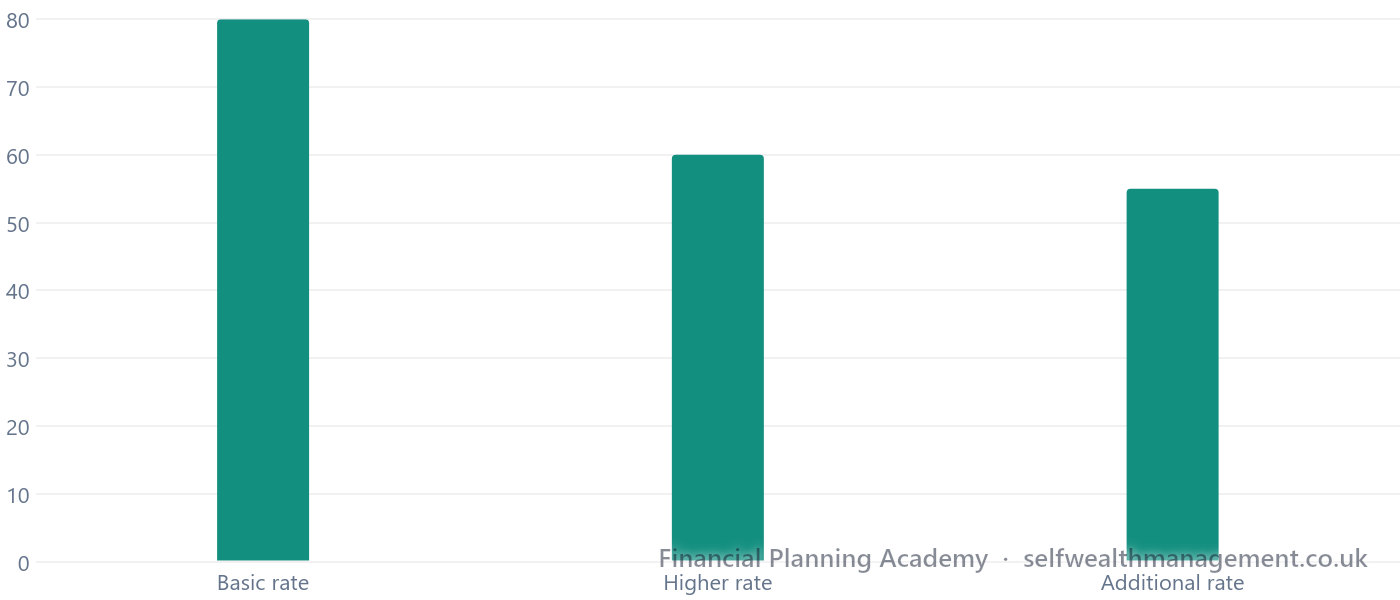
Higher and additional-rate taxpayers can claim more, for themselves
The charity only ever reclaims the basic rate. A higher or additional-rate taxpayer can claim the rest of the relief personally, through self-assessment or a PAYE tax code adjustment — the difference between their own rate and the basic rate, calculated on the grossed-up £100. A higher-rate taxpayer can reclaim £20 for themselves, and an additional-rate taxpayer £25 — bringing the true net cost of that £100 reaching the charity down to £60 or £55 respectively. Unlike the charity's share, this doesn't happen automatically, and is estimated to go unclaimed by a significant number of eligible donors every year.
The basic-rate band gets extended too
Gift Aid donations extend both the basic-rate and higher-rate bands by the grossed-up amount, working in a similar way to pension contributions for the same purpose — bringing down adjusted net income, which can help restore a tapered Personal Allowance, reduce exposure to the 60% trap, or affect the High Income Child Benefit Charge, all covered in earlier chapters.
The same extension applies for Capital Gains Tax, so more of a gain can be taxed at the lower rate.
The condition that catches people out
The donor needs to have paid at least as much Income Tax and/or Capital Gains Tax for that tax year as the charity reclaims through Gift Aid — 25p for every £1 given, so £100 of donations needs at least £25 of qualifying tax. Capital Gains Tax counts, which can matter for someone with a modest income but a large gain, such as a retiree selling shares or a second property. VAT and council tax don't. Falling short — most commonly for someone with a low income and no gains — can mean owing the shortfall back to HMRC directly, not the charity.
Giving shares or property instead of cash
Giving qualifying shares, land or property directly to a charity isn't Gift Aid, but it brings its own relief: no Capital Gains Tax on the gift, plus Income Tax relief on its full market value. That can be worth more than selling the asset and donating the proceeds, where the gain would be taxed first.
A Gift Aid donation can be elected to count as though made in the previous tax year, provided the election is made by the filing deadline for that year's return and enough tax was paid in that year to cover it. This can bring relief forward a full year, or make use of a higher tax rate paid in the earlier year.
For higher-rate taxpayers giving meaningfully to charity, checking whether the personal relief has actually been claimed — not just whether the Gift Aid box was ticked — is worth a few minutes on the next tax return.
- Gift Aid turns an £80 payment into £100 for the charity, at no extra cost to a basic-rate taxpayer.
- Higher and additional-rate taxpayers can reclaim a further amount for themselves — money that often goes unclaimed.
- The donor must have paid enough income tax and Capital Gains Tax to cover what the charity reclaims, or the shortfall may need to be repaid to HMRC.
- Gift Aid also extends the basic-rate band for Capital Gains Tax, and gifts of shares or property to charity attract their own CGT and Income Tax relief.
Educational disclaimer: This information is for educational purposes only and should not be considered financial advice or a recommendation. Investments can fall as well as rise in value, and you may get back less than you invest. Past performance is not a reliable indicator of future results.
Using Your ISA and LISA Allowances Well
When an ISA allowance is used matters almost as much as whether it's used at all, and a LISA can be a genuinely strong retirement option for a specific group of young, high-earning people.
In short: Contributing to an ISA early in the tax year, rather than near the following April, gives up to a year of extra tax-free growth compared to waiting. For a young higher earner whose tapered annual allowance is already fully used, a LISA can be one of the few remaining tax-efficient options for further retirement saving.
Two separate ideas, both about getting more from an ISA or LISA allowance than simply using it.
Why timing within the tax year matters
The £20,000 ISA allowance resets every 6 April, and it's common to see contributions cluster near the following deadline rather than spread across the year. Money contributed early in the tax year gets up to a full year longer inside the tax-free wrapper than the same amount contributed the following March — an advantage that has nothing to do with market timing or predicting returns, just how long money has been sheltered from tax on its growth. Where the money is available, contributing at the start of the tax year, or spreading contributions monthly from April rather than waiting, captures that extra time.
A LISA for a young, fully-tapered high earner
Pensions are usually the strongest tax-efficient option for higher earners — but not always. Someone young enough to still qualify for a Lifetime ISA (opened before 40, contributions allowed to 50) whose annual pension allowance is already fully tapered down to £10,000 and fully used for the year has, for that portion of their saving, no further pension relief available. In that specific situation, a LISA's 25% government bonus can be one of the strongest remaining tax-efficient options, regardless of how high their income is — the same point covered in more detail in the Tax-Efficient Investing guide's LISA chapter, and connected directly to the tapered annual allowance and 60% trap chapters earlier in this Academy. But beware of the 25% withdrawal charge if it is accessed before age 60 for any reason other than buying your first home.
- Contributing to an ISA early in the tax year, rather than near the following deadline, gives up to a year of extra tax-free growth for the same money.
- A LISA can be a genuinely strong retirement option for a young higher earner whose tapered pension allowance is already fully used for the year.
- Both points are about using an allowance well, not just using it — timing and circumstance both change how much value the same contribution delivers.
Educational disclaimer: This information is for educational purposes only and should not be considered financial advice or a recommendation. Investments can fall as well as rise in value, and you may get back less than you invest. Past performance is not a reliable indicator of future results.
The Order of Withdrawals in Retirement
Which pot is drawn from first can matter almost as much for tax as which pots were built up in the first place — and a 2027 rule change may reshape the usual thinking on pensions specifically.
In short: Different pots are taxed differently on the way out, so the order they're drawn in can matter almost as much as how they were built up. A pension can currently deliver up to £16,760 completely tax-free with no other income, though the 2027 IHT changes may mean drawing more from a pension earlier makes sense for some people.
Building up pensions, ISAs and other investments is only half the picture. How money is actually drawn out in retirement — and in what order — can meaningfully affect how much tax ends up being paid along the way.
Why the order matters
Different pots are taxed differently on the way out. ISA withdrawals are entirely tax-free. General Investment Account withdrawals may trigger Capital Gains Tax on any growth, though there's an annual exempt amount to use each year. Pension withdrawals beyond the 25% tax-free element are taxed as income at the marginal rate. Drawing the same amount of spending money from a different combination of these can result in very different tax bills.
The income that arrives regardless
State Pension income, and any defined benefit pension already in payment, arrives automatically once claimed and is taxed as income — it can't usually be switched off. This forms a fixed baseline of taxable income each year, and other withdrawals are typically planned around it, to avoid unnecessarily pushing into a higher tax band.
One commonly discussed approach
Why GIA is often drawn before the ISA
This can look backwards at first — many assume the ISA should be preserved until last. In practice, it's often the opposite. The annual Capital Gains Tax exempt amount doesn't carry forward, so realising GIA gains up to that amount each year uses an allowance that would otherwise be wasted. Money left in an ISA, meanwhile, keeps compounding completely tax-free the longer it stays there. Drawing the GIA down first, and leaving the ISA to keep growing, tends to make better use of both.
A useful number: £16,760
Someone who retires before their State Pension or any defined benefit pension begins, with no other income, can draw a specific amount from a pension entirely tax-free — combining the 25% tax-free cash element with the Personal Allowance covering the rest.
| Gross pension withdrawal | £16,760 |
| 25% tax-free cash | £4,190 |
| Remaining 75%, taxed as income | £12,570 |
| Covered by the Personal Allowance | £12,570 |
| Tax due | £0 |
Based on the 2026/27 Personal Allowance of £12,570. £12,570 ÷ 75% = £16,760 — the point at which the taxable three-quarters of a withdrawal exactly fills the Personal Allowance.
Why this may be changing
Pensions have traditionally been left until last for two reasons: withdrawals beyond the tax-free element are taxed as income, and unused pensions have historically sat outside the taxable estate. From April 2027, that second reason weakens — a large unused pension would then face both inheritance tax and income tax on the same money. Some planners are now considering the opposite approach: withdrawing more during retirement, at a known rate, rather than leaving a pot exposed to that risk later. For someone with no other income, that could mean drawing up to the full basic rate band, not just the Personal Allowance — provided it's genuinely needed or usable elsewhere, and sustainable over the length of a retirement.
| Gross pension withdrawal | £67,027 |
| 25% tax-free cash | £16,757 |
| Remaining 75%, taxed as income | £50,270 |
| Covered by the Personal Allowance | £12,570 |
| Taxed at 20% (basic rate) | £7,540 |
| Effective rate on the whole withdrawal | ~11.3% |
Illustrative, based on 2026/27 thresholds. The blended effective rate stays well below the 20% marginal rate because the tax-free 25% dilutes it.
Investment bonds: an edge case worth knowing
Onshore and offshore investment bonds don't fit neatly into this order at all. Their 5% annual withdrawal facility defers tax rather than avoiding it, and a bond surrendered awkwardly alongside other income in the same tax year can push a chargeable event gain into a higher rate than necessary. Where bonds form part of a retirement income plan, they're usually considered alongside this order rather than simply slotted into it.
A different question for defined benefit pensions
Everything above assumes flexibility over how much taxable income to draw — the kind a drawdown pot allows. That mostly disappears once a defined benefit pension and the State Pension are both in payment, since neither can usually be turned down. This needs a different approach entirely, covered in the earlier chapter on defined benefit pensions.
Managing income within tax bands, not just wrapper order
In practice, this is often less about draining one pot completely before moving to the next, and more about blending: deciding how much total taxable income makes sense for a given tax year, and choosing which combination of sources delivers that.
This is a different question from sequence of returns risk, which is about the order investment returns arrive in during retirement — a market-timing risk, not a tax-planning one. Withdrawal order is about which wrapper to draw from first; sequence of returns risk is about market timing once withdrawals begin. The two interact, but they're solving different problems.
Pension Wise, a free government-backed guidance service delivered by MoneyHelper, offers anyone aged 50 or over with a defined contribution pension a genuinely impartial appointment — by phone, in person, or online — talking through the options and their tax implications, before any decision is made. It's guidance rather than a personal recommendation, but it's free, and pension providers are required to actively point savers toward it before allowing access to a pension.
This is one of the more individual decisions in the whole of financial planning, and the 2027 changes make it more so, not less. It depends on whether income is needed now or can be deferred, health and life expectancy considerations, other family members' tax positions, charitable intentions, whether preserving a pension for inheritance purposes still makes sense once it may sit inside the estate anyway, and market conditions at the time withdrawals begin. A sensible order for one household can be the wrong order for another with an almost identical pot size — and the right order for the same household may look different again after April 2027.
- Different withdrawal sources are taxed differently — ISA withdrawals are tax-free, GIA withdrawals may trigger CGT, and pension withdrawals beyond the tax-free element are taxed as income.
- A pension can currently deliver up to £16,760 completely tax-free with no other income, by combining the 25% tax-free element with the Personal Allowance.
- From April 2027, the traditional case for preserving them until last may weaken — defined benefit pensions raise a different question entirely, covered in their own chapter.
Educational disclaimer: This information is for educational purposes only and should not be considered financial advice or a recommendation. Investments can fall as well as rise in value, and you may get back less than you invest. Past performance is not a reliable indicator of future results.
Bond Withdrawals and Assignment
Beyond the 5% rule, bonds offer other ways to extract value — including assigning ownership to someone else entirely, without triggering a tax charge.
In short: A bond can be assigned to someone else as a genuine gift without triggering any tax charge — the liability simply moves with it, based on the new owner's tax position. A pension contribution made in the same tax year as a bond encashment can also extend the basic-rate band, reducing the tax on the gain.
Earlier chapters covered the 5% annual withdrawal facility available on onshore and offshore bonds. There are other ways to get value out of a bond, and one of them — assignment — doesn't involve a withdrawal at all.
Beyond the 5% rule
A bond can also be partially or fully surrendered beyond the 5% allowance, which crystallises a chargeable event gain immediately, taxed as covered in the earlier chapter on how HMRC stacks income. There are two different ways to do this, and they're not calculated the same way.
Segments vs a straight partial withdrawal
Most bonds are divided into a number of identical segments — sometimes 100 or more. Surrendering whole segments crystallises a chargeable event gain only on those specific segments, leaving the rest of the bond untouched and still deferring tax. A straight partial withdrawal across the whole bond, rather than by segment, is calculated differently and offers less precise control over exactly how much gain is realised in a given tax year. Segment surrender is generally the more deliberate tool of the two.
Assignment: moving a bond without triggering tax
A bond — or individual segments of one — can be legally assigned to someone else entirely. Provided this is a genuine gift, with nothing given in return, assignment is specifically not a chargeable event in itself. The tax bill doesn't disappear; it simply moves with the bond. Whoever now owns it becomes liable for tax on any future chargeable event, based on their own tax position, not the original owner's.
Common uses of assignment
- Assigning to a spouse or civil partner — moving a bond to a lower-earning partner before it's eventually surrendered, so the gain is assessed against their tax band rather than the higher earner's.
- Assigning segments to adult children — a gift that lets the segments eventually be encashed at the child's own tax rate, which may also start the seven-year clock for inheritance tax purposes if intended as part of a wider gifting strategy, as covered in the gifting chapter.
How pension contributions can reduce the tax on a bond withdrawal
A personal pension contribution extends the basic-rate and higher-rate band thresholds by the gross amount contributed, in the tax year it's made. Timed alongside a bond encashment, this means more of the resulting chargeable event gain can fall within a lower tax band than it otherwise would.
It goes further than that. A chargeable event gain counts towards adjusted income, the same figure that determines the tapered annual allowance, and adjusted net income, the figure that determines the Personal Allowance taper, the High Income Child Benefit Charge, and the childcare thresholds covered in an earlier chapter. A single large bond encashment can push someone across one of these lines for that tax year alone, even if their normal income never comes close. A pension contribution made in the same year reduces adjusted net income directly, which can protect several of these thresholds at once — not just reduce the direct tax on the gain itself.
Timing a chargeable event
Because the tax due depends heavily on total income in the specific tax year a gain is realised, the timing of an encashment matters as much as the method. A lower-income year — early retirement, a career break, or a gap before other pension income begins — can be a considerably more tax-efficient time to realise a gain than a year with a full salary. Spreading segment surrenders across several tax years, rather than triggering one large gain in a single year, is a common way of achieving the same outcome more gradually. Top slicing relief, covered in more detail in the Tax-Efficient Investing guide, can also reduce the effective rate on a larger gain, particularly one built up over many years.
Extracting value from a bond well rarely comes down to the bond in isolation. A planner would typically think about whose tax band the eventual gain will fall into, whether a pension contribution could be timed alongside the encashment to extend the basic-rate band, whether segments or a straight partial withdrawal gives more control, whether assignment to a lower-earning family member is worth considering, any inheritance tax implications of a gift, and how the gain interacts with everything else happening in that person's tax year — see the earlier chapters on the order of withdrawals in retirement and how HMRC stacks income.
- Assigning a bond as a genuine gift is not itself a chargeable event — tax is simply deferred until whoever now owns it eventually surrenders it, based on their own tax position.
- Surrendering whole segments, rather than a straight percentage across the entire bond, generally allows more precise control over how much gain is realised in a given tax year.
- A pension contribution made in the same tax year as a bond encashment can extend the basic-rate band, potentially reducing the tax on the gain and protecting other thresholds it might otherwise affect.
Educational disclaimer: This information is for educational purposes only and should not be considered financial advice or a recommendation. Investments can fall as well as rise in value, and you may get back less than you invest. Past performance is not a reliable indicator of future results.
How Family Can Help a First-Time Buyer
Gifted deposits, guarantor arrangements and springboard mortgages solve the same problem in genuinely different ways.
In short: A gifted deposit is money given outright, with no expectation of repayment and no claim on the property — the most common route, and simplest for the lender. A Joint Borrower Sole Proprietor arrangement adds a family member's income to boost affordability without giving them ownership. A springboard or family deposit mortgage locks a family member's savings as security for a fixed period, returned with interest if payments are maintained — help without giving the money away permanently.
Family help with a deposit is now genuinely common — a significant share of first-time buyers get some form of it. There's more than one way to structure that help, each with a different trade-off.
At a glance
| Route | Money returned? | Affects buyer's ownership? |
|---|---|---|
| Gifted deposit | No — given outright | No, buyer owns it outright |
| Joint Borrower Sole Proprietor | N/A — no money changes hands, income only | No, helper isn't on the title |
| Springboard / family deposit mortgage | Yes — after 3-5 years, with interest | No, buyer owns it outright |
The right choice usually comes down to whether the money needs to come back eventually, or is genuinely being given away — covered in more detail below.
A gifted deposit
Money given outright, with no expectation of repayment and no claim on the property afterwards. Lenders require a formal gifted deposit letter confirming this, as part of standard anti-money laundering checks — the gift genuinely has to be a gift, not a loan in a different form. There's no legal cap on the amount, and it can cover part of a deposit or the whole purchase.
Joint Borrower Sole Proprietor arrangements
A family member's income is added to the mortgage application to boost affordability, without them going on the title deeds or gaining any ownership. This has replaced most traditional guarantor mortgages, where a family member simply promised to cover missed payments. Because only the actual buyer appears on the title, first-time buyer status — and the associated Stamp Duty relief covered in a later chapter — isn't affected even if the family member helping already owns their own home.
Springboard and family deposit mortgages
Rather than gifting money outright, a family member places a sum — commonly around 10% of the purchase price — into a savings account linked to the mortgage, or occasionally offers their own property as security instead. The money is locked away for a fixed period, typically three to five years, and returned with interest provided the buyer keeps up with payments. This suits a family member who wants to help without permanently giving the money away, though it does mean that money is inaccessible to them for the length of the arrangement.
Assuming a gifted deposit has no inheritance tax relevance. It's still a gift, using the same rules and exemptions covered in a later chapter on gifting — for most parents gifting a typical deposit, this falls well within the available exemptions, but it's still worth understanding rather than assuming it's simply outside the system.
Which of these suits a particular family usually comes down to one question: does the money need to come back eventually, or is it genuinely being given away? That answer tends to point clearly toward one of the three.
- A gifted deposit is the simplest route — money given outright, with a formal letter confirming no repayment is expected.
- A Joint Borrower Sole Proprietor arrangement boosts affordability using a family member's income, without affecting the buyer's first-time buyer status for Stamp Duty.
- Springboard and family deposit mortgages let a family member help without permanently giving the money away, at the cost of it being locked up for several years.
Educational disclaimer: This information is for educational purposes only and should not be considered financial advice or a recommendation. Investments can fall as well as rise in value, and you may get back less than you invest. Past performance is not a reliable indicator of future results.
Should You Overpay Your Mortgage?
One of the most common financial planning questions — and there's genuinely no universal answer.
In short: There's no universal answer — it depends on current interest rates, tax position, and personal comfort with debt. Unused pension allowance or an unclaimed employer match is often more valuable than either overpaying or investing elsewhere.
This is one of the most common financial planning questions, and it doesn't have a single correct answer for everyone.
The case for overpaying
- The same guaranteed, risk-free return logic covered in the earlier chapter on debt — here, equal to the mortgage interest rate
- Reducing the outstanding balance can improve the loan-to-value bracket at remortgage, covered in more detail below
- A real psychological benefit from reducing debt and building financial security — one that shouldn't be dismissed simply because it doesn't show up in a spreadsheet
The case for doing something else instead
- Long-term investment returns have historically exceeded typical mortgage rates over sustained periods
- Pension contributions carry tax relief that can make them significantly more compelling than either option
- Money invested earlier has longer to compound
- Keeping a liquid emergency fund intact matters more than accelerating overpayments, as covered in the earlier chapters on emergency funds and liquidity
Factors that typically influence this decision
Rather than a single formula, this tends to come down to weighing a handful of factors against each other:
- The current mortgage rate — the higher it is, the more a guaranteed return from overpaying is worth, relative to an uncertain investment return.
- Unused pension allowance or an unclaimed employer match — tax relief and free employer contributions are factors many people weigh well below either mortgage or investing decisions, when arithmetically they often deserve to be weighed first.
- Personal comfort with debt — the psychological value of being mortgage-free is real, even where the pure arithmetic might point elsewhere.
A related factor: loan-to-value
Loan-to-value (LTV) is the ratio of a mortgage to the property's value — a £240,000 mortgage on a £300,000 property is an 80% LTV. Lower LTV ratios generally unlock better mortgage rates, which gives overpaying a secondary benefit beyond the overpayments themselves: crossing into a lower LTV bracket at remortgage can sometimes save considerably more in interest than the overpayments cost, if it tips the mortgage into a materially better rate tier.
Individual tax position tends to matter more here than people expect. Pension allowance and employer contributions sit outside this question entirely for many people, simply because it doesn't occur to them to compare a mortgage decision against a pension one — even though the tax relief involved can be larger than either the mortgage saving or the investment return under consideration. Whatever the arithmetic suggests, it's worth treating as a deliberate, informed choice — made with a clear view of what else that money could be doing — rather than an automatic default.
- There's no universal answer — the case depends on current interest rates, tax position and personal comfort with debt.
- Unused pension allowance or an unclaimed employer match is often more valuable than either overpaying a mortgage or investing elsewhere.
- Overpaying enough to cross into a lower loan-to-value bracket at remortgage can sometimes be worth more than the overpayments alone.
Educational disclaimer: This information is for educational purposes only and should not be considered financial advice or a recommendation. Investments can fall as well as rise in value, and you may get back less than you invest. Past performance is not a reliable indicator of future results.
Should You Fix Your Mortgage?
Fixed-rate mortgages offer certainty; tracker and variable rates offer potential savings and potential risk — there's no reliably correct answer.
In short: Fixed rates offer payment certainty; tracker and variable rates offer potential savings and potential risk. Even professional economists have historically struggled to predict which will turn out cheaper.
Fixed-rate mortgages provide certainty — the payment stays the same regardless of what happens to interest rates.
The trade-off
Tracker or variable mortgages can be cheaper if rates fall, but carry the risk of payments rising if they don't. The right choice depends on budget flexibility, comfort with uncertainty, and the current interest rate environment.
Why nobody can answer this with confidence
There's no reliably correct answer here — even professional economists regularly get interest rate predictions wrong. Anyone presenting a confident forecast about where rates are heading is offering an opinion, not a fact.
- Fixed-rate mortgages offer payment certainty; tracker and variable rates offer potential upside and downside.
- The right choice depends on budget flexibility and personal comfort with uncertainty.
- Interest rate predictions, even from professionals, have historically proved unreliable.
Educational disclaimer: This information is for educational purposes only and should not be considered financial advice or a recommendation. Investments can fall as well as rise in value, and you may get back less than you invest. Past performance is not a reliable indicator of future results.
Remortgaging: Product Transfer or a Full Switch?
When a mortgage deal ends, staying with the same lender is usually faster — but not always the better deal.
In short: A product transfer stays with the current lender, often without a new affordability check, legal work, or valuation — quick, but limited to that lender's own range. A full remortgage switches lender entirely, potentially unlocking a better rate, but with more paperwork and a fresh affordability assessment. Leaving a deal early usually triggers an early repayment charge, commonly 1-5% of the outstanding balance, though a product transfer with the same lender sometimes avoids it.
When a fixed or discounted mortgage deal comes to an end, doing nothing means falling onto the lender's standard variable rate — usually considerably more expensive than either option below.
Product transfer versus a full remortgage
A product transfer moves to a new deal with the same lender — often quick, sometimes entirely online, and frequently without a new affordability check, valuation, or legal work. A full remortgage moves to a different lender entirely, opening up the whole market rather than just one lender's range, but with more paperwork: a fresh affordability assessment, a valuation, and legal work to complete. Getting a quote from the current lender first, then comparing it against the wider market, is usually the sensible starting point before deciding which route to take.
Early repayment charges
Leaving a fixed or discounted deal before it ends usually triggers an early repayment charge, commonly somewhere between 1% and 5% of the outstanding balance — on a £200,000 mortgage, even 1% is £2,000. This needs weighing directly against any savings from a better rate elsewhere; a cheaper rate isn't actually cheaper once a large ERC is factored in. Some lenders waive the charge for a product transfer, particularly close to the end of a deal, though this varies and isn't guaranteed.
Porting: taking a deal to a new property
Porting means taking an existing mortgage rate and terms to a new property when moving home, avoiding both the early repayment charge and a full remortgage. It isn't automatic — it requires requalifying under current affordability rules, and the new property still has to meet the lender's criteria. It's most useful where the existing rate beats what's currently available, or where the ERC would otherwise be substantial.
Waiting until a deal has actually ended before starting to look. Most lenders allow a new rate to be locked in up to six months before the current deal expires, with no penalty either way — if rates fall in the meantime, it's often possible to switch to the better rate before completion; if rates rise, the earlier rate is protected.
- A product transfer is usually quicker and simpler, staying with the current lender; a full remortgage opens up the whole market but involves more paperwork.
- Early repayment charges, commonly 1-5% of the balance, need weighing directly against any savings from switching.
- Rates can usually be locked in up to six months before a deal ends, with no downside either way.
Educational disclaimer: This information is for educational purposes only and should not be considered financial advice or a recommendation. Investments can fall as well as rise in value, and you may get back less than you invest. Past performance is not a reliable indicator of future results.
Stamp Duty Land Tax
Stamp Duty is charged on a sliding scale when buying property — England, Wales and Scotland each set their own rates, and additional properties usually cost more.
In short: SDLT applies in England and Northern Ireland; Wales and Scotland run their own separate systems with different rates and reliefs. Additional-property purchases are taxed differently in each nation too — England and Northern Ireland add a flat surcharge to the standard bands, Scotland adds a flat 8% of the whole price on top of standard LBTT, and Wales uses an entirely separate rate table.
Stamp Duty Land Tax (SDLT) applies to most property purchases in England and Northern Ireland. Scotland and Wales have their own separate equivalents — Land and Buildings Transaction Tax (LBTT) in Scotland, and Land Transaction Tax (LTT) in Wales — with different rates and thresholds from SDLT and from each other.
How it's charged in England and Northern Ireland
SDLT is charged on a sliding scale — different portions of the purchase price are taxed at different rates, similar in structure to how income tax bands work. Standard residential rates from 1 April 2025:
| Property price | SDLT rate |
|---|---|
| Up to £125,000 | 0% |
| £125,001 to £250,000 | 2% |
| £250,001 to £925,000 | 5% |
| £925,001 to £1.5 million | 10% |
| Over £1.5 million | 12% |
Example: a £300,000 purchase at standard rates works out as £0 on the first £125,000, £2,500 on the next £125,000 (2%), and £2,500 on the remaining £50,000 (5%) — a total of £5,000.
First-time buyer relief
From 1 April 2025, the first-time buyer tax-free threshold reduced from £425,000 to £300,000.
| Property price | First-time buyer rate |
|---|---|
| Up to £300,000 | 0% |
| £300,001 to £500,000 | 5% on the portion above £300,000 |
| Over £500,000 | Standard rates apply to the whole value — relief no longer applies |
The additional property surcharge
Buying an additional residential property — a second home or a buy-to-let, where a main residence is retained — attracts a surcharge on top of the standard rates. From 1 April 2025, this surcharge increased from 3% to 5% across all bands.
| Property price | Rate with surcharge |
|---|---|
| Up to £125,000 | 5% |
| £125,001 to £250,000 | 7% |
| £250,001 to £925,000 | 10% |
| £925,001 to £1.5 million | 15% |
| Over £1.5 million | 17% |
The surcharge can usually be reclaimed in full if a previous main residence is sold within 36 months of buying the new one.
Wales: Land Transaction Tax (LTT)
Wales doesn't have a specific first-time buyer discount, though many first-time buyers benefit from the standard 0% band up to £225,000 in the same way any buyer would.
| Property price | LTT rate (main residence) |
|---|---|
| Up to £225,000 | 0% |
| £225,001 to £400,000 | 6% |
| £400,001 to £750,000 | 7.5% |
| £750,001 to £1.5 million | 10% |
| Over £1.5 million | 12% |
Wales: additional properties
Additional properties in Wales don't work the way England, Northern Ireland and Scotland's surcharges do. Rather than adding a flat percentage on top of the standard bands, Wales moved to an entirely separate rate table from 11 December 2024 — with no nil-rate band at all, so every pound is taxed:
| Property price | LTT rate (additional property) |
|---|---|
| Up to £180,000 | 5% |
| £180,001 to £250,000 | 8.5% |
| £250,001 to £400,000 | 10% |
| £400,001 to £750,000 | 12.5% |
| £750,001 to £1.5 million | 15% |
| Over £1.5 million | 17% |
The two tables don't line up with each other at all — a £200,000 additional property is taxed at 8.5% under this table, not simply "the standard 6% band plus a surcharge." A refund of the difference is normally available if a previous main residence is sold within 36 months.
Scotland: Land and Buildings Transaction Tax (LBTT)
Scotland replaced SDLT with its own tax, LBTT, in 2015, administered separately by Revenue Scotland rather than HMRC. Standard residential rates:
| Property price | LBTT rate |
|---|---|
| Up to £145,000 | 0% |
| £145,001 to £250,000 | 2% |
| £250,001 to £325,000 | 5% |
| £325,001 to £750,000 | 10% |
| Over £750,000 | 12% |
First-time buyer relief raises the nil-rate band from £145,000 to £175,000 — a maximum saving of £600. Unlike the England and Northern Ireland relief, Scotland's version has no upper property price limit, so it applies to any qualifying first-time buyer purchase regardless of value.
Scotland: Additional Dwelling Supplement
Scotland's Additional Dwelling Supplement (ADS) — its equivalent of the surcharge on second homes and buy-to-let — adds 8% on top of the standard LBTT bands above, raised from 6% in December 2024. Revenue Scotland calculates it as a separate flat 8% of the whole price added to the standard LBTT bill, but the combined result is identical to simply adding 8 percentage points to every standard band:
| Property price | Combined rate with ADS |
|---|---|
| Up to £145,000 | 8% |
| £145,001 to £250,000 | 10% |
| £250,001 to £325,000 | 13% |
| £325,001 to £750,000 | 18% |
| Over £750,000 | 20% |
Worked example: a £300,000 additional property works out as £11,600 on the first £145,000 (8%), £10,500 on the next £105,000 (10%), and £6,500 on the remaining £50,000 (13%) — a total of £28,600, exactly matching standard LBTT of £4,600 plus a separate flat £24,000 ADS.
It can usually be reclaimed if a previous main residence is sold within 36 months of the new purchase.
Non-UK residents buying in England or Northern Ireland pay an additional 2% surcharge on top of standard SDLT rates. Residency for this purpose is based on spending fewer than 183 days in the UK in the 12 months before the purchase — and a refund of the surcharge may be available if UK residency is established within 12 months afterwards.
- Stamp Duty (SDLT) applies in England and Northern Ireland, with Wales and Scotland running their own separate systems, rates and reliefs.
- First-time buyer relief currently covers the first £300,000 in England and Northern Ireland, and the first £175,000 in Scotland with no upper price limit — Wales has no first-time buyer relief at all.
- Additional-property rules differ by mechanism, not just numbers: England and Northern Ireland add a flat surcharge to the standard bands, Scotland adds a flat 8% of the whole price on top of standard LBTT, and Wales uses an entirely separate rate table — but in all three nations, the extra charge can usually be reclaimed if a previous main residence is sold within 36 months.
Educational disclaimer: This information is for educational purposes only and should not be considered financial advice or a recommendation. Investments can fall as well as rise in value, and you may get back less than you invest. Past performance is not a reliable indicator of future results.
Buy-to-Let as an Investment
A buy-to-let property is taxed very differently from a residential home — and the numbers work differently from a standard mortgage decision too.
In short: Mortgage interest on a buy-to-let is relieved as a 20% tax credit rather than a full deduction, considerably less generous for higher-rate taxpayers than it once was. The additional-property SDLT surcharge and Capital Gains Tax on eventual sale both need factoring in from the outset.
Everything covered so far in this part has assumed a mortgage on a home someone actually lives in. Buying property as an investment — to let out, rather than live in — works under a different set of rules entirely.
Mortgage interest relief works differently
For residential landlords, mortgage interest can no longer be deducted from rental income before calculating tax, as it once could be. Instead, landlords receive a tax credit worth 20% of the mortgage interest paid, regardless of their tax band. For a higher or additional-rate taxpayer, this is considerably less generous than a full deduction would have been — a change that's made buy-to-let noticeably less tax-efficient for higher earners than it was previously.
Stamp Duty on an additional property
Buy-to-let purchases attract the additional property surcharge covered in the previous chapter — currently pushing SDLT rates up considerably compared with a standard residential purchase. This is a substantial upfront cost that needs to be factored into the numbers from the outset, not treated as an afterthought.
Rental income and Capital Gains Tax
Rental income is taxed as income in the usual way, alongside any other earnings. On sale, any gain is subject to Capital Gains Tax, using the annual exempt amount and the applicable CGT rates — both covered in earlier chapters.
A main home benefits from Private Residence Relief (PRR), which usually exempts the entire gain on sale from CGT — a buy-to-let, since it isn't a main residence, doesn't get this at all. It's worth understanding PRR properly rather than treating it as all-or-nothing, because it applies proportionally. If a property was someone's main home for only part of the time they owned it — they let it out for a few years before selling, for example — only the gain relating to the period it was genuinely their main residence is exempt; the rest is taxable in the normal way. The final nine months of ownership are always treated as exempt regardless of actual use, and certain periods of absence (working away, for instance) can still qualify. This partial PRR calculation is the reason a former home that's later rented out, or a buy-to-let someone eventually moves into, needs careful CGT calculation on sale rather than an assumption of either full exemption or no exemption at all.
How landlords sometimes hold property differently
Some landlords, particularly those with several properties, hold them through a limited company rather than personally — since companies pay corporation tax rather than income tax on rental profit, and retain full mortgage interest deductibility. This comes with its own costs and complexity, including potentially two layers of tax when profit is eventually extracted from the company, and is generally a decision made with an accountant rather than a straightforward default.
Furnished holiday lets: a different category again
Furnished holiday lettings were historically taxed more like a trading business than an ordinary rental — full mortgage interest deductibility, and eligibility for certain pension and Capital Gains Tax reliefs not available to standard buy-to-let. This distinct treatment has been abolished, which is a reminder that property tax rules in this area have changed meaningfully in recent years and are worth checking current status on rather than assuming past treatment still applies.
Comparing buy-to-let returns purely on rental yield, without factoring in the mortgage interest tax credit change, the additional SDLT surcharge, and Capital Gains Tax on eventual sale. A property that looks like a strong income return on paper can look very different once all of these are actually accounted for.
Buy-to-let sits at the intersection of several chapters in this Academy at once — mortgage decisions, Stamp Duty, Capital Gains Tax, and how rental income interacts with the tapered annual allowance or the 60% trap if it pushes someone's income higher. It rarely makes sense to look at the property in isolation from the rest of someone's tax position.
- Mortgage interest on a buy-to-let is relieved as a 20% tax credit, not a full deduction — considerably less generous for higher and additional-rate taxpayers than it once was.
- Buy-to-let purchases attract the additional property Stamp Duty surcharge, a substantial upfront cost worth factoring in from the outset.
- Private Residence Relief applies proportionally, not all-or-nothing — a property that was only sometimes a main home only gets relief for that portion of the gain.
Educational disclaimer: This information is for educational purposes only and should not be considered financial advice or a recommendation. Investments can fall as well as rise in value, and you may get back less than you invest. Past performance is not a reliable indicator of future results.
Property as an Investment: Why the Numbers Have Changed
Bricks and mortar made one generation genuinely wealthy — but the specific conditions that did it have mostly gone, and the case for property today looks meaningfully different.
In short: Property performed exceptionally well for people who bought roughly between the mid-1990s and mid-2000s, helped by explosive real house price growth, no stamp duty surcharge on second homes, full mortgage interest relief, and generous capital gains tax reliefs — none of which apply today in the same way. Property isn't a bad investment, but the numbers behind it have genuinely changed, and it's worth weighing against the alternatives rather than assuming it still works the way it once did.
The previous chapter covered how buy-to-let is taxed today. This one asks a different question: how does that compare with how things used to work, and is property still the investment people often assume it is?
The previous chapter covered how buy-to-let is taxed today. This one asks a different question: how does that compare with how things used to work, and is property still the investment people often assume it is?
Then and now
| Mid-1990s to mid-2000s | Today | |
|---|---|---|
| Real house price growth | ~10% a year | Roughly flat to negative over the last 20 years |
| Stamp duty on a second home | None — same rate as any purchase | 5% surcharge on top of standard rates |
| Mortgage interest relief | Fully deductible before tax | 20% tax credit only, see the previous chapter |
| Capital gains tax | Indexation allowance + taper relief, up to 40% off a long-held gain | Neither applies — flat rate only |
| Regulation | Minimal | Deposit protection, licensing, EPC rules, Renters' Rights Act |
Individually, each change is often described as a minor adjustment. Put together, they add up to a genuinely different proposition than the one that made property look so reliably good for so long.
The practical downsides, beyond the tax changes
Property carries costs that a shares-and-funds portfolio simply doesn't:
- Illiquid — selling can take months, not days, and isn't guaranteed to happen at a chosen time.
- Inaccessible in smaller amounts — there's no equivalent of selling a few shares to cover an unexpected bill.
- Genuine hassle — tenants, repairs, agents, compliance paperwork.
- Void periods — a mortgage still needs paying with no rental income coming in.
- Unpredictable costs — a boiler, a roof, a damp problem — in a way a diversified portfolio's expenses generally don't.
When it might still make sense — and when it might not
None of this makes property a bad investment — it makes it one worth weighing against the alternatives on its current merits, not on what it delivered for an earlier generation:
- Already own a family home with no other investments or pension provision? Diversifying may do more than a second property — concentrating everything in one asset carries its own risk.
- Value being able to access money at short notice? Illiquidity is a real cost, not just a technicality.
- Don't want the hassle of being a landlord? That's allowed to weigh against the numbers, not just sit outside them.
- Rental income would push into a higher tax band once counted on a gross basis? The property may be quietly loss-making once every cost is properly accounted for.
The idea that property "always goes up" is really a description of one specific historical period, not a permanent feature of the UK market. Real house price growth over the last two decades has been far more modest than the mid-1990s to mid-2000s stretch that shaped a lot of common wisdom about property — and there's no guarantee it returns to that earlier pace.
The right comparison isn't "property versus doing nothing" — it's property against the actual alternatives available: paying down debt, pension contributions with their own tax relief, or a diversified portfolio. Each carries a different mix of return, cost, tax treatment, and liquidity, covered in earlier chapters on investing and pensions.
- Property performed exceptionally well for buyers roughly between the mid-1990s and mid-2000s, helped by real house price growth of around 10% a year, no stamp duty surcharge, full mortgage interest relief, and generous CGT reliefs that have since been abolished.
- Nearly all of those favourable conditions have reversed — a 5% stamp duty surcharge, a 20% tax credit instead of full mortgage interest relief, no indexation or taper relief on capital gains, more regulation, and real house price growth that's been flat to negative over the last two decades.
- Property carries genuine costs beyond tax — illiquidity, hassle, void periods, and unpredictable maintenance — worth weighing against the alternatives on today's merits rather than what property delivered for an earlier generation.
Educational disclaimer: This information is for educational purposes only and should not be considered financial advice or a recommendation. Investments can fall as well as rise in value, and you may get back less than you invest. Past performance is not a reliable indicator of future results.
Rent a Room Relief: Letting Part of Your Home Tax-Free
Up to £7,500 a year from a lodger or paying guest in your own home can be entirely tax-free, but claiming it means giving up any deduction for the costs of having them there.
In short: Rent a Room Relief lets someone earn up to £7,500 a year (£3,750 each if shared) completely tax-free from letting a furnished room in their own main home — to a lodger or a paying guest such as an Airbnb visitor. It applies automatically below that threshold. Above it, there's a genuine choice between paying tax only on the amount over £7,500 with no expenses deducted, or working out actual profit properly with real costs deducted — whichever comes out cheaper.
This is a different scenario from buying a second property — it's about letting out part of the home someone already lives in, and it comes with its own, genuinely generous, allowance.
How it works
Rent a Room Relief exempts up to £7,500 of gross income a year from letting a furnished room in a main or only home — whether to a long-term lodger or a short-term paying guest such as an Airbnb visitor. Below that threshold, it's automatic: nothing needs to be reported to HMRC, and no tax is due, unless a Self Assessment return is already required for other reasons. If two people in the same home both receive income from letting rooms — a couple, for example — the threshold is halved to £3,750 each, not doubled to £15,000 between them.
What qualifies
The relief only applies to a furnished room in the home someone actually lives in as their main residence. A separate, self-contained annexe doesn't qualify, and neither does a second property that isn't lived in — that income falls under ordinary property rules instead. It applies equally to a traditional lodger and to short-term guests through a platform like Airbnb, as long as the room being let is genuinely part of the home being lived in.
The choice once income goes over £7,500
Above the threshold, there are two ways to be taxed, and it's worth working out both rather than assuming one is better. The default, once in the scheme, is to pay tax only on the amount above £7,500, with no deduction for any costs at all — simple, but potentially expensive if the actual costs of having a lodger are high. The alternative is to opt out of Rent a Room Relief for that property and be taxed the normal way instead — income minus actual allowable expenses, such as a share of insurance, cleaning, wear and tear, and a 20% tax credit on any relevant mortgage interest, the same restricted relief that applies to other residential lettings. Whichever comes out cheaper can be chosen each year — this isn't a one-off, permanent decision.
A rough way to think about which is better
Rent a Room Relief tends to work out better when actual costs are low relative to the income — a lodger in a spare room with minimal extra expense, for example. Claiming actual expenses tends to work out better when genuine costs are high relative to income — significant mortgage interest, meaningful running costs, or a property let for enough of the year that the numbers add up differently. A quick comparison most years is often enough to tell which applies, without needing to track every receipt.
Someone with a lodger paying close to £7,500 a year, and few real costs beyond normal household bills, is usually well served by simply letting the relief apply automatically. It's only worth doing the actual-expenses comparison when income is meaningfully above the threshold, or when genuine costs — particularly mortgage interest, covered in the earlier chapter on property as an investment — are substantial.
- Up to £7,500 a year (£3,750 each if shared) from letting a furnished room in a main home is tax-free and automatic, with no reporting needed below that threshold.
- It only applies to a room in a home someone actually lives in — not a separate annexe or a second property, and it applies equally to long-term lodgers and short-term guests.
- Above £7,500, there's a genuine choice between paying tax only on the excess with no expenses deducted, or claiming actual expenses instead — worth comparing each year rather than defaulting to one method.
Educational disclaimer: This information is for educational purposes only and should not be considered financial advice or a recommendation. Investments can fall as well as rise in value, and you may get back less than you invest. Past performance is not a reliable indicator of future results.
Wills — Why They Matter
Without a valid Will, an estate is distributed according to a fixed legal formula — one that may look nothing like what its owner would have chosen.
In short: Without a valid Will, an estate is distributed by fixed intestacy rules, not personal wishes — and an unmarried partner has no automatic right to inherit anything, however long the relationship lasted. Pension nominations, trusts and jointly-owned property all sit outside a Will and need checking separately.
A Will directs how an estate is distributed, appoints executors to carry that out, and can appoint guardians for children. Despite this, a large proportion of UK adults don't have a valid one in place.
What happens without a Will
Dying without a valid Will means an estate is distributed according to intestacy rules — a fixed legal formula that takes no account of personal wishes. One of the most surprising consequences: unmarried partners have no automatic entitlement under intestacy rules at all, regardless of how long the relationship lasted or how intertwined the finances were. Everything can pass to other relatives instead, even a estranged one, while a long-term partner receives nothing by default.
What a Will doesn't control
Not everything passes through a Will. Pension nominations, life insurance written in trust, and jointly-owned property held with rights of survivorship all pass by their own separate rules, regardless of what a Will says. A complete plan usually means checking all of these line up with the same overall intentions, not just the Will itself.
Keeping it current
Marriage generally revokes an existing Will automatically, which catches some people out. Divorce doesn't revoke a Will, but has specific effects on how it's interpreted. Reviewing a Will after any major life change — marriage, divorce, a new child, a house move — is a small task that can prevent a significant mismatch later.
A Will isn't necessarily the final word
Beneficiaries can redirect some or all of what they've inherited using a Deed of Variation, provided it's done within two years of death, includes the correct tax statement, and everyone whose entitlement is reduced by the change agrees to it. Done correctly, HMRC treats the redirected assets as though the deceased had left them that way in the first place — not as a fresh gift from the beneficiary giving them up, which means no new seven-year clock starts running. This applies whether the estate was distributed under a Will or under intestacy.
Common uses include redirecting an inheritance to skip a generation entirely, passing it straight to grandchildren rather than through a beneficiary who doesn't need it and would otherwise face inheritance tax on it twice; or increasing a gift to charity to reach the 10% threshold covered in a later chapter, after the fact. HMRC needs notifying within six months if the variation increases the IHT payable — but not if it doesn't.
Under intestacy rules, an unmarried partner has no automatic legal right to inherit anything from their partner's estate — no matter how long they lived together or how shared their finances were. Only marriage or civil partnership carries automatic intestacy rights.
- Without a valid Will, an estate is distributed by fixed intestacy rules, not personal wishes.
- Unmarried partners have no automatic entitlement under intestacy rules, regardless of relationship length, and pension nominations, trusts and jointly-owned property all sit outside a Will and need checking separately.
- A Deed of Variation lets beneficiaries redirect an inheritance within two years of death, treated by HMRC as though the deceased had left it that way originally — useful for skipping a generation or topping up a charitable gift after the fact.
Educational disclaimer: This information is for educational purposes only and should not be considered financial advice or a recommendation. Investments can fall as well as rise in value, and you may get back less than you invest. Past performance is not a reliable indicator of future results.
Lasting Power of Attorney
A Lasting Power of Attorney protects against loss of mental capacity — a risk at any age, not just later in life.
In short: An LPA protects against loss of mental capacity, a distinct risk from those covered by a Will, and can only be set up while capacity still exists. Without one, even a spouse has no automatic right to manage someone's finances — a Court of Protection application is required instead.
Most estate planning conversations focus on death. A Lasting Power of Attorney (LPA) covers something different: the possibility of losing the ability to manage decisions while still alive.
The two types
- Property and Financial Affairs LPA — covers decisions about money, property and finances.
- Health and Welfare LPA — covers decisions about medical treatment and daily care, and only takes effect if capacity is genuinely lost.
What happens without one
Without an LPA in place, family members have no automatic right to manage someone's finances or make decisions on their behalf, even a spouse. Instead, an application has to be made to the Court of Protection — a process that's typically slower, more expensive, and considerably less flexible than an LPA arranged in advance, since the court appoints and supervises a deputy rather than allowing the individual to have chosen their own attorney beforehand.
Why this isn't only a later-life consideration
Mental capacity can be lost at any age, through illness or injury, not only through conditions associated with later life. LPAs are commonly set up well before retirement for exactly this reason — it's a document that only matters if it's needed, but can't be put in place after it's needed.
Turning 18 resets this for parents too
This catches parents out specifically. The moment a child turns 18, a parent has no more automatic authority over their finances or medical decisions than a stranger would — regardless of having managed everything on their behalf for the previous eighteen years. An LPA is one of the few ways an adult child can proactively hand that authority back to a parent, should it ever genuinely be needed.
Assuming a spouse or adult child can automatically step in and manage finances if capacity is lost. Without an LPA, even a spouse has no automatic legal authority over jointly held or separately owned assets — a Court of Protection application is required, which takes considerably longer than most people expect.
- An LPA protects against loss of mental capacity, not just death — a distinct risk from those covered by a Will.
- Without one, family members have no automatic right to manage finances or decisions on someone's behalf, even a spouse — or a parent, once a child turns 18.
- LPAs can only be set up while capacity exists, which is why they're often arranged well in advance.
Educational disclaimer: This information is for educational purposes only and should not be considered financial advice or a recommendation. Investments can fall as well as rise in value, and you may get back less than you invest. Past performance is not a reliable indicator of future results.
Understanding Inheritance Tax
IHT is charged at 40% on the value of an estate above available allowances — and rising house prices mean it's no longer a concern only for the very wealthy.
In short: IHT is charged at 40% on estate value above available allowances, and rising house prices mean it's no longer a concern only for the very wealthy.
Inheritance tax is charged on the estate of someone who has died, at a standard rate of 40% on the value above available allowances.
Why more people are affected than expect to be
With house prices having risen significantly over recent decades, more estates are being brought into scope than ever before. IHT is no longer exclusively a concern for the very wealthy — a family home in many parts of the country, combined with ordinary savings and pensions, can bring a fairly typical estate within reach of the tax.
- Inheritance tax is charged at 40% on estate value above available allowances.
- Rising house prices mean more estates are affected than in the past.
- IHT planning is increasingly relevant well beyond very wealthy families.
Educational disclaimer: This information is for educational purposes only and should not be considered financial advice or a recommendation. Investments can fall as well as rise in value, and you may get back less than you invest. Past performance is not a reliable indicator of future results.
The Nil-Rate Band and Residence Nil-Rate Band
Between the two main allowances, a couple can potentially pass up to £1 million free of inheritance tax.
In short: Between the nil-rate band and residence nil-rate band, a married couple can potentially pass up to £1 million free of inheritance tax. The residence nil-rate band tapers away for estates above £2 million — gone entirely at £2.35 million for one person, or £2.7 million for a surviving spouse with a transferred allowance.
The nil-rate band is the amount that can pass free of inheritance tax — currently £325,000 per person.
Combining allowances as a couple
Married couples and civil partners can combine their allowances, potentially passing up to £650,000 free of IHT. Any unused nil-rate band from a deceased spouse or civil partner can typically be transferred to the survivor.
The residence nil-rate band
An additional allowance of up to £175,000 may apply when a main residence passes to direct descendants — children or grandchildren. Combined with the nil-rate band, a couple could potentially pass up to £1 million free of inheritance tax.
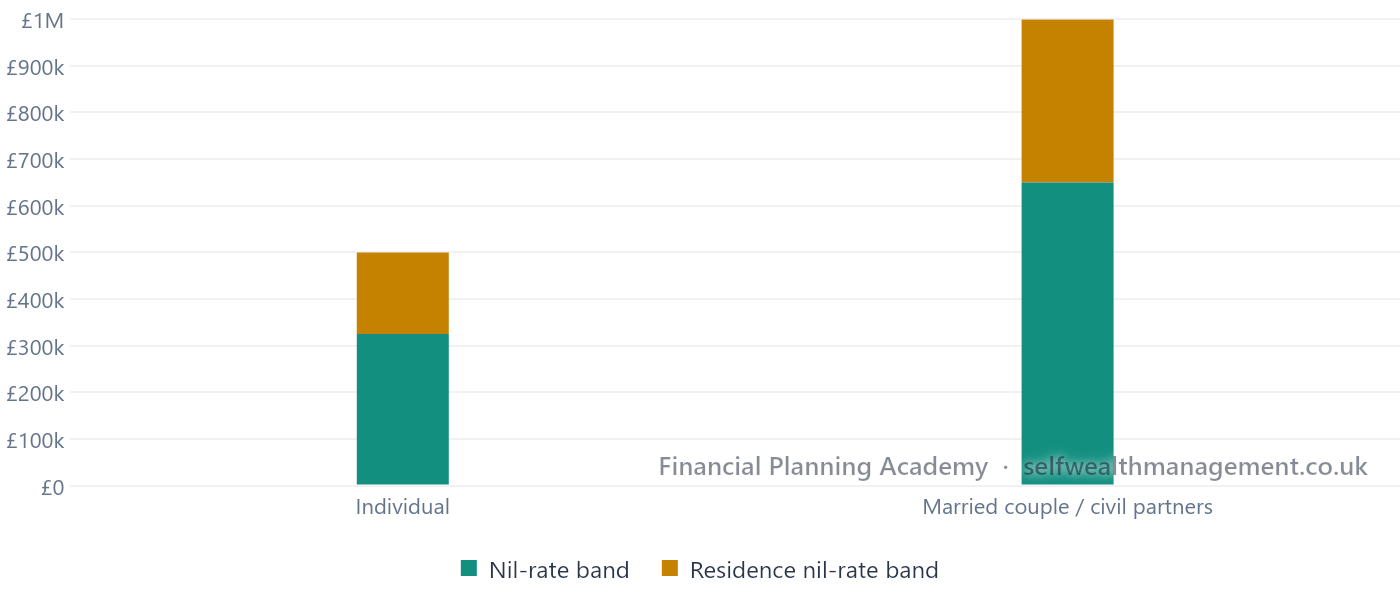
The residence nil-rate band is reduced by £1 for every £2 that an estate is worth over £2 million, measured after debts but before reliefs and exemptions (like Business Relief investments). For one person, the full £175,000 is gone at £2.35 million; for a surviving spouse who has also inherited their late partner's unused allowance (up to £350,000 in total), it's gone at £2.7 million. For a couple, the test applies to the second person's estate on its own — including whatever they inherited — so it's worth knowing for larger estates, where the benefit can vanish just when it might otherwise matter most.
A key distinction is that it only applies to your estate when you die, so completed lifetime gifts aren't counted in that £2 million figure. For example, if someone had an estate of £2.5 million and made a £500,000 gift the day before they died, there would still be inheritance tax to pay on the gift (because it's within seven years of death), but it would reduce their estate to £2 million, reinstating their full residence nil-rate band. The gift has to be genuine, though: if the giver keeps benefiting from what they've given away, it still counts as part of the estate.
Downsizing doesn't automatically lose it
Selling the family home, downsizing to something smaller, or moving into care might look like it forfeits the residence nil-rate band entirely — but a "downsizing addition" can preserve some or all of it, provided the former home would have qualified had it been kept until death, the move happened on or after 8 July 2015, and at least some of the estate still passes to direct descendants. The addition broadly restores what would otherwise have been lost, even though the actual property is no longer part of the estate. The calculation itself is genuinely complex, and has to be claimed by the executors using form IHT435 within two years of death — this is one to get right with professional help rather than assume.
- The nil-rate band is currently £325,000 per person, or up to £650,000 combined for a married couple.
- The residence nil-rate band can add up to £175,000 when a home passes to direct descendants, and tapers away completely at £2.35 million for one person's estate, or £2.7 million where a spouse's unused allowance has been transferred.
- Downsizing, selling, or moving into care doesn't automatically lose the residence nil-rate band — a downsizing addition can preserve it, though executors need to actively claim it within two years of death.
- The nil-rate band, the residence nil-rate band and the £2 million threshold are all frozen until 5 April 2031
Educational disclaimer: This information is for educational purposes only and should not be considered financial advice or a recommendation. Investments can fall as well as rise in value, and you may get back less than you invest. Past performance is not a reliable indicator of future results.
Gifting Rules and Exemptions
Gifts generally fall outside the estate after seven years — but several exemptions apply immediately, with no wait at all.
In short: Gifts generally fall outside the estate after seven years, with tapered relief reducing the tax rate — not the gift's value — in years three to seven. Several exemptions, including regular gifts from surplus income, apply immediately with no wait at all.
Gifts generally fall outside the estate if the donor survives for seven years — commonly known as the seven-year rule. Gifts made three to seven years before death may benefit from tapered relief on the IHT charge.
How taper relief actually works
Taper relief only reduces the rate of tax charged on a gift — it doesn't reduce the value of the gift itself, and it only applies where the gift, combined with others in the seven years before death, exceeds the nil-rate band.
| Years before death | Taper relief | Effective IHT rate |
|---|---|---|
| Less than 3 years | 0% | 40% |
| 3 to 4 years | 20% | 32% |
| 4 to 5 years | 40% | 24% |
| 5 to 6 years | 60% | 16% |
| 6 to 7 years | 80% | 8% |
| 7 years or more | 100% | 0% (fully exempt) |
A common misconception: taper relief only reduces the tax rate charged, not how much of the nil-rate band the gift uses up. A large gift that dies within three years still uses its full value against the nil-rate band, even though no taper relief applies to it.
Exemptions that apply immediately
- £3,000 annual exemption — gifts up to this amount each tax year are immediately exempt; unused allowance from the previous year can be carried forward.
- Small gifts — up to £250 per person per year, to any number of individuals.
- Wedding gifts — up to £5,000 from a parent, £2,500 from a grandparent, £1,000 from anyone else.
- Gifts from surplus income — regular gifts that don't affect standard of living can be immediately exempt, provided they're properly documented.
Why the surplus income exemption is often underused
Regular gifting from income, properly documented, can be highly effective over time with no seven-year wait at all — but it requires genuinely being surplus income, not capital, and needs a clear paper trail. It's one of the more powerful exemptions available, and one of the least well known.
Paying school or university fees: it depends who's paying
A parent paying a child's tuition, rent, or reasonable living costs during full-time education is generally treated by HMRC as fulfilling a parental duty of maintenance — this isn't even categorised as a gift in the first place, so it carries no IHT implications at all, regardless of the amount, provided it's reasonable and genuinely connected to need.
Grandparents don't get the same treatment. Support from a grandparent — even for exactly the same tuition or living costs — is generally treated as an ordinary gift, and needs to fall under one of the exemptions above to avoid IHT implications. Regular fee payments made directly to a school or university are one of the cleanest, most naturally evidenced ways to use the surplus income exemption specifically: predictable, regular, and easy to document with a clear paper trail — exactly what that exemption wants to see.
Income funds versus accumulation funds, for surplus income gifting
The surplus income exemption specifically requires the gift to come from income, not capital. This makes fund choice genuinely relevant for anyone planning to rely on it: an income share class distributes dividends or interest as cash, which counts as income for this purpose, while an accumulation share class retains and reinvests that income within the fund, where it shows up as capital growth instead. Someone wanting to maximise what they can gift under this exemption may deliberately favour income funds over accumulation funds for that reason, even though the underlying investment is otherwise identical.
Junior ISAs as a form of gifting
Paying into a child's Junior ISA — up to £9,000 a year — is itself a gift, using the same exemptions covered above, and permanently leaves the contributor's estate once paid in. It's one of the cleaner ways to combine reducing an estate with giving a child a genuine head start: the money is locked away until they turn 18, growing completely tax-free in the meantime, with a clear paper trail that suits the surplus income exemption particularly well if contributions are made regularly.
A pension contribution goes further, but locks up for far longer
A pension contribution for a child works under the same non-earner rules covered in the earlier chapter on pension allowances — up to £2,880 paid in becomes £3,600 inside the pension immediately, with the government's 20% top-up added automatically. Pound for pound, that makes it more immediately efficient than a Junior ISA contribution, which gets no equivalent top-up. The trade-off is access: a Junior ISA becomes the child's to use at 18, while pension money stays locked away for decades, inaccessible until well into their working life.
Gifting an asset that's grown in value — a property, a shareholding — is a disposal for Capital Gains Tax purposes, even though no money changes hands, and can trigger an immediate CGT bill. If the donor then dies within seven years, the gift can also fail as a Potentially Exempt Transfer and be pulled back into the estate for inheritance tax. That's a real risk of paying both taxes on the same asset. Assets are revalued to market value on death for CGT purposes, with no CGT due on the historic gain — so simply keeping the asset until death would have avoided the CGT charge entirely, even though gifting felt like the more proactive, tax-efficient move at the time.
- Gifts generally fall outside the estate after seven years, with tapered relief in years three to seven.
- Several exemptions — annual, small gifts, wedding gifts, and surplus income — apply immediately with no wait, and a parent paying a child's education or living costs generally isn't a gift at all, unlike the same support from a grandparent.
- Gifting an appreciating asset can trigger CGT immediately, and if death follows within seven years, the same asset can also face inheritance tax — a risk that simply holding it until death would have avoided.
Educational disclaimer: This information is for educational purposes only and should not be considered financial advice or a recommendation. Investments can fall as well as rise in value, and you may get back less than you invest. Past performance is not a reliable indicator of future results.
Giving to Charity and the 10% Rule
Leaving at least 10% of a net estate to charity reduces the IHT rate on the remainder from 40% to 36% — and can sometimes leave more to family overall.
In short: Leaving at least 10% of a net estate to charity reduces the IHT rate on the rest from 40% to 36%. For larger estates, reaching that threshold can sometimes leave more to family overall, not less.
Charitable giving reduces inheritance tax in two distinct ways.
Two separate benefits
- Full exemption — money left to a registered charity in a Will falls completely outside the taxable estate.
- The 10% rule — leaving at least 10% of the net estate to charity reduces the IHT rate on the remainder from 40% to 36%.
A counterintuitive result
For larger estates, this creates a genuine planning opportunity. In some cases, increasing a charitable gift to reach the 10% threshold can actually leave more to family beneficiaries after tax than a smaller charitable gift — because the rate reduction on the rest of the estate more than compensates for the larger gift. It's a rare case where giving more away can mean family receives more too.
- Gifts to registered charities are fully exempt from inheritance tax.
- Leaving at least 10% of a net estate to charity reduces the IHT rate on the rest from 40% to 36%.
- Reaching the 10% threshold can sometimes leave more to family overall, not less.
Educational disclaimer: This information is for educational purposes only and should not be considered financial advice or a recommendation. Investments can fall as well as rise in value, and you may get back less than you invest. Past performance is not a reliable indicator of future results.
A Practical Order for IHT Planning
IHT planning typically works through a rough hierarchy of strategies, broadly moving from simplest to most complex.
In short: IHT planning typically moves from simplest to most complex — spending and gifting first, then Business Relief and trusts as two comparable routes, then EIS for those comfortable with higher risk. The right combination depends on the whole picture, not just the size of the estate.
IHT planning typically works through a hierarchy of strategies, though the right combination depends heavily on individual circumstances.
A rough order of strategies
Business Relief and trusts aren't really a strict sequence — they're two different routes to a similar goal, and which one comes first depends on the individual. Both are commonly considered before EIS, which carries the most investment risk of the three.
Business Relief and trusts sit level with each other — different tools solving a similar problem — before both potentially feeding into EIS for those comfortable with higher risk. Spending and gifting more remains the starting point.
The detail behind each step
- Spending and gifting more — annual exemptions, gifts from surplus income, and increased personal expenditure are often the starting point. This can be highly effective over time with no seven-year wait.
- Business Relief (BR) — certain qualifying investments attract 100% IHT relief after two years, up to £2.5m, and 50% in excess of that - AIM-listed shares attract just 50% IHT relief from the first pound. Unlike a trust, these assets remain accessible to the investor, though the underlying investments typically carry meaningfully higher risk than a trust holding conventional assets.
- Trusts — assets placed in trust may be removed from the estate over time, and can hold conventional, diversified assets rather than being tied to specific higher-risk investments. Entry charges, periodic charges and ongoing administration make this a more complex route than BR, and the settlor typically gives up direct access to the assets — covered in full in the next chapter.
- Enterprise Investment Scheme (EIS) — can qualify for Business Relief alongside separate income tax and capital gains tax reliefs. Higher risk than either "standard" BR investments or trusts, and suitable only for appropriate investors.
- Charitable legacy in a Will — leaving 10% or more of the net estate to charity, as covered in the previous chapter.
- Whole of life insurance in trust — a different kind of strategy entirely. Rather than reducing the eventual bill, it insures against it, providing the cash to pay HMRC quickly without forcing a rushed sale of assets — covered in the Protection chapters.
The right strategy depends on the size of the estate, age and health, access needs, family circumstances, and the interaction with pension planning — particularly given the 2027 changes to how pensions are treated for IHT. Business Relief and trusts genuinely aren't a strict either-before-the-other choice: BR is administratively simpler and faster to qualify, but trusts can hold conventional assets rather than forcing a shift into higher-risk investments — which one comes first depends on how much risk someone is comfortable with, not just how complex the paperwork is. Whole of life cover sits apart from the rest: it's often used alongside these strategies, not instead of them, funding whatever liability remains once gifting and structural planning have done what they can. This is rarely a single-strategy decision; most plans combine several of these at once.
- IHT planning typically moves from simplest to most complex — gifting first, more structured tools later.
- Business Relief offers 100% IHT relief after two years while keeping assets accessible, unlike a trust.
- Whole of life insurance in trust takes a different approach entirely — insuring against the bill rather than reducing it, often used alongside the other strategies rather than instead of them.
Educational disclaimer: This information is for educational purposes only and should not be considered financial advice or a recommendation. Investments can fall as well as rise in value, and you may get back less than you invest. Past performance is not a reliable indicator of future results.
EIS: A High-Risk Way to Manage a Large Gain
A genuinely powerful stack of reliefs — income tax, CGT deferral, inheritance tax, and loss protection — attached to some of the riskiest, least accessible investments available.
In short: EIS offers 30% income tax relief, deferral of a capital gain from another asset, Business Relief for inheritance tax after two years, and loss relief if the investment fails. It's often used when realising a large capital gain. In exchange, the underlying investments are genuinely high risk and hard to access — this isn't a relief to chase without being comfortable with losing the money.
The Enterprise Investment Scheme (EIS) offers one of the more powerful stacks of tax relief available — attached to some of the riskiest investments a portfolio can hold.
What it actually is
EIS shares are unquoted stakes in small, early-stage trading companies. Some will do very well; a meaningful proportion will fail outright. The reliefs exist specifically because the underlying risk is real, not incidental to it.
The relief stack
- Income tax relief — 30% of the amount invested, up to £1 million a year (£2 million if the excess goes into knowledge-intensive companies), and can be carried back to the previous tax year.
- Tax-free growth — any gain on the EIS shares themselves is entirely free of Capital Gains Tax, provided income tax relief was claimed and the shares are held at least three years.
- CGT deferral — a gain from selling something else entirely can be deferred by reinvesting it into EIS shares, within one year before to three years after the original gain. This delays the tax, it doesn't remove it — the deferred gain becomes chargeable again on certain events, most commonly selling the EIS shares.
- Inheritance tax relief — EIS shares can qualify for Business Relief after two years. From April 2026, 100% relief applies to the first £2.5 million of combined Business Relief and Agricultural Relief assets, with 50% relief above that — an effective 20% rate on the excess, not the standard 40%.
- Loss relief — if the investment fails, the loss net of income tax relief already claimed can be set against income tax or CGT, substantially softening a bad outcome.
A worked example of loss relief
An additional rate taxpayer investing £100,000 receives £30,000 of income tax relief, bringing the net cost to £70,000. If the investment fails completely, loss relief at 45% on that £70,000 recovers a further £31,500 — leaving a true net loss of roughly £38,500.
Why it's often used against a large gain
Someone facing a large Capital Gains Tax bill — from selling a business, a second property, or a share portfolio — can reinvest that gain into EIS shares, deferring the CGT while also picking up 30% income tax relief on the same money. If the investor dies still holding the shares, the deferred gain is washed out completely, not just delayed — genuinely eliminated, provided they were still held and still qualified.
Tax relief is a consolation for risk, not a reason to take it. EIS investments are illiquid — there's no ready market to sell out of early — and the underlying companies genuinely can fail. The reliefs make a bad outcome less bad; they don't make the underlying risk disappear.
A planner would typically only consider EIS once the more straightforward reliefs — pensions, ISAs, the CGT annual exemption — are already being used, and only where the investor is genuinely comfortable with the possibility of losing the money invested.
- EIS combines 30% income tax relief, CGT deferral, inheritance tax relief after two years, and loss relief if the investment fails.
- From April 2026, the 100% inheritance tax relief is capped at £1 million combined with other Business Relief and Agricultural Relief assets, dropping to 50% above that.
- The underlying investments are genuinely high risk and illiquid — the relief stack softens a loss, it doesn't remove the risk of one.
Educational disclaimer: This information is for educational purposes only and should not be considered financial advice or a recommendation. Investments can fall as well as rise in value, and you may get back less than you invest. Past performance is not a reliable indicator of future results.
Understanding Trusts
Trusts range from a simple bare arrangement to specialist structures built specifically for inheritance tax planning — and the differences between them matter far more than the word "trust" alone suggests.
In short: A bare trust gives a beneficiary an absolute right to the assets; a discretionary trust leaves that decision to the trustees and falls under a separate charging regime — entry, periodic and exit charges. Discounted Gift Trusts and Loan Trusts are specialist tools built on top of these basic structures, usually using an investment bond, to let someone reduce their estate while keeping some access to their capital.
"Trust" covers a wide range of structures, from something as simple as holding money for a grandchild until they turn 18, to specialist arrangements designed specifically to reduce inheritance tax while keeping some access to capital. The differences between them matter considerably more than the shared word suggests.
The two basic building blocks: bare and discretionary
A bare trust is the simplest structure. The beneficiary has an absolute, unconditional right to the assets — the trustee holds them administratively, but has no discretion over who benefits or how much they receive. For tax purposes, the assets are broadly treated as belonging to the beneficiary already, even before they're old enough to access them directly. A gift into a bare trust is a Potentially Exempt Transfer, exactly like an outright gift — it falls outside the estate if the donor survives seven years, with no entry charge and no ongoing periodic or exit charges.
A discretionary trust gives the trustees discretion over how income and capital are distributed among a class of beneficiaries — nobody has an automatic right to anything. This flexibility is genuinely valuable, particularly where beneficiaries' circumstances might change over time, but it comes at a cost: a gift into a discretionary trust is a Chargeable Lifetime Transfer, and the trust falls under the relevant property regime, covered below.
Interest in possession trusts: a common misconception
An interest in possession trust gives one beneficiary (the "life tenant") an immediate right to the trust's income, or the use of an asset, while the capital usually passes to different beneficiaries later. Before 2006, most of these were taxed broadly like bare trusts. Since the 2006 Finance Act, most new interest in possession trusts are taxed under the same relevant property regime as discretionary trusts — a change that catches out anyone assuming these are automatically the simpler, bare-trust-style option. A small number of exceptions remain, including trusts created immediately on death for a surviving spouse, and trusts for disabled beneficiaries or bereaved minors.
The relevant property regime: entry, periodic and exit charges
Discretionary trusts, and most modern interest in possession trusts, are charged to inheritance tax in three separate ways rather than simply following the seven-year rule.
| Charge | When it applies | Broadly |
|---|---|---|
| Entry charge | When the trust is created | Up to 20% on the value above the nil-rate band |
| Periodic charge | Every 10 years | Up to 6% on the value above the nil-rate band at that time |
| Exit charge | When capital leaves the trust | A proportionate charge based on time since the last periodic charge |
These charges are the price of the flexibility a discretionary structure offers — a bare trust avoids all three, but gives up the ability to change who benefits later.
Why investment bonds are the default trust investment
Onshore and offshore bonds are commonly used to fund trusts, for reasons that are more practical than tax-driven on the surface. A bond doesn't produce dividends or interest in the way a fund or share portfolio does, which means trustees generally avoid the ongoing income tax reporting — and the high trustee rate of tax on income — that other investments would create. The 5% withdrawal facility also fits naturally with a trust's need to make regular payments without triggering an immediate chargeable event.
There's a further advantage specific to trusts: individual segments of a bond can be assigned to a beneficiary — the same mechanism covered in the earlier chapter on bond withdrawals and assignment — who can then encash them personally, taxed at their own rate, rather than the trustees encashing and facing a gain taxed at the trustee rate before whatever's left is distributed.
Discounted Gift Trusts
A Discounted Gift Trust lets someone gift a lump sum — usually via an investment bond — into trust, while retaining the right to fixed regular capital payments for the rest of their life, funded through the bond's 5% facility. Because part of the value is being retained as future payments rather than genuinely given away, HMRC allows a "discount" on the gift for IHT purposes: an actuarial calculation, based on medical underwriting of the settlor's age and health, estimates what those retained payments are worth, and that amount is immediately treated as outside the estate — with no seven-year wait.
The remaining, non-discounted portion of the gift follows the normal PET or CLT rules depending on whether the underlying trust is bare or discretionary. Any growth on the trust fund is immediately outside the estate. The trade-off is real inflexibility: once set up, the payment amount can't be changed, and the settlor has no way to access the underlying capital beyond those pre-agreed payments — not in an emergency, not for care costs, not for any reason.
Loan Trusts (also called Gift and Loan Trusts)
A Loan Trust and a Gift and Loan Trust are the same structure — the name varies by provider. A small nominal gift, often £10, is used to formally establish the trust, and the settlor then lends a much larger sum to the trustees, typically invested in a bond. Unlike a DGT, nothing significant has actually been given away yet: the outstanding loan remains an asset of the settlor's estate, repayable to them on demand, usually taken as regular or ad hoc withdrawals via the bond's 5% facility.
What does leave the estate immediately is any growth on the trust fund — the settlor has no right to that, only to repayment of what they originally loaned. Over time, the settlor can choose to waive part or all of the outstanding loan, converting it into a further gift (a PET or CLT depending on the trust type), often done gradually using the annual exemption to avoid a large single transfer.
Will Trusts
A Will Trust is simply a trust created by a Will, taking effect on death rather than during someone's lifetime — it can be structured as bare, discretionary, or interest in possession, depending on what it's designed to do. A common use is providing an income or a right to live in the family home for a surviving spouse, while ultimately protecting the capital for children — often structured as an interest in possession trust set up immediately on death, one of the specific exceptions that still avoids the relevant property regime. Another common use is protecting an inheritance for a beneficiary who's too young, vulnerable, or otherwise not yet ready to manage a lump sum directly.
The biggest risk with a Discounted Gift Trust isn't the tax mechanics — it's discovering years later that the capital is needed after all. Once set up, there's no way back in beyond the pre-agreed payments, regardless of changed circumstances, care costs, or anything else. A Loan Trust is more forgiving in this respect, since the original loaned capital can still be recalled in full.
"Rysaffe planning" — named after a 2003 court case — involves settling several separate discretionary trusts instead of one large one, since each trust then has its own nil-rate band for periodic charge purposes. Done correctly it can meaningfully reduce the 10-yearly charge; done incorrectly, anti-avoidance rules around "related settlements" can undo the benefit entirely. This is genuinely specialist territory, not something to attempt without professional advice.
A planner would typically think about how much access someone genuinely needs to keep, not just how much IHT a structure could save — a Discounted Gift Trust and a Loan Trust solve a similar problem with very different degrees of permanence. Whether bare or discretionary suits better usually comes down to how settled the choice of beneficiaries already is, and how much the settlor values flexibility to change that later against the entry, periodic and exit charges that flexibility costs under the relevant property regime.
- Bare trusts are simple and avoid entry, periodic and exit charges; discretionary trusts offer flexibility over beneficiaries at the cost of all three.
- Most interest in possession trusts created since 2006 are taxed like discretionary trusts, not like the simpler bare-trust-style treatment many people assume.
- Discounted Gift Trusts and Loan Trusts both use an investment bond to reduce an estate while keeping some access, but a DGT is far more irrevocable than a Loan Trust.
Educational disclaimer: This information is for educational purposes only and should not be considered financial advice or a recommendation. Investments can fall as well as rise in value, and you may get back less than you invest. Past performance is not a reliable indicator of future results.
Pensions and Inheritance Tax
Pensions have historically been one of the most effective IHT planning tools — but changes from 2027 change that considerably.
In short: Pensions have historically been one of the most effective IHT planning tools, since they've sat outside the taxable estate. With the new rule changes from April 2027, anyone using a pension primarily as an inheritance vehicle may want to review that strategy.
Historically, pensions have been one of the most effective inheritance tax planning tools, because they've sat outside the taxable estate.
Why this is changing
Changes from April 2027 alter this position, bringing unused pension funds within the scope of inheritance tax for the first time — covered in more detail in the pensions section of this Academy.
What's worth reviewing
Anyone who specifically planned to preserve their pension as an inheritance vehicle — deliberately drawing other assets first and leaving the pension untouched — may want to review that strategy, and consider whether drawing down the pension to fund gifts, ISAs, or other investments could now be more tax-efficient overall. This is very much an evolving area, and decisions here are rarely simple.
- Pensions have historically sat outside the estate, making them a common IHT planning tool.
- Changes from April 2027 bring unused pensions within scope for inheritance tax.
- Anyone using a pension primarily as an inheritance vehicle may want to review that strategy.
Educational disclaimer: This information is for educational purposes only and should not be considered financial advice or a recommendation. Investments can fall as well as rise in value, and you may get back less than you invest. Past performance is not a reliable indicator of future results.
Funding Later-Life Care
Care costs can be substantial, means-testing is more nuanced than many expect, and deliberately giving away assets to avoid care fees rarely works as intended.
In short: Care costs are means-tested against savings, investments and sometimes property — and deliberately giving away assets to reduce that assessment can be investigated and unwound by local authorities. This is one of the clearer cases where planning years in advance behaves very differently from a reactive decision.
Care costs — whether care at home or in a residential or nursing setting — can be significant, and funding them is an area many families only start thinking about once a need has already arisen.
How means-testing broadly works
Local authorities generally assess savings, investments, and sometimes the value of a home, against set thresholds to determine how much state support, if any, is available toward care costs. The exact thresholds and rules can vary and are subject to change, and differ depending on whether care is provided at home or in a residential setting — it's an area where checking current, location-specific rules matters more than relying on a general figure.
Deprivation of assets
Giving away money or assets specifically to reduce what a means test would otherwise capture is known as deliberate deprivation of assets, and local authorities can investigate and effectively unwind this when assessing eligibility for support — treating the gifted assets as if they were still owned, even though they've genuinely been given away. This makes late, reactive gifting a poor strategy for care funding specifically, however well it might work for other inheritance tax purposes.
Why this favours planning ahead
Because deprivation rules exist, care funding is one of the clearer cases where advance planning behaves very differently from a reactive decision made once care is already needed. The same gift made years in advance, for unrelated reasons, is treated very differently from one made shortly before a care need arises.
- Means-testing for care costs assesses savings, investments and sometimes property against set thresholds.
- Deliberately giving away assets to reduce a means test can be investigated and unwound by local authorities.
- Care funding is an area where planning well in advance behaves very differently from a reactive decision.
Educational disclaimer: This information is for educational purposes only and should not be considered financial advice or a recommendation. Investments can fall as well as rise in value, and you may get back less than you invest. Past performance is not a reliable indicator of future results.
Why Protection Matters
Most financial plans assume continued good health and income — protection is what happens when those assumptions don't hold.
In short: This part of the Academy covers the three main types of protection — income protection, life insurance and critical illness cover — and where each one typically fits. Between them, they cover what happens if income, health or life itself doesn't go as planned.
Most financial plans are built around assumptions — that income will continue, health will hold, and there'll be time to see goals through. Protection insurance is what happens when those assumptions don't hold, and the right cover can mean the difference between a setback and years of careful planning unravelling in a single event.
Why it's so often skipped
Protection tends to lose out to more visible priorities — an ISA has a balance that grows, a pension has a statement that arrives every year, but a protection policy that's never claimed on can feel like money spent for nothing. That's precisely the point: the value shows up exactly once, and only when it's needed.
The least glamorous, most important part
Protection is frequently the least exciting part of financial planning — there's no growth chart, no compounding, nothing to watch build over time. It's also often the most important, precisely because it's the part of a plan that protects everything else.
- Protection exists for the scenarios a financial plan otherwise assumes won't happen — illness, injury, or death.
- It's easy to underweight, since a policy that's never claimed on can feel like money spent for nothing.
- The following chapters cover income protection, life insurance and critical illness cover in turn.
Educational disclaimer: This information is for educational purposes only and should not be considered financial advice or a recommendation. Investments can fall as well as rise in value, and you may get back less than you invest. Past performance is not a reliable indicator of future results.
Income Protection Explained
Income protection replaces 50–70% of earnings if illness or injury prevents work — arguably the most important cover for most working people.
In short: Income protection typically replaces 50–70% of earnings during illness or injury, arguably the most important cover for most working people since the ability to earn is usually someone's single most valuable asset.
Income protection pays a regular income, typically 50–70% of earnings, if someone is unable to work due to illness or injury.
How it works
Payments continue until return to work, a specified retirement age, or the end of the policy term. Cover begins after a deferral period — typically 4, 8, 13, 26 or 52 weeks — and a longer deferral period generally means a lower premium.
Why it's often underappreciated
It's arguably the most important protection policy for most working people, since the ability to earn is usually someone's single most valuable financial asset. Self-employed individuals and anyone without employer sick pay are particularly exposed without it. Benefits are usually paid free of income tax, and it's worth being clear this is a different, more comprehensive product to Payment Protection Insurance (PPI), which is linked to a specific debt rather than income generally.
- Income protection typically replaces 50–70% of earnings during illness or injury.
- A longer deferral period generally reduces the premium.
- The self-employed and those without employer sick pay are particularly exposed without it.
Educational disclaimer: This information is for educational purposes only and should not be considered financial advice or a recommendation. Investments can fall as well as rise in value, and you may get back less than you invest. Past performance is not a reliable indicator of future results.
Life Insurance Explained
Life insurance pays out to dependants on death — and when written in trust, it can pass entirely outside the estate.
In short: Life insurance is particularly relevant with a mortgage or dependants, and writing a policy in trust can keep the payout outside the estate while speeding up payment considerably, since it avoids waiting for probate.
Life insurance pays a lump sum or regular income to dependants if the policyholder dies during the policy term.
Types of cover
- Level term — pays a fixed sum if death occurs within the term; suitable for general family protection.
- Decreasing term — the payout reduces over time, usually in line with a repayment mortgage balance.
- Family Income Benefit — pays a regular tax-free income for the rest of the term, rather than a lump sum, typically cheaper than an equivalent lump sum policy.
- Whole of life — covers the entire lifetime; commonly used in inheritance tax planning, where the payout can cover an expected IHT liability.
Family Income Benefit suits a cost with an end date
Because it only pays out for whatever's left of the policy term, Family Income Benefit works well against a cost that itself runs for a fixed period, rather than indefinitely. A policy timed to end when a child finishes school, for example, could be sized specifically to cover private school fees — paying out only if death occurs before school ends, rather than leaving behind a lump sum that has to be invested and carefully managed to last the right number of years.
Cover can usually increase with inflation, but so do the premiums
Level and whole of life cover can usually be set up to increase each year in line with inflation, keeping the real value of the eventual payout from eroding over a long policy term. This isn't free: the premium increases at roughly the same rate, so the cost of the policy rises steadily year on year rather than staying level throughout.
The trust detail worth knowing
Life insurance written in trust can pass to beneficiaries outside the estate entirely, avoiding inheritance tax on the payout and significantly speeding up payment — since it doesn't need to wait for probate. It's a small piece of paperwork with a genuinely meaningful effect.
Insuring against the tax, rather than only trying to reduce it
Every other inheritance tax strategy covered elsewhere in this Academy — gifting, trusts, Business Relief — works by reducing the eventual bill. Whole of life cover, written in trust, takes a different approach entirely: rather than shrinking the tax owed, it provides the cash to pay it, arriving quickly and outside the estate, so beneficiaries aren't forced into a rushed sale of a home or other illiquid assets simply to settle HMRC before probate completes. Sized correctly against an expected liability, it can sit alongside gifting and trust-based planning rather than replacing it — reducing the bill where possible, and guaranteeing the liquidity to pay whatever's left.
- Life insurance is particularly relevant with a mortgage, dependants, or a specific sum intended for beneficiaries.
- Family Income Benefit pays a regular tax-free income rather than a lump sum, well suited to a cost with a natural end date such as school fees, and cover can usually increase with inflation — though the premium rises at roughly the same rate.
- Whole of life cover is commonly used specifically to fund an expected inheritance tax bill, and writing any policy in trust can keep the payout outside the estate and speed up payment considerably.
Educational disclaimer: This information is for educational purposes only and should not be considered financial advice or a recommendation. Investments can fall as well as rise in value, and you may get back less than you invest. Past performance is not a reliable indicator of future results.
Whole of Life in Detail: Funerals, Spouses, and Large Gifts
Whole of life covers genuinely different needs with genuinely different products — a funeral, a spouse's eventual estate, or a single large gift made years before death.
In short: Over-50s plans are a simplified, capped form of whole of life with guaranteed acceptance, mainly used for funeral costs. Full whole of life is medically underwritten with no cap, commonly used for inheritance tax planning — often as a joint life, second death policy for a married couple, since that's when the IHT bill actually falls due. A large lifetime gift can be insured separately with a decreasing policy that matches the shrinking tax risk over the following seven years, protecting whoever receives the gift specifically.
Whole of life insurance gets used for several genuinely different jobs — a funeral, a spouse's eventual estate, or a single large gift — and the right product looks different for each one.
Two very different products share the same name
An over-50s plan is a simplified form of whole of life: guaranteed acceptance with no medical questions, but capped at a fairly modest sum — commonly £20,000-£25,000 — with a waiting period of a year or two before the full amount is paid for a non-accidental death. It's built for funeral costs and small legacies, not for a meaningful inheritance tax liability. A full, medically underwritten whole of life policy has no such cap, but requires health questions and can cost considerably less per pound of cover for someone in reasonable health. A third option — a prepaid funeral plan — isn't insurance at all; it locks in today's price directly with a funeral provider, rather than paying out a cash lump sum.
Joint life, second death policies
For a married couple or civil partners, a joint life second death policy pays out only once both have died — not on the first death. This lines up precisely with when an inheritance tax bill actually tends to fall due, since transfers between spouses are usually exempt, deferring the tax until the second death. It's also typically cheaper than two separate individual policies covering the same eventual liability.
Insuring a large gift: Gift Inter Vivos cover
A large lifetime gift can create inheritance tax exposure of its own if the giver dies within seven years — and it's the person who received the gift who's generally responsible for paying it, not the estate. Gift Inter Vivos cover is a decreasing term policy, not whole of life, specifically sized to shrink alongside the tapering tax liability over that seven-year window — full cover in year one, tapering down as the gift gets closer to falling outside the estate entirely, covered in the earlier chapter on gifting rules. It means a recipient isn't left finding a tax bill years after the money may already have been spent.
How one gift can affect everyone else's inheritance
The Nil-Rate Band is used up by gifts in the order they were made — so a large early gift can claim it all before the rest of the estate gets a look in, at the other beneficiaries' expense. This is a different risk from the gift's own tax bill above; Gift Inter Vivos cover doesn't touch it.
Worked example: a single parent with a £650,000 estate, no property, and two children. They gift £325,000 to one child within seven years of death — exactly the Nil-Rate Band, so the gift itself pays no tax at all, but still uses up the entire Nil-Rate Band ahead of the rest of the estate. The remaining £325,000 estate now has none of it left, and is taxed in full at 40% — £130,000 the other child simply doesn't receive, because of a gift they had nothing to do with. A seven-year level policy for £130,000, taken out alongside the gift, would cover exactly that gap.
Assuming a policy meant to help pay an inheritance tax bill won't itself be caught by the same tax. Written outside a trust, the payout simply joins the estate and can be taxed again — the same point already covered for whole of life more generally in the earlier chapter on life insurance.
Whether a large gift is likely, and whether it's worth insuring separately from the rest of an estate, is usually worth thinking through before the gift is made rather than after — the cover becomes harder and more expensive to arrange once age or health has moved on.
- Over-50s plans and full whole of life share a name but serve different purposes — one for funeral costs, the other for larger estate planning.
- A joint life second death policy pays out on the second death, matching when an inheritance tax bill on a married couple's estate actually tends to fall due, and costs less than two single policies.
- A large lifetime gift can be insured with decreasing Gift Inter Vivos cover — but because gifts use the Nil-Rate Band in the order they were made, a failed gift can also increase the tax bill facing every other beneficiary of the estate. That risk can be insured separately too, but with level cover for the seven years rather than decreasing, since the Nil-Rate Band it uses up doesn't taper the way the gift's own tax does.
Educational disclaimer: This information is for educational purposes only and should not be considered financial advice or a recommendation. Investments can fall as well as rise in value, and you may get back less than you invest. Past performance is not a reliable indicator of future results.
Death in Service: What It Covers, and What It Doesn't
A valuable, often-overlooked benefit many employers provide automatically — but one that disappears the moment employment ends.
In short: Death in service pays a tax-free lump sum, usually two to four times salary, if an employee dies while employed — provided automatically by many employers at no cost. It's almost always already held in trust, so keeping the nomination form up to date matters more than arranging the trust itself, and cover typically ends the moment employment does.
Death in service is one of the more valuable employee benefits many people never think about — until they're asked to nominate a beneficiary, or until they leave the job that provided it.
How it works
Death in service is group life insurance an employer provides, typically at no cost to the employee and usually with no medical underwriting required. It pays a tax-free lump sum — commonly two to four times annual salary, though this varies by employer — if the employee dies while employed, whether or not the death is work-related. "Salary" usually means base salary only; bonus and commission are often excluded unless the scheme documentation says otherwise.
It's usually already in trust — but the nomination still matters
Unlike personal life insurance, where writing a policy in trust is an active choice someone has to make, death in service benefits are almost always already structured under a discretionary trust by the employer. That's part of why the payout usually falls outside the deceased's estate for inheritance tax, and why it can typically be paid to beneficiaries faster than other assets, without waiting for probate.
Because it's a discretionary trust, the trustees — not a Will — ultimately decide who receives the money. That's exactly why completing an Expression of Wish (sometimes called a nomination form) matters. It isn't legally binding on the trustees, but they'll normally follow it closely unless there's a clear reason not to, such as circumstances having changed significantly since it was last updated. This form sits entirely separately from a Will, and is one of the most commonly forgotten updates after a divorce, a new relationship, or a new child — someone might update their Will and completely forget this separate form still names an ex-partner.
Why it can't be fully relied on
Death in service is tied to current employment, and in most cases the cover simply ends the moment that employment does — resignation, redundancy, or retirement — with continuation options being uncommon. Anyone who changes jobs may have a gap in cover until a new employer's scheme begins, if one is offered at all.
There's a subtler risk too. Because death in service typically requires no medical underwriting while someone remains employed, relying on it as the only source of life cover can create a hidden problem: if it's ever lost and needs replacing with personal life insurance, that replacement cover does require underwriting, at whatever point that happens to be — potentially after health has changed in the meantime, which can make replacement cover considerably more expensive, or in some cases difficult to obtain at all.
Death in service can be provided either through an employer's registered pension scheme, or as a standalone policy outside it. For most employees this distinction doesn't matter, but for higher earners with large multiples of salary, a pension-wrapped benefit can interact with pension allowances in a way a standalone policy doesn't — worth checking with HR for anyone with a significant multiple of a high salary.
A planner would typically treat death in service as one layer of a wider protection picture, not the whole of it — factoring in what multiple of salary is actually provided, whether it would be enough alongside other protection and savings, and being realistic about how quickly it could disappear if a job changes. Confirming the Expression of Wish is current is a five-minute task worth revisiting alongside a Will, not a one-off.
- Death in service pays a tax-free lump sum, usually two to four times salary, if an employee dies while employed — provided automatically by many employers at no cost.
- It's almost always already held in trust, which is why keeping the nomination (Expression of Wish) form up to date matters more than arranging the trust itself.
- Cover typically ends the moment employment ends, and usually requires no medical underwriting while in place — exactly why relying on it as a sole source of life cover carries a hidden risk if it ever needs replacing later.
Educational disclaimer: This information is for educational purposes only and should not be considered financial advice or a recommendation. Investments can fall as well as rise in value, and you may get back less than you invest. Past performance is not a reliable indicator of future results.
Critical Illness Cover Explained
Critical illness cover pays a tax-free lump sum on diagnosis of a specified serious illness — not on inability to work.
In short: Critical illness cover pays a tax-free lump sum on diagnosis of a specified condition, not an ongoing income. Policies vary meaningfully in which conditions are covered, so the cheapest isn't automatically the best.
Critical illness cover pays a tax-free lump sum if diagnosed with a specified serious illness — typically including cancer, heart attack and stroke, among others depending on the policy.
How it differs from income protection
Critical illness pays a one-off lump sum, not an ongoing income, and it pays on diagnosis of a specified condition rather than necessarily on inability to work. The money can be used for anything — mortgage repayment, home adaptations, private treatment, or simply financial breathing room.
What's worth checking
Policies vary significantly in the conditions covered and the definitions used, so the cheapest policy isn't always the best one for a given situation. It can be combined with life cover in a single policy, often reducing the overall premium, and tends to be particularly valuable for the self-employed or anyone without meaningful employer sick pay.
- Critical illness cover pays a tax-free lump sum on diagnosis, not an ongoing income.
- Policies vary meaningfully in which conditions are covered — the cheapest isn't automatically the best.
- It can often be combined with life cover in a single policy at a reduced overall premium.
Educational disclaimer: This information is for educational purposes only and should not be considered financial advice or a recommendation. Investments can fall as well as rise in value, and you may get back less than you invest. Past performance is not a reliable indicator of future results.
Private Medical Insurance Explained
Faster access to diagnosis and treatment, not income replacement or a lump sum — a genuinely different kind of protection from everything else in this part.
In short: Private Medical Insurance (PMI) pays for private diagnosis and treatment of new, acute conditions, giving faster access than the NHS rather than paying out cash. Employer-provided PMI is a taxable benefit in kind — the employee pays income tax on the premium value, though not National Insurance. It doesn't cover pre-existing or chronic conditions, and complements rather than replaces Income Protection or Critical Illness Cover.
Private Medical Insurance answers a different question from everything else in this part — not "how much cash arrives," but "how quickly can treatment start."
What it actually covers
PMI pays for the cost of private diagnosis and treatment of new, acute conditions — faster access to specialists, a choice of hospital, and treatment without an NHS waiting list. It generally excludes pre-existing conditions — anything already diagnosed or treated before the policy started — and chronic, ongoing conditions that need long-term management rather than a course of treatment, which remain the NHS's responsibility either way.
Employer-provided PMI is a taxable benefit
Where an employer pays for PMI, the premium value counts as a benefit in kind — the employee pays income tax on it at their marginal rate, usually collected through their tax code, though not National Insurance on their side. The employer separately pays Class 1A National Insurance on the same value. A self-funded personal policy, arranged without any employer involvement, has no benefit-in-kind charge, but also gets no tax relief on the premium at all.
Underwriting affects what's actually covered
Full medical underwriting asks about medical history upfront and excludes specific pre-existing conditions by name. Moratorium underwriting skips the upfront questions, instead automatically excluding anything treated or with symptoms in a set period before the policy started — commonly the previous five years — with those exclusions potentially lifting after a further set period with no symptoms or treatment. Moving between employers with different PMI providers can sometimes preserve existing cover without fresh underwriting, but isn't guaranteed — it's worth checking before a gap opens up between employers.
Assuming PMI does the same job as Income Protection or Critical Illness Cover. It doesn't replace lost income, and it doesn't pay a lump sum — it pays for treatment itself. Someone relying on PMI alone still has no cover for the financial impact of being unable to work.
- PMI pays for faster private diagnosis and treatment, not cash — genuinely different from Income Protection or Critical Illness Cover.
- Employer-provided PMI is a taxable benefit in kind for the employee, though not subject to employee National Insurance.
- Pre-existing and chronic conditions are generally excluded, and the type of underwriting used affects exactly what that means in practice.
Educational disclaimer: This information is for educational purposes only and should not be considered financial advice or a recommendation. Investments can fall as well as rise in value, and you may get back less than you invest. Past performance is not a reliable indicator of future results.
Bringing Protection Together
Four different types of cover, each answering a different question — worth understanding as a set, not just individually.
In short: Income Protection, Life Insurance, Critical Illness Cover and Death in Service each trigger on something different and rarely fully substitute for one another. Death in Service and personal life insurance both pay out on death, but Death in Service disappears the moment employment ends. Income Protection and Critical Illness Cover look similar but trigger differently — one pays ongoing income for being unable to work, the other a lump sum on diagnosis of a specific listed illness, whether or not work is affected.
Each type of protection covered in this part answers a different question. Seeing them side by side makes the overlaps, and the genuine gaps, easier to spot.
At a glance
| Product | Triggers on | How it pays |
|---|---|---|
| Death in Service | Death, while still employed | Lump sum, tax-free, ends the moment employment ends |
| Life Insurance | Death, within the policy term (or whole of life) | Lump sum, tax-free |
| Income Protection | Inability to work due to illness or injury | Ongoing monthly income, tax-free if personally funded |
| Critical Illness Cover | Diagnosis of a specific listed illness | One-off lump sum, tax-free |
| Relevant Life Policy | Death, for a single director or employee | Lump sum, tax-free, company-funded |
| Executive Income Protection | Inability to work due to illness or injury | Ongoing income via the company, taxed on receipt |
The rest of this chapter goes into the overlaps and nuances behind this summary — worth reading in full, since a few of these differences matter more than they might look at a glance.
Where Death in Service and life insurance overlap
Both pay out on death, which can make personal life insurance feel unnecessary where Death in Service already exists. The difference is durability: Death in Service disappears the moment employment ends, as covered in the earlier chapter on death in service, while a personal policy continues regardless of who the employer is, or whether there's an employer at all. Relying entirely on Death in Service means the level of cover is set by a job, not by what's actually needed.
Income Protection and Critical Illness Cover trigger differently
These two are often confused for each other, but they answer different questions. Income Protection replaces a portion of income for as long as someone genuinely can't work, for almost any qualifying illness or injury, paid monthly. Critical Illness Cover pays a single lump sum on diagnosis of one of a specific, listed set of serious illnesses — whether or not the diagnosis actually stops someone working. Each can trigger without the other: a serious but treatable illness might trigger Critical Illness Cover with no real effect on someone's ability to work, while a long-term but non-listed condition might stop someone working entirely without ever triggering a Critical Illness payout.
For company directors and business owners
Two products exist specifically for people who own or run their own limited company, filling a gap for those without access to a large employer's group schemes. A Relevant Life Policy works much like Death in Service, but for a single director or employee — the company pays the premium as a business expense with no personal tax charge, and the payout goes into trust for the family on death, outside the estate for inheritance tax. Executive Income Protection works similarly on the funding side — company-owned and company-paid, typically able to cover a higher percentage of income than a personal policy, up to around 80% rather than the usual 50-70% cap. The tax treatment differs at the point of claim, though: an Executive Income Protection payout goes to the company first and is then distributed as income, taxed accordingly, unlike a Relevant Life Policy's tax-free payout to the family.
Waiver of premium: insurance for the insurance itself
Available as an add-on to Life Insurance, Critical Illness Cover, or Income Protection, waiver of premium pays the policy's own premiums — not an income, and not a lump sum — if the policyholder becomes unable to work due to illness or injury. Without it, a serious illness could mean choosing between keeping up premiums and covering everyday costs, right at the point cover matters most; a lapsed policy pays nothing at all, regardless of how much was already paid in. It's easily confused with Income Protection, but the two do different jobs — Income Protection replaces income directly, paid to the policyholder, while waiver of premium only ever covers what's owed to the insurer, and usually has to be added when a policy is first taken out rather than later.
How people commonly think about how much cover to get
None of these has a single correct amount — what follows are commonly used starting points, not a formula to apply directly. For life insurance, some people work from a multiple of annual income, others from what would be needed to clear a mortgage and replace lost income for a set number of years. For Income Protection, cover is generally capped by the insurer at somewhere around 50-70% of income — partly to preserve some incentive to return to work, and partly because a personally-funded benefit is paid entirely tax-free, so that percentage of gross income roughly matches what take-home pay would have been anyway. For Critical Illness Cover, some think in terms of clearing debt and covering a period of reduced income during recovery, rather than replacing income indefinitely the way Income Protection does.
Treating these four as a checklist to complete rather than a set of trade-offs to weigh against cost and against each other. Budget is finite, and comprehensive cover across all four isn't always the right starting point — which gaps matter most depends heavily on individual circumstances, including what's already covered through an employer.
Reviewing all four together, rather than one at a time as life events prompt them, tends to surface overlaps and gaps that aren't obvious in isolation — this is often a conversation worth having with a professional, particularly where cover needs to be balanced against a tight budget.
- Death in Service and personal life insurance both pay out on death, but only one continues regardless of who the employer is.
- Income Protection and Critical Illness Cover trigger on different things — ongoing inability to work, versus diagnosis of a specific listed illness — and neither substitutes fully for the other.
- Waiver of premium keeps a policy's own premiums paid during illness, distinct from Income Protection's direct income replacement, and company directors have two further options worth knowing about — Relevant Life Policies and Executive Income Protection.
- There's no single correct amount of cover for any of these; common starting points exist, but the right level depends on individual circumstances and budget.
Educational disclaimer: This information is for educational purposes only and should not be considered financial advice or a recommendation. Investments can fall as well as rise in value, and you may get back less than you invest. Past performance is not a reliable indicator of future results.
Does Cashflow Modelling Actually Help?
Cashflow modelling turns abstract financial goals into concrete, visual projections — replacing guesswork with informed decision-making.
In short: Cashflow modelling projects income, expenditure, assets and liabilities forward, often to age 90 or beyond, turning abstract goals into concrete, visual projections. It often reveals more flexibility in a plan than people assume, not less.
Cashflow modelling is a financial planning tool that projects income, expenditure, assets and liabilities forward over time — typically to age 90 or beyond.
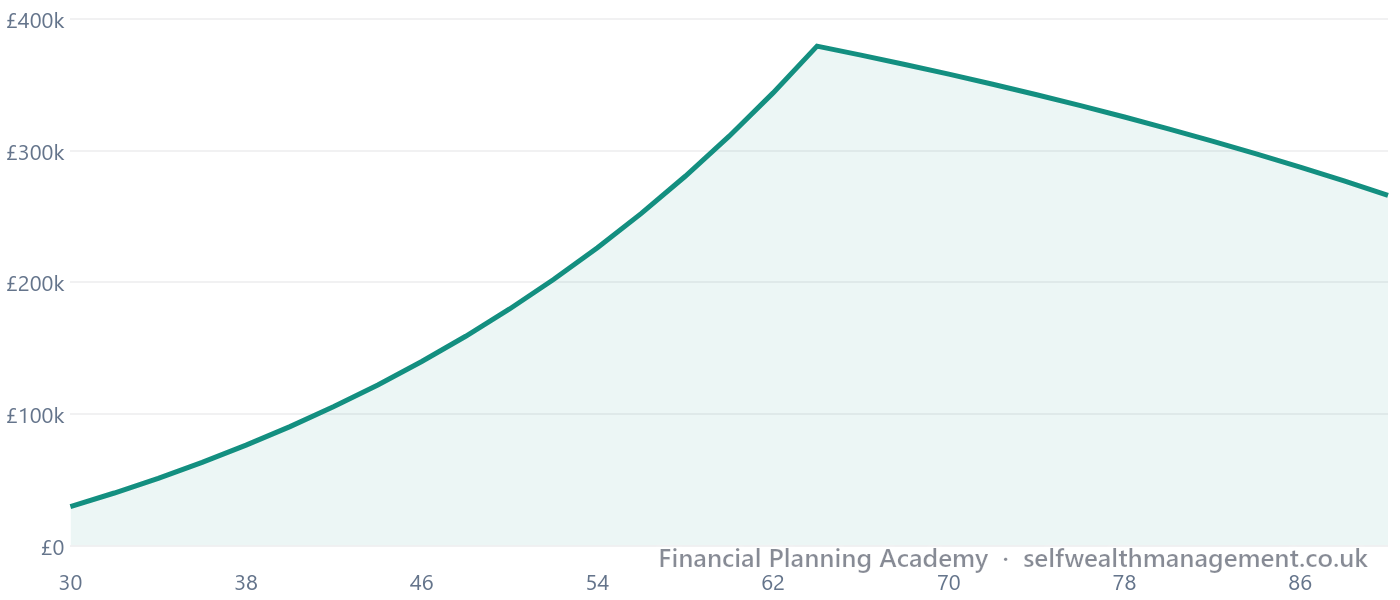
What it can help answer
- Can I afford to retire at 60?
- What happens to my finances if my partner dies or becomes seriously ill?
- How much can I give to my children without running out of money?
- What level of investment return do I need to meet my goals?
Why it tends to be reassuring, not alarming
Cashflow modelling turns abstract financial goals into concrete, visual projections, and is often one of the most reassuring things someone can see about their own finances. It replaces guesswork with informed decision-making — sometimes confirming a plan is already on track, and sometimes revealing there's more flexibility available than expected.
- Cashflow modelling projects finances forward, often to age 90 or beyond.
- It turns abstract goals into concrete, visual projections that are easier to plan around.
- It often reveals more flexibility in a plan than people assume, not less.
Educational disclaimer: This information is for educational purposes only and should not be considered financial advice or a recommendation. Investments can fall as well as rise in value, and you may get back less than you invest. Past performance is not a reliable indicator of future results.
Money and Wellbeing: The Hedonic Treadmill
Beyond a certain point, more money contributes less and less to day-to-day happiness — good planning is about identifying what genuinely matters, not just accumulating more.
In short: Beyond a certain income level, additional wealth contributes less and less to day-to-day wellbeing, while financial security, time and purpose tend to matter more. Good planning can be about giving confidence to spend and slow down, not only about building more.
The hedonic treadmill is a well-documented psychological phenomenon: as income and wealth increase, expectations and desires tend to rise in step, meaning overall satisfaction returns to roughly the same baseline regardless of how much is earned or accumulated.
What this looks like in practice
- A pay rise that feels transformative quickly becomes the new normal
- Each new purchase provides a temporary boost, but the satisfaction fades
- People consistently overestimate how much happier more money will make them
What tends to matter more
Research consistently shows that beyond a certain income level, additional wealth contributes less and less to day-to-day wellbeing. What tends to matter more: financial security and freedom from financial worry, time and flexibility to choose how days are spent, meaningful relationships and experiences, and a sense of purpose and progress toward goals that matter.
Good financial planning isn't simply about accumulating as much as possible — it's about identifying what genuinely matters and building a plan that supports it. Sometimes the most valuable thing a financial plan can do is give someone the confidence to spend more, work less, or retire earlier than they thought possible, rather than always pushing to accumulate further.
- Satisfaction tends to return to a similar baseline regardless of income, once basic needs are met.
- Financial security, time, relationships and purpose tend to matter more to wellbeing than further accumulation.
- Good planning can be about giving confidence to spend and slow down, not only about building more.
Educational disclaimer: This information is for educational purposes only and should not be considered financial advice or a recommendation. Investments can fall as well as rise in value, and you may get back less than you invest. Past performance is not a reliable indicator of future results.
Spending It: The Case for Dying With Less
Maximising the eventual estate isn't automatically the goal — spending and gifting more during a lifetime can mean less inheritance tax, and more of it actually enjoyed.
In short: Deliberately spending and gifting more during retirement, rather than defaulting to preserving the largest possible estate, can mean paying less inheritance tax and seeing loved ones benefit while both parties are around to enjoy it. It's a genuine philosophy, not just a tax strategy — the two happen to point the same way.
The opening chapter of this Academy made the case for planning around goals, not the biggest possible number. This is that idea applied to the other end of a plan.
The default isn't neutral
Preserving capital feels like the safe, responsible choice, and often it is. But an estate that grows for decades and passes on only after death represents money that was never actually used for anything — not spent, not given, not enjoyed by anyone while they were around to see it.
Where this and inheritance tax planning overlap
Spending more, and gifting more within the exemptions covered in the earlier chapter on gifting rules, both shrink the eventual estate — which is also, incidentally, exactly what reduces an inheritance tax bill. The tax benefit isn't the reason to do it, but it's a genuine side effect worth knowing about.
Building the largest estate possible may not mean as much when up to 40% over your allowances goes to HMRC and you haven't been able to see anybody enjoy the money in your lifetime. Spending and gifting it throughout your lifetime, whilst not harming your future desired spending, can solve both issues. Cashflow modelling can help you find out how much you can spend/gift each year, without running out of money in later life. Your loved ones may not inherit as much when you die, but they will have inherited at the times they needed it most - and you'll have been around to see it!
Why timing matters more than people assume
A gift or a shared experience lands differently depending on when it arrives. Help with a house deposit in your thirties solves a different problem than the same money inherited in your fifties. Watching a grandchild's wedding or seeing a business get started isn't something an estate can do after death — the timing is often the actual point, not just the amount.
This general approach is sometimes referred to as "die with zero," after a popular framing of the idea — not a literal target of leaving nothing, but a deliberate shift away from maximising the estate as the automatic default.
This only works safely alongside the rest of this Academy, not instead of it — the emergency fund, sustainable withdrawal rates, and long-term care costs covered elsewhere all still apply. Spending deliberately is different from spending without a plan.
- Maximising the eventual estate is a default, not automatically the right goal — spending and gifting more during a lifetime is a genuine alternative, not a mistake.
- This overlaps naturally with inheritance tax planning, since a smaller eventual estate generally means a smaller bill.
- When a gift or experience arrives can matter as much as how much it's worth — money is often more useful earlier in someone's life than inherited later.
Educational disclaimer: This information is for educational purposes only and should not be considered financial advice or a recommendation. Investments can fall as well as rise in value, and you may get back less than you invest. Past performance is not a reliable indicator of future results.
When to Get Regulated Financial Advice
This whole Academy is a sat nav, not a driver — and a sat nav is honest about the roads it can't take you down.
In short: This Academy is education, not personal advice — certain decisions, like DB transfers or complex estates, genuinely benefit from a regulated adviser who can take responsibility for a specific recommendation tailored to one person's whole situation.
Everything in this Academy is education, not personal advice — explaining how things work, so decisions can be made with a clearer picture. Some decisions, though, genuinely benefit from a regulated adviser who can look at someone's whole situation and take responsibility for a specific recommendation. This chapter pulls together the moments, flagged throughout this Academy, where that line tends to sit.
Where this Academy has already flagged it
- Transferring a defined benefit pension — giving up guaranteed income is a significant, largely irreversible decision.
- Transferring safeguarded benefits worth more than £30,000 — a legal requirement, not just a suggestion, as covered in the pension consolidation chapter.
- Pension recycling questions — where there's genuine doubt whether a specific contribution pattern might be caught by the anti-avoidance rules.
- Complex or large estates — particularly where multiple strategies interact, or where the 2027 pension changes might significantly affect an existing plan.
- Assigning bonds or gifting significant assets — where the inheritance tax and income tax consequences both need to be got right together.
What regulated advice actually adds
A regulated adviser can look at someone's entire situation — income, assets, family circumstances, other plans already in motion — and take personal responsibility for a specific recommendation tailored to them. That's a genuinely different thing from education. This Academy can explain that a pension transfer involves giving up valuable guarantees; it can't tell any individual reader whether transferring theirs is the right decision, because that depends on details this Academy has no way of knowing.
Why this isn't a failure of the Academy
Being clear about this is the whole point of a sat nav rather than a driver. A sat nav that pretended it could drive through terrain it genuinely can't navigate would be worse than one that says plainly: this is where you need something else. Understanding the mechanics covered in this Academy makes that conversation with an adviser considerably more productive when it happens — arriving with the right questions, rather than needing the basics explained from scratch.
- Regulated financial advice adds something education can't — a specific recommendation, tailored to one person's whole situation, that an adviser takes responsibility for.
- Certain decisions — DB transfers, large safeguarded benefits, complex estates — are flagged throughout this Academy as ones where that matters most.
- Understanding how something works, as covered throughout this Academy, tends to make any later conversation with an adviser considerably more productive.
Educational disclaimer: This information is for educational purposes only and should not be considered financial advice or a recommendation. Investments can fall as well as rise in value, and you may get back less than you invest. Past performance is not a reliable indicator of future results.